These are some of the title pages from the John Ford / Harry Carey Universal titles as adapted for the Boys’ Cinemacomics, published between 1919 and 1921. All of the films below are presumed lost, apart from The Judgement of the Desert, an alternative title for Hell Bent (1918).
These two images are from Harry Carey Junior’s private archive collection. The first still is from A Gun Fightin’ Gentleman (1919). The second shows Harry Carey on a promotional tour for Roped (1919).
Promotional materials from the Ford Universal titles.
Desperate Trails (1921)
The following are assorted images from some of the lost titles and extant but incomplete films that Ford directed for the Fox Corporation in the early to mid-1920s.
ThankYou (1925)The Fighting Heart (1925)
Sample of the newsletter published during production of The Iron Horse (1924).
This is a transcript of an interview conducted with Harry Carey Jr., at his home in Santa Barbara in October of 2007. The transcript has been edited to include only those comments relating to his father’s partnership with John Ford.
SM: How many films did Harry Carey Senior make with Ford?
HC: They made 26 films together. My mother always said Joseph Harris – he was a character actor, and played the heavy in a lot of my dad’s films – and Joe was a very physical guy, he was in great shape. Anyway, he came up to the ranch (Carey Senior’s home in Newhall) and he stayed for 35 years. He gave up acting and became foreman of the ranch – he loved it up there and actually we couldn’t have run the place without him – but he was also my dad’s closest friend, but my mum always resented him because she said that he broke up Jack [Ford] and Harry. [He] got Ford and my dad kind of mad at one another – it was time for them to split up anyway because they just couldn’t go on making films.
SM: I understand one of the other issues was that your dad was earning a lot more than Ford at the time.
HC: Well, he did at the beginning, he was earning a lot more, but Ford said, ‘Harry Carey guided me along at the beginning’.
SM: What was the situation with your dad at Universal before Ford came along? Was he making films for the studio already?
HC: Yeah, he was making films at Universal, but he wasn’t the big-time [star] at the studio. His pictures always made money, but they were always in a certain budget. Old man [Carl] Laemmle was very clever that way, and my father was very fond of him – he said he was a very fair man. Ford came along – my mother [Olive Golden] was a young actress [at the studio] and she was there with Victoria Ford, who later married Tom Mix, and Dorothy Gish – they were kind of a clique – the girls kind of all ran around together – and one of the rumours was that you didn’t go anywhere near Harry Carey, Henry Walthall or Lionel Barrymore. They were terrible men and would lead you down the primrose path. My mum said that made my father more fascinating to her – he was 19 years older than she was. Actually, mum and Ford were very similar, very close, and they used to kind of hang out together before my dad started courting her. So she knew him much better before my father knew him.
SM: When Ford first came to Universal I understand he initially worked for his brother, Frank
HC: That’s right. He was an assistant for his brother – I have a still picture somewhere that tells the whole story – it shows Francis Ford and Grace Cunard, his leading lady, and Francis is talking to her, while Ford is right back off behind them, and Ford is about 19, 20 years old, and he’s looking like, ‘I’m going to be over there – that’s going to be my spot pretty soon’.
SM: Your wife tells me that you’re pulling together your own collection of memorabilia.
HC: That’s right.
SM: Do you have anything that is relevant to that particular era?
HC: Yes, we have over a hundred and some stills, and also a lot from the African picture, Trader Horn.
SM: I’m trying to get into the Universal archives, but it’s difficult – and there was a fire there recently…
HC: Excuse me for interrupting, but the twenty-six films of Ford and Carey were not that highly regarded, they were not prestige films, and they were filmed on that old nitrate film, and allowed to just sit there and disintegrate. The emulsion wore off, and they never got a good negative out of it and when they did find some in Czechoslovakia and Holland –
SM: A Gun Fightin’ Gentleman…
HC: That’s right.
SM: Do you have any copies of these films?
HC: We’ve got Straight Shooting, and A Gun Fightin’ Gentleman too.
SM: The Last Outlaw. Does that ring a bell with you?
HC: I think Ford was going to do that with Duke [John Wayne] at RKO.
SM: Let me check the Bogdanovich book… actually your father wasn’t in that one. It was Ed Jones. 1919.
HC: Ed Jones was a shooter, a trick-shot guy.
SM: I’ll try and send you over some of the films I’ve tracked down starring your father.
HC: Thank you.
SM: Hell Bent is available for viewing at the Museum of Modern Art in New York.
HC: Yes, I know about that one. I haven’t been back to New York in five years. My first job was at the World’s Fair, in 1939. I could ride a horse and my music coach – I was trying to be a singer – was going to conduct the orchestra out there and he said ‘they need horseback riders. Why don’t you go out there and see about it and I went there and the guy had me ride around and he said ‘fine, you’ve got the job’ and that’s how I first got started.
SM: Just going back to your dad, when Ford went off to Fox, did he continue playing Cheyenne Harry, and had he played Cheyenne Harry before Ford came along?
HC: No. Cheyenne Harry was all between Ford and him. They wrote these things together. They’d sit at the kitchen table, and work at night, then shoot it the next day. There was a guy called – I don’t remember his name…
SM: The writer?
HC: Yes.
SM: George Hively?
HC: No, Jack Hively. But they [Ford and Carey] would do what they wanted. And when they’d see each other off and on over the years they’d get into an argument, and by this time Ford had this aura and everybody was terrified of him, but not my pop, and he’d say ‘it was my story’ – but it was fun to listen to them.
SM: They say about 70 per cent of all silent films are missing, but there’s about 30 per cent of Ford’s silent films still available, in one form or the other.
HC: I watch those old films of Ford sometimes and see the same old tricks being used over and over again.
SM: And the same locations. I watched a couple of Francis Ford films and they featured the same stockade, and the same actors.
HC: [Henry] Hathaway had that same habit too. Ford had Monument Valley, and Hathaway had Lone Pine, California. Anyway, it was an interesting era. It ended when I was born in 1921, and that was when they [Carey and Ford] went their different ways. It was better for everybody concerned. Ford of course took off like wildfire. The Iron Horse was the big turning point.
SM: That’s the one Joseph McBride said made him famous.
HC: They [the studio] could trust him with money. But they [Carey and Ford] had gags they’d do if they ran out of dough. It was very simple then. It wasn’t like they – they didn’t have to go through all these channels and paperwork. They’d want to extend the picture but they didn’t want Laemmle to know they were doing it so they’d say that the film dropped in the water and they needed – they’d come out with these crazy ideas to get some more film. A couple of times Laemmle fired them because of that stuff, then he’d hire them back of course when he ran the film.
SM: Would you say your dad and Ford were trying something different in the way your dad portrayed his cowboy character, Cheyenne Harry?
HC: Exactly right. The two of them were very much alike in their creative styles [and] they loved the idea of the tramp cowboy, not the kind with the fancy clothes […]. [Cheyenne Harry] was the sort of adventurous guy who doesn’t know what’s coming up next and he sort of wanders around. That’s the kind of characters they liked, and basically that was the Cheyenne Harry character. They had a good time writing these scripts and plotting it all out. They lived in Newhall, California, in a little white house, and they’d sit in the kitchen and talk about the next day and then they’d go and shoot it, around Newhall and that area. It was all low budget and they couldn’t afford to go away to big fancy locations.
SM: So after Ford left Universal, your dad didn’t carry on making Cheyenne Harry films?
HC: No. That was the end of that. My dad – he had a career that went up and down. He was the only Western star that became a regular character actor that could do other roles. The other ones were more or less limited to those – like Mix and all of them, they were bigger names than pop was but of course he had a career, went on to Mr Smith Goes to Washington, all those other films, so he was a much better actor than most of them. And that’s what Gene Autry said one time when he was here. He said ‘The best actor of them all was Harry Carey’, and that’s true. He was.
Working within the framework of the Hollywood system, one can detect in Ford’s
(Fig. 5.12) (Fig. 5.13)
son by filming what was for him a rare close-up featuring the couple in question (Fig. 5.12).
Their devotion to each other is rendered comical at times, simply by the appearance of the mother dressed in over-sized bonnet and boots, and the manner in which she holds on to the back of her son‘s shirt as they walk down the aisle of the local church (Fig. 5.13).The theme of mother-love does not appear to be a constant in Ford’s Universal films. Evaluated in more detail in the following chapters, the motif of mother-love evolves into a key component of Ford’s late-1920s Fox work, although the theme eventually disappears from his sound films. The continued emphasis on the central role of the matriarch within the family suggests that this theme is not so much a result of studio convention, however, but more a reflection of the director’s relationship with his own mother.
This section details the sources for the twenty-three silent John Ford films that form the basis for the main text of the thesis. Those films for which there is no official outlet for release are labelled as being supplied by a Private Collector. The list also includes two early Francis Ford films at the beginning, and three sound films directed by John Ford at the end, that are also covered in detail in the thesis.
The Battle of Bull Run (Francis Ford, 1913) – Running time: 27 minutes (incomplete) –
This film supposedly includes a young John Ford as a background extra, and was discovered in the archives of the Moving Image Research Collections department at the University of South Carolina in 2010. A copy of the film was supplied by the University free of charge for research purposes. Email info@sc.edu for further information on availability of this film.
This film was initially available up until a few years ago on a bootleg VHS copy from Balzac Video, which appears to be no longer listed on the internet. The video also contained footage from three other silent films, starring and / or directed by Francis Ford: Under the Stars and Bars (Gaston Méliès, 1910), Blazing the Trail (Thomas Ince, 1912), and Unmasked(Francis Ford, 1913). The film is advertised for purchase from the www.lovingtheclassics internet DVD supplier site. It is not known if this release also includes the aforementioned Francis Ford films.
The Secret Man (John Ford, 1917) – Running time: 18 minutes (incomplete)– Private collector.
Bucking Broadway (John Ford, 1917) – Running time: 53 minutes (complete) – A copy of this film was given away as a free DVD with the 2004 issue of the French film magazine Cinéma 08, after a surviving print had been discovered in the Service des Archives du Film du Centre National de la Cinématographie [CNC] in 2000. The film is also available as a bonus disk included with the Criterion release of Stagecoach (John Ford, 1939), issued in America (region 1 only) in 2010. The Criterion release can be purchased from Amazon.
The Scarlet Drop (John Ford, 1918) – Running time: 32 minutes (incomplete)
– The film can be purchased from Getty Images. The company issues the footage with a copyright clock in the middle of the image. A copy of the film without the clock can be purchased, although at considerably more expense. Contact Getty Images via the film.sales@gettyimages.com email address for more details.
Hell Bent (John Ford, 1918) – Running time: 50 minutes (complete) – This film is available for purchase for research purposes only from the Czech Film Archive in Prague. Contact the archive via the nfa@nfa.cz email address for further details.
By Indian Post (John Ford, 1919) – Running time: 13 minutes (incomplete) – The remaining footage for this film can be found on a French DVD entitled Retour de Flamme (Vol 5): The Fabulous Days of the Early Cinema. The DVD can be purchased from Amazon, Play.Com and MovieMail.
The Last Outlaw (John Ford, 1919) – Running time: 10 minutes (incomplete) – Private collector.
Just Pals (John Ford, 1920) – Running time: 50 minutes (complete) – In 2007, 20th Century Fox released a box set of John Ford films (region 1 only), containing 25 full length feature films directed by Ford for the studio between the years 1920 to 1952. The set included 5 of his silent films, as well as a documentary on the director, and footage from his wartime documentaries. Just Pals is the earliest of the silent films included. The set can be purchased from Amazon and Ebay.
The Village Blacksmith (John Ford, 1922) – Running time: 11 minutes (incomplete) – Private collector
North of Hudson Bay (John Ford, 1923) – Running time: 40 minutes (incomplete) –
This film is available for purchase for research purposes only from the Czech Film Archive in Prague. Contact the archive via the nfa@nfa.cz email address for further details.
A copy of this film can be purchased through the DVD website www.lifeisamovie.com.
The Iron Horse (John Ford, 1924) – Running times: Various (see below) (complete) –
The Ford at Fox box set contains two versions of this film. The domestic U.S. version has a running time of 149 minutes, whilst the International version runs for 133 minutes.
Riley the Cop (John Ford, 1928) – Running time: 71 minutes (complete) – A copy of this film can be purchased through the DVD website www.lifeisamovie.com.
A copy of this film can be purchased through the DVD website www.lifeisamovie.com.
Strong Boy (John Ford, 1929) – Running time: 1 minute (trailer only) – Available on the DVD release Lost and Found: American Treasures from the New Zealand Film Archive, which can be purchased from Amazon.
Available on the DVD release Lost and Found: American Treasures from the New Zealand Film Archive, which can be purchased from Amazon
The Black Watch (John Ford, 1929) – Running time: 92 minutes (complete) –
The film is advertised for purchase from the www.lovingtheclassics internet DVD supplier site.
The film is advertised for purchase from the www.lovingtheclassics internet DVD supplier site.
Men Without Women (John Ford, 1930) – Running time: 77 minutes (complete) – The film is advertised for purchase from the www.lovingtheclassics internet DVD supplier site.
Benshoff, H.M. and Griffin, S. (2009) America on Film. 2nd Edition. London: Wiley-Blackwell.
Bogdanovich, P. (1978) John Ford. 2nd Edition. California: University of California Press.
Bogle, D. (2004) Toms, Coons, Mulattoes, Mammies & Bucks: An Interpretive History of Blacks in American Films. 4th Edition. New York: Continuum.
Bordwell, D., Staiger, J. and Thompson, K. (2002) The Classical Hollywood Cinema: Film Style & Mode of Production to 1960. 6th Edition. London: Routledge.
Bordwell, D. and Thompson, K. (2003) Film History: An Introduction. 2nd Edition. New York: McGraw Hill.
Boschi, A. and Manzoli, G. (2007), ‘Beyond the Author’ [Online]. Accessed: 18th March 2007 – No longer available
Brooker, W. (2012) Hunting the Dark Knight: Twenty-First Century Batman. London: I.B. Tauris.
Brownlow, K. (1979a) The War, The West, and the Wilderness. London: Secker & Warburg Ltd.
Brownlow, K. (1979b) Hollywood: The Pioneers. Cambridgeshire: Book Club Associates.
Brownlow, K. (1996) The Parade’s Gone By…. 2nd Edition. Los Angeles: University of California Press.
Buscombe, E. (ed.) (1991) The BFI Companion to the Western. 2nd Edition. London: Museum of the Moving Image.
Buscombe, E. (1993) ‘Ideas of Authorship’, in Caughie, J. (ed.) Theories of Authorship. 5th Edition. London: Routledge & Kegan Paul Ltd, pp.22-34.
Buscombe, E. (1998) ‘Inventing Monument Valley: Nineteenth Century Landscape Photography and the Western Film’, in Kitses, J and Rickman, G. (eds) The Western Reader. New York: Limelight Editions, pp.115-130.
Buscombe, E (2000) The Searchers, London: BFI.
Buscombe, E. (2001) ‘Painting the Legend: Frederic Remington and the Western’, in Studlar, G. and Bernstein, M. (eds) John Ford Made Westerns: Filming the Legend in the Sound Era. Bloomington: Indiana University Press, pp.154-168.
Buscombe, E. (2010) ‘Injuns!’ Native Americans in the Movies, 2nd Edition. London: Reaktion Books Ltd.
Carey Jr., H. (1994) Company of Heroes: My Life as an Actor in the John Ford Stock Company. London: The Scarecrow Press.
Caughie, J. (ed.) (1993) Theories of Authorship. 5th Edition. London: Routledge & Kegan Paul Ltd.
Coe, B. (1981) The History of Movie Photography. London: Ash & Grant.
Colonnese, T. G. (2004) ‘Native American Reactions to The Searchers’, in Eckstein, A. M. and Lehman, P. (eds) The Searchers: Essays and reflections on John Ford’s Classic Western. Detroit: Wayne State University Press, pp.335-342.
Cook, P. (ed.) (1985) The Cinema Book. London: BFI.
Cowie, P. (2004) John Ford and the American West. New York: Harry N. Abrams, Inc.
Cripps, T. (1993) Slow Fade to Black: The Negro in American Film 1900 – 1942. 2nd Edition. Oxford: Oxford University Press.
Crofts, S. (1998) ‘Authorship and Hollywood’, in Hill, J. and Gibson, P. (eds) The Oxford Guide to Film Studies. Oxford: Oxford University Press, pp.310-324.
D’Angela, T. (2010) ‘Interview with Tag Gallagher. L’autre, c’est moi.’ [Online]. Accessed: 31st October, 2010 – No longer available
Davis, R. L. (1995) John Ford: Hollywood’s Old Master. Oklahoma: University of Oklahoma Press.
Drehle, D. (2011) ‘The Civil War 1861-2011: The Way We Weren’t’, Time, 18/04/2011.
Drew, W. (1989) Speaking of Silents: First Ladies of the Screen. New York: Vestal Press.
Drinkwater, J. (1931) The Life and Adventures of Carl Laemmle. London: William Heinemann Ltd.
Eckstein, A. M. and Lehman, P. (eds) (2004) The Searchers: Essays and reflections on John Ford’s Classic Western. Detroit: Wayne State University Press.
Edmonds, I.G. (1977) Big U: Universal in the Silent Days. London: Thomas Yoseloff Ltd.
Everson, W.K. (1972) A Pictorial History of the Western Film. New Jersey: The Citadel Press.
Eyles, A. (1980) ‘Lonesome Trails’, The Movie, 19, p.363.
Eyman, S. (1999) Print the Legend: The Life and Times of John Ford. New York: Simon and Schuster.
Eyman, S. and Duncan, P. (eds) (2004) John Ford: The Complete Films. Koln: Taschen.
Fenin, G. N. and Everson, W. K. (1978) The Western: From Silents to the Seventies. 2nd Edition. Middlesex: Penguin Books Ltd.
Ford, F. (1934) Up and Down the Ladder (Unpublished), John Ford Collection, Lilly Library, Indiana University, Indiana.
Ford, D. (1998) Pappy: The Life of John Ford. 2nd Edition. New York: Da Capo Press.
Foucault, M. (1984) ‘What is an Author?’, in Rabinow, P. (ed.) The Foucault Reader. London: Penguin, pp.101-120.
Gallagher, T. (1988) John Ford: The Man and his Films. 2nd Edition, California: University of California Press.
Gerstner, D. and Staiger, J. (eds) (2003) Authorship and Film. London: Routledge.
Harrison, P.S. (ed.) (1925) Harrison’s Reports, New York, MOMA Collection.
Hasumi, S. (2005) ‘John Ford, or the Eloquence of Gesture’ [Online].Available at: http://www.rouge.com.au/7/ford.html(Accessed: 14th October, 2009)
Henderson, B. (1993) ‘Critique of Cinestructuralism Part 1’, in Caughie, J. (ed.) Theories of Authorship. 5th Edition. London: Routledge & Kegan Paul Ltd, pp.166-182.
Hicks, J. (ed.) (1980) The Old West: The End of the Myth. 2nd Edition. Illinois: Time-Life Books Inc.
Hicks, A. and Petrova, V. (2006) ‘Auteur Discourse and the Cultural Consecration of American Films’ [Online]. Available at: http://www.sociology.emory.edu/ahicks/HPPoetics.pdf (Accessed: 25th February 2007)
Hill, J. and Gibson, P. (ed.) (1998) The Oxford Guide to Film Studies. Oxford: Oxford.
Jewell, R. (1982) The RKO Story. London: Octopus Books.
Kael, P. (1985) ‘Circles and Squares’, in Mast, G. and Cohen, M. (eds) Film Theory and Criticism: Introductory Readings. 3rd Edition. Oxford: Oxford University Press, pp.541-552.
Kalinak, K. (2001) ‘The Sound of Many Voices: Music in John Ford’s Westerns’, in Studlar, G. and Bernstein, M. (eds) John Ford Made Westerns: Filming the Legend in the Sound Era. Bloomington: Indiana University Press, pp.169-192.
Kalinak, K. (2007) How the West Was Sung: Music in the Westerns of John Ford. Berkeley: University of California Press.
King, S. (2011) 11.22.63. London: Hodder & Soughton.
Kitses, J. (2004) Horizons West: Directing the Western from John Ford to Clint Eastwood. New Edition. London: BFI.
Kobel, P. (2007) Silent Movies: The Birth of Film and the Triumph of Movie Culture. New York: Little, Brown and Company.Koszarski, R. (1990) History of the American Cinema: An Evening’s Entertainment – The Age of the Silent Feature Picture 1915-1928. New York: Charles Scribner’s Sons.
Koszarski, R. (1990) History of the American Cinema: An Evening’s Entertainment – The Age of the Silent Feature Picture 1915-1928. New York: Charles Scribner’s Sons.
Leutrat, J. (1996) Sentieri Selvaggi Di John Ford. Genova: La Mani.
Levy, B. (1998) John Ford: A Bio-Bibliography. Westport: Greenwood Press.Lourdeaux, L. (1990) Irish and Italian Filmakers in America: Ford, Capra, Coppola and Scorsese. Philadelphia: Temple University Press.
Lourdeaux, L. (1990) Irish and Italian Filmakers in America: Ford, Capra, Coppola and Scorsese. Philadelphia: Temple University Press.
Maltby, R. (1997) Hollywood Cinema: An Introduction. 3rd Edition. Oxford: Blackwell Publishers.
Marchetti, G. (1993) Romance and the “Yellow Peril”: Race, Sex, and Discursive Strategies in Hollywood Fiction. Berkeley: University of California Press.
Mast, G. and Cohen, M. (ed.) (1985) Film Theory and Criticism: Introductory Readings. 3rd Edition. Oxford: Oxford University Press.
Matthews, P. (1999), ’The Innovators 1950-1960: Divining the Real’, Sight & Sound, Vol. 9, No.4: pp.24-26May, L. (2002) ‘The Big Tomorrow’, Movies and American Society. London: Blackwell Publishers.
May, L. (2002) ‘The Big Tomorrow’, Movies and American Society. London: Blackwell Publishers.
McBride, J. (2003) Searching for John Ford. London: Faber and Faber Limited.McBride, J. and Wilmington, P. (1975) John Ford. Massachusetts: De Capo Press.
McBride, J. and Wilmington, P. (1975) John Ford. Massachusetts: De Capo Press.
Oehling, R.A. (1973) ‘Germans in Hollywood Films: 1914 – 1939’, Film and History, 3:2, pp.1-10, 26.
Oehling, R.A. (1978) ‘Hollywood and the Image of the Oriental: 1910 – 1950 Part 1’, Film and History, 8:2, pp.33-41.
Paulus, T. (2007) ‘“If You Can Call It an Art…”: Pictorial Style in John Ford’s Universal Westerns (1917-1918)’ in Stoehr, K. and Connolly, M. (eds) (2007) John Ford in Focus. Jefferson: McFarland & Company, pp.131-141.
Pavia, W. (2010) ‘Slavery Back in the mix as southern discomfort grows over the Civil War’, The Times, 04/12/2010.
Peary, G. (ed.) and Lefcourt, J. (Assistant Editor) (2001) John Ford Interviews. Mississippi: University Press of Mississippi.Piette, A. and Cardullo, B. (eds) (1997) Bazin at Work: Major Essays & Reviews From the Forties and Fifties. New York: Routledge.
Piette, A. and Cardullo, B. (eds) (1997) Bazin at Work: Major Essays & Reviews From the Forties and Fifties. New York: Routledge.
Pirie, D. (ed.) (1981) Anatomy of the Movies. New York: Macmillan Publishing Co. Inc.
Place, J.A. (1973) The Western Films of John Ford. Secaucus: The Citadel Press.
Place, J.A. (1979) The Non-Western Films of John Ford. Secaucus: The Citadel Press.
Place, J.A. (1979) The Non-Western Films of John Ford. Secaucus: The Citadel Press.
Rabinow, P. (ed.) (1984) The Foucault Reader. London: Penguin. Richards, J. (1981) ‘The Silent Films of John Ford’, The Movie, 118, pp.2345-2347.
Richards, J. (1981) ‘The Silent Films of John Ford’, The Movie, 118, pp.2345-2347.
Rist, P. H. (1988) Visual Style in the Early Films of John Ford: From ‘Straight Shooting’ to the End of the Fox Contract (1934), University of Glasgow, Unpublished Ph.D Thesis.
Robinson, D. (1979) ‘All Talk, No Action’, The Movie, 2, p.22.
Robinson, D. (1980) ‘Movies and Morals’, The Movie, 8, pp.141-143.
Rotha, P. and Griffith, R. (1967) The Film Till Now: A Survey of World Cinema. 6th Edition. London: Spring.
Salt, B. (1983) Film Style and Technology: History and Analysis. London: Starword.
Sarris, A. (1975) The John Ford Movie Mystery. Indiana: Indiana University Press.
Sarris, A. (1985) ‘Notes on the Auteur Theory in 1962’, in Mast, G. and Cohen, M. (eds) Film Theory and Criticism: Introductory Readings. 3rd Edition. Oxford: Oxford University Press, pp.527-540.
Schatz, T. (1988) The Genius of the System: Hollywood Filmmaking in the Studio Era. New York: Metropolitan Books.
Schickel, R. (1996) D.W. Griffith: An American Life. New York: Proscenium Publishers.
Silver, C. (May 1976) ‘The Apprenticeship of John Ford’, Film Comment, Vol. X, No. 1, pp.62-67.
Slide, A. (1996) The Silent Feminists: America’s First Women Directors. Maryland: Scarecrow Press.
Smith, A.B. (2003) Shooting Cowboys and Indians. Boulder: University Press of Colorado.
Spittles, B. (2002) John Ford. Harlow: Pearson Education Ltd.
Staiger, J. (ed.) (1995) The Studio System. New Jersey: Rutgers University Press.
Stam, R. and Miller, T. (eds) (2000) Film and Theory: An Anthology. Massachusetts: Blackwell Publishers.
Stoehr, K. and Connolly, M. (eds) (2007) John Ford in Focus. Jefferson: McFarland & Company.
Street, J. (2012) Colour Films in Britain. London: Palgrave MacMillan.
Studlar, G. and Bernstein, M. (eds) (2001) John Ford Made Westerns: Filming the Legend in the Sound Era. Bloomington: Indiana University Press.
Thompson, K. (1998) ‘Cinematic Expressivity’, in Grieveson, L and Krämer, P. (eds) The Silent Cinema Reader. London: Routledge, pp.254-269.
Thomas, T. and Solomon, A. (1985) The Films of 20th Century Fox: A Pictorial History. Secaucus N.J: Citadel Press.
Thomson, D. (2002) The New Biographical Dictionary of Film. 3rd Edition. London: Little Brown.
Thomson, D. (2008a) Have You Seen…?: A Personal Introduction to 1000 Films. London: Allen Lane.
Welsh Joint Education Committee (1986) Film Studies A2 Exam Paper.
Whipple, T. (2012) ‘High Noon on Mars as Rover Heads for the Hills’, The Times, 20/08/2012.
Wollen, P. (1987) Signs and Meaning in the Cinema. 3rd Edition. London: Secker and Warburg.
Wood, R. (1993) ‘Shall We Gather at the River?: The Late Films of John Ford’, in Caughie, J. (ed.) Theories of Authorship. 5th Edition. London: Routledge & Kegan Paul Ltd, pp.83-101.
Wooton, P. W. (1948) ‘An Index to the Films of John Ford’, Sight and Sound, Index Series No. 13.
In gathering together the most comprehensive collection of John Ford’s extant silent films over a research period of more than six years, I have been able to examine the early development of the director’s style and aesthetic in a manner that had not been possible before. Previously, Ford scholars such as Joseph McBride, Tag Gallagher, Scott Eyman, Lindsay Anderson, Andrew Sarris and Peter Harry Rist had only a handful of surviving silent titles from which to make their observations regarding Ford’s silent directing career. For the first time, it is now feasible to demonstrate that the director’s silent titles contain a wealth of information regarding the development of those thematic and visual motifs that comprise the ‘Fordian sensibility’, and to illustrate quite clearly the genesis of Ford’s growth towards becoming an auteur.
It should be pointed out that the extensive research process that I undertook was not restricted purely to the collection of extant Ford silent films. I also visited as many archives and film research facilities as possible in order to collect promotional materials, articles, photographs and other related texts specific to the silent directing career of John Ford that might help shed light on the director’s evolutionary progress from a journeyman director to a filmmaker of considerable note.
One of the most interesting and exciting discoveries that has been brought to light as a result of my research is the fact that Ford’s evolution as a director and auteur can be charted through close analysis of the technological innovations of the time, an approach put forward as a tool to test the validity of the auteur theory by Edward Buscombe. Although Rist also examined the development of Ford’s visual style in the early films in his thesis, I have built on his findings by evaluating the effect that the introduction of new lighting techniques, camera mobility, lens technology, advanced set design, and of course the innovation of sound, had on Ford’s overall style.
In this concluding section, I will summarise the findings and observations made during the course of researching and writing this thesis by framing my comments within the context of the research questions posed at the beginning. I will then also make some general comments on the director’s early work that have emerged from a close reading of John Ford’s silent titles.
This work proposed the following research questions:
How and when did Jack Ford, the man and the director, become ‘John Ford’, the brand, and the label?
Using Ford as a case study, is it possible, through a close examination of his early silent work, to evaluate how the idea of ‘authorship’ is formed?
To what extent do Ford’s silent films demonstrate the evolution of a personal, individual style and aesthetic, and to what extent is this aesthetic shaped by external influences such as biographical background, changes in technology, studio and institutional conventions, and surrounding cultural discourses?
The conclusions I have reached on these questions inevitably overlap at certain points, particularly as regards the first two, so I will combine my observations and summary on the evolution of Ford as a brand and using the director as a case study of authorship, before addressing the final question in detail.
Conclusions
In his essay, ‘What Is an Author?’, Foucault examines ‘how the author became individualised in a culture like ours’ (Foucault, 1984, p.101), and proposes to ‘deal solely with the relationship between text and author […] in which the text points to this “figure”’ (Foucault, 1984, p.101). Ford’s evolution from a named individual to ‘this “figure”’, a brand labelled ‘John Ford’, can be pinpointed to the year 1924, and the release, and subsequent box-office success, of The Iron Horse (1924). The director had already undergone a number of transitions in terms of his name alone, starting out as John Martin Feeney, then ‘Bull’ Feeney during his football-playing college days, before moving to Hollywood and adopting the name Jack Ford, until in 1923 he directed his first film, Cameo Kirby (1923), under the name John Ford.
My research shows that the nature of the promotional materials dating from his working career at Universal indicates a conscious attempt on behalf of the studio to heighten Ford’s profile in line with that of Harry Carey, with his name growing in prominence on publicity posters and stills from 1917 through to 1921. As indicated, however, by 1921 he was still plain Jack Ford, and nowhere near the stature of an individualised ‘name’ director at that point in time.
His move to Fox was therefore astute as well as mercenary, as the director’s earnings increased by approximately $10,000 the year after he left Universal (McBride, 2003, p.130). Fox was a more eminent studio than Universal, and, as indicated in Chapter Six on the early Fox years, Ford’s work on prestige productions, such as The Village Blacksmith (1922) and Cameo Kirby (1923), provided a foundation upon which the director and the studio were able to slowly but surely strengthen his reputation both inside and outside of the industry. It is ironic that practically all of the films Ford made for Fox prior to The Iron Horse were not Westerns, apart from Three Jumps Ahead (1923) and North of Hudson Bay (1924), both with cowboy star Tom Mix, but seemingly inevitable that the catalyst for the director’s metamorphosis from man to brand should be a super-Western. As demonstrated via the inclusion of studio promotional materials from the 1920s, Ford eventually shared the heightened profiles of other name directors of the time such as Frank Borzage and Raoul Walsh. The beginning of his journey from an anonymous director for hire to that of a fully branded name, both in terms of Ford the man and Ford the label, can therefore be dated to the year 1924.
In examining the auteur theory through a case study of Ford’s early work, the conclusion is that the evolution of John Ford’s reputation from the ‘man’ to the ‘brand’ develops in parallel along with the advancement of his perceived status as an auteur. In accordance with certain aspects of Foucault’s theory on authorship, Ford is defined as a figure that is seen to guarantee a set of cultural values specific to the author in question. This work also demonstrates that authorship, in film at any rate, is a construction formed through a confluence of a number of factors: studio marketing, choice of genre, the external validation of a director’s work through non-studio texts, public appeal and box-office success, along with the consistent reference to themes and patterns in a filmmaker’s work that are of personal interest to the individual director.
The originality of the thesis lies primarily in its approach towards emphasising that the ‘Fordian sensibility’ is created through a combination of Ford as a label or brand, which in turn encompasses Ford’s distinctive approach to genre, and the evolution of a style that is recognisable to the spectator. The motifs most constantly associated with Ford in academic scholarship are the primary antimonies of East versus West, and civilisation versus wilderness, as defined by Peter Wollen; and Scott Eyman and Peter Duncan’s list of themes incorporating community, nostalgia for the South, disintegration of family and outsider as man of action. The thesis demonstrates that these motifs, along with the theme of class and certain visual motifs that I have identified in the earlier films, such as low-angle action shots and figures overwhelmed by landscape, are all present and identifiable right from the outset of Ford’s directing career. As we would expect, these motifs evolve, develop, and mature over time until they reach their most sophisticated form in the later sound films.
When examining the thematic motifs Ford interrogates in his early work, we must also consider to what extent Ford himself knowingly contributed towards the creation of his own ‘author-function’, or brand. This conclusion suggests that, in emphasising certain motifs that were personal to himself and his history, such as family, religion and ritual, the director consciously contributed towards the construction of his own authorial style in the early years, as much as he contributed towards the public perception of ’John Ford’ in his later years. For example, this work shows that the mother-love films in particular were a victim not only of audience apathy but also, in Ford’s case, the director’s somewhat ambivalent attitude towards the power of the matriarch in his own family. Other themes such as ethnicity and class slowly make their way towards the foreground of Ford’s work, along with the visual motifs of landscape and wilderness, all of which eventually claim permanent residence in his films.
This is of course by no means the end of the process that created ‘John Ford’. In his later years Ford perpetuated the myth that he was born in Ireland, consciously reinforcing the popular impression of himself as an immigrant, and projecting the persona of a bad-tempered, irascible director who gave short shrift to critics who attempted to impose their own reading or analysis upon his work. This in itself is evidence of a conscious awareness of how Ford himself wanted to be viewed by the general public. In reality, Ford had a sense of who he was, and how those who knew the real John Ford, as well as the brand ‘John Ford’, regarded him. As the actress Carroll Baker recounts, ‘I told Mr Ford I wanted to wear my hair down for Cheyenne Autumn (1964) […] like the women in Ingmar Bergman’s films. […] As I was leaving [Ford] said, “Oh, Ingmar Bergman – you mean the fella that called me the greatest director in the world?”’ (in Bogdanovich, 1978, p.18).
Despite Ford having made his last full-length feature film as far back as 1966, it is significant that his legacy continues to endure, and that the director’s work and recognisably ‘Fordian’ components of style are still referenced within contemporary culture. For example, the main character of the Stephen King novel, 11.22.63, published in 2011, adopts a disguise that brings to mind ‘an outlaw in a John Ford western’ (King, 2011, p.559). A NASA scientist remarked in an interview that pictures of the landscape of Mars beamed back to earth ‘reminded him of “something out of a John Ford movie”, referring to the director of such cowboy classis as Stagecoach’ (Whipple, 2012, p.14). Filmmakers such as Steven Spielberg, George Lucas, Martin Scorsese and John Milius, all quote or reference Ford in their own work. For example, as Arthur Eckstein points out, ‘In the original Star Wars (George Lucas, 1977), George Lucas has Luke Skywalker discover the destruction of his foster parents’ home in scenes that – shot-for-shot – pay homage to Martin Pauley’s horror at the destruction of his foster family in The Searchers (1956)’ (Eckstein and Lehman, 2004, p.45). My thesis contributes towards the understanding of the importance of Ford as a recognisable name and brand, and emphasises the popularity and relevance of a director who continues to be name-checked and referenced cinematically over the four decades since his death in 1973.
In reaching my conclusions on the last research question dealing with the external factors that shaped John Ford’s style and aesthetic, it is necessary to look at all of the influences covered in the main chapters of the thesis separately.
Other artists
Chapters Four, Five, and Seven demonstrate that there were four main individuals who influenced Ford’s work more than any other in the years 1917 to 1930, the result of which is palpably discernible in the films he produced throughout this period. The first of these was Ford’s older brother, Francis. The thesis reveals that reference to themes such as burial as ritual, and civilisation versus wilderness, can be linked in the work of John Ford back to the films of his older sibling. My research also indicates that Ford adopts other aspects of his brother’s aesthetic in his own work, including the visual motif of figures filmed against the horizon, and the constant reference to Abraham Lincoln which pervades his films.
As a number of Ford scholars have pointed out, D.W. Griffith became a defining influence on Ford and practically every other director who followed in his footsteps. However, the textual analysis of Ford’s extant silent titles reveals that the influence of Griffith on the young director’s visual style dissipates from about the mid-1920s onwards. It is suggested that Ford’s intuition in adopting aspects of the visual, rather than the thematic, components of Griffith’s style ensured that the young director maintained an individual approach to cinematic expression, gradually developing his own distinctive aesthetic and technique. A close look at Ford’s late 1920s Fox titles shows how Ford’s admiration for F.W. Murnau is reflected in the director’s adoption of a more mobile and fluid movement of the camera, as witnessed in Four Sons (1928) and Hangman’s House (1928). The use of visual examples in Chapter Seven discloses that Murnau’s expressionistic mise-en-scène is also apparent in these films. Although Ford’s penchant for long takes and the moving camera would soon disappear from his work, he would continue to occasionally utilise Murnau’s style of lighting and use of shadows in his later sound films.
My research clarifies, however, that Harry Carey was the single most important influence on Ford during the early years. The director’s close personal and professional association with Carey was instrumental in Ford working almost exclusively within the Western genre for the four years he was employed by Universal. The close textual analysis of the extant Ford / Carey Universal titles, as referenced in Chapter Five, shows a definite evolutionary shift in the persona of Cheyenne Harry from that of a ‘good bad man’ character as a seeker of domestication and a settled life, to a character that would eventually personify the Fordian protagonist as an outsider and a man of action, albeit one who still yearns for home. In doing so the thesis also reveals the direct link between Cheyenne Harry and later Fordian figures such as Tom Joad in The Grapes of Wrath (1940), Wyatt Earp in My Darling Clementine (1946), Ethan Edwards in The Searchers (1956) and Tom Doniphon in The Man Who Shot Liberty Valance(1962). Ford’s films with Carey indicate a move towards foregrounding the main character as more of an outsider than an established member of the community, at the same time marginalising the then generic romantic subplot. This shift in narrative focus becomes a mainstay of Ford’s later work, highlighting the director’s empathy for borderline characters on the fringes of society.
Biographical
As pointed out in the earlier chapters, Ford was incorporating aspects of the biographical into his work at a very early point in his career. Ford’s ethnicity and family background are a constant, and his Irishness and religious upbringing are repeatedly referenced in his work. The close analysis presented in Chapter Six and Chapter Seven of the 1920s titles that Ford directed at Fox, such as The Shamrock Handicap (1926), The Iron Horse (1924), 3 Bad Men (1926), Mother Machree (1928), Hangman’s House (1928), and Riley the Cop (1928), indicate Ford’s growing zeal for integrating Irish characters into all of the genres in which he was required to work. The director’s empathy for the immigrant experience of the Irish, informed by the experiences of his own parents, can be detected in The Shamrock Handicap (1926) and Mother Machree (1928) in particular, leading to the conclusion that Irishness inhabits the director’s work as a recurring ‘Fordian motif’ as much as family, community, and ritual. The early twentieth-century migrant experience is depicted in The Shamrock Handicap (1926) and Mother Machree (1928), and it is a subject also touched upon in The Iron Horse (1924).
The presence of these thematic motifs in Ford’s films is perhaps inevitable. However, although it is unsurprising that the director expressed aspects of his own life in his chosen medium, my research indicates that Ford referenced these personal motifs an inordinate number of times throughout his early work, more so than would be expected in such a young director at that point in his career. This work proposes that the constant presence of family and community in Ford’s silent films, depicted either literally, as in Straight Shooting (1927), or figuratively, as in Upstream (1927), is directly linked to Ford’s own personal background as the youngest surviving child of a large family.
The director’s screen families invariably revolve around a strong and caring matriarchal figure. The mothers in his films represent the emotional core of the family group, and they usually suffer accordingly, as depicted in Mother Machree (1928) and Four Sons (1928). Ford’s families disintegrate and fracture, usually through the pressure of outside factors such as war or conflict within the community, and are eventually reunited again, but rarely as a complete unit. It is also apparent that he favours the matriarch above all other members of the group. McBride points out that Ford’s ‘habit of sentimentalising mothers in his movies […] should be a tip-off that beneath that overabundance of feeling, some forbidden emotions may be lurking’ (McBride, 2003, p.45). This wariness towards his own mother, along with the forbidden emotions that McBride speaks of, may also go some way to explain why Ford abandoned the mother-love genre for a less emotionally complicated approach. His later work still featured the mother figure but the matriarchal protagonists in these films tend to offer unequivocal love with no strings attached. As my research indicates, the continued emphasis on the central role of the matriarch within the family would suggest that this motif is not so much a consequence of studio convention, but is more a corollary of the director’s relationship with his own mother.
The close reading of Ford’s early work, as afforded through the collection of his extant silent films gathered together for this thesis, indicates that other sub-themes grouped under the motif of family, notably the destruction of the family group, can be detected in the director’s work practically from the beginning of his filmmaking career. I suggest in my research that Ford’s obsession with the workings of the family group can be traced to the complexity of his relationship with his siblings and parents, his mother in particular. He felt he was the ‘baby’ or the ‘cudjeen’ (McBride, 2003, p.38) of the family, a position in the communal group that traditionally invites more love and attention than other members of the family. The underlying theme of family that Ford therefore actually promotes in his films is the transient nature of the social group, one in which members leave and join at a moment’s notice. In the films of John Ford, a family is never always totally complete. It is just a shelter in which those protagonists who live on the fringes of society occasionally take refuge, whether it is Cheyenne Harry in Straight Shooting (1917), Tom Joad in The Grapes of Wrath (1940) or Ethan Edwards in The Searchers (1956).
As for religion, it has been demonstrated that the director’s representation of this theme in his early films evolves in a manner dependent upon the genre in which it is referenced. For example, Ford’s Westerns, such as The Scarlet Drop(1918) and 3 Bad Men (1926), tend to emphasise a more old-fashioned depiction of piety within the community. On the other hand, the Irish films, such as The Shamrock Handicap (1926), and Mother Machree (1928), stress the observance of ritual and the subservience of his protagonists towards the Catholic Church. My close textual analysis of the more contemporary-themed films, such as The Blue Eagle (1926) and Hangman’s House (1928), reveals Ford’s tendency to elaborate on the status of the holy man as a beacon of morality within the social group. The research carried out on the subject of religion, and particularly Catholicism, in Ford’s work, shows that it is integral to understanding the nature of Ford as a director, as well as defining the relationship in his work between his own personal interests and the objective concerns of genre.
The thesis establishes that the major Fordian theme of ritual, and the associated sub-themes of communal eating, funerals, and music, are all present in Ford’s silent work. They may not be fully evolved from the outset but the fact of their presence at such an early stage in the director’s work shows that Ford was already exploring patterns and motifs that would serve to underpin his directorial style. Even when working in a silent medium, Ford demonstrates his ability to define character through music, invoking camaraderie and the common purpose of community.
On the subject of class, Ford attempted through interviews to establish his credentials as one of the proletariat. Numerous biographers such as Joseph McBride, Scott Eyman and Andrew Davis record that Ford appeared to have enjoyed a fairly well-nourished upbringing, but that does not necessarily preclude membership of the working class. My research suggests that Ford’s interest in the plight of the disenfranchised is not so much a matter of personal biographical experience, but more a reflection of the director’s individual politics.
Peter Bogdanovich suggests that ‘it would be instructive (in fact schools might do well making it a regular course) to run Ford’s films about the United States in historical chronology – because he has told the American saga in human terms and made it come alive’ (Bogdanovich, 1978, p.22). John Ford’s predilection for American history and the settling of the West grows from a mere hint of interest in Universal films such as The Scarlet Drop (1918), to a full-blown celebration of frontier life in The Iron Horse(1924) and 3 Bad Men (1926). Along the way, as shown, his early films reference the American Civil War, the building of the railroads and the inevitable displacement of the Native American. My research also shows that Ford acknowledges the Irish Republican struggle in Hangman’s House (1928), albeit superficially, and the First World War in both The Blue Eagle (1926) and Four Sons (1928).
Ford’s regard for the military obviously has its beginnings in his silent work, but a close look at the extant silent titles shows that this is not really apparent in the director’s films until the mid-1920s. After The Blue Eagle (1926), Ford’s admiration for the army and the navy becomes more overt, with the following films Four Sons (1928), Salute (1929) and Men Without Women (1930) setting the foundation for later military titles such as The Lost Patrol (1934), Wee Willie Winkie (1937), and of course the notable cavalry trilogy of Fort Apache (1948), She Wore a Yellow Ribbon (1949), and Rio Grande (1950). All of the early pre-1930 films mentioned touch in one way or another upon the rituals associated with military life, such as marching, traditional music and patriotism. The caveat to this is of course the prejudice Ford displays towards the actions of the Union army during the American Civil War, and the thesis describes examples of the director’s overt preference for the Confederate military and their ‘civilised’ conduct in matters of warfare. As Cowie notes, ‘Ford was intrigued less by the war as such than by its aftermath – the convulsive effect on survivors of both North and South [and] the nostalgia for some elusive graciousness of life in the antebellum South’ (Cowie, 2004, p.17).
Institutional
It would be almost impossible for Ford’s style not to have been forged and influenced in some way by working within the institutional factors that prevailed inside the Hollywood studio system. Out of all of the influences inherent within an industrialised approach to filmmaking, the thesis highlights two factors in particular that continued to help shape Ford’s work throughout his career. The first is genre, in which Ford indulged his passion for the Western in his early apprenticeship at Universal. It is an interest that was fortuitously in tune with the demands of both the studio and the public. Conversely, as pointed out, during his early career at Fox, over half of the films Ford made between 1920 and 1930 dealt with more contemporary themes in terms of narrative content. This suggests a specific policy by the Fox Corporation to concentrate on material felt to be more relevant to the audiences of the time. When Ford and the studio turned their attention to the past, the films tended to possess a more epic quality than the modern-day titles. Indeed, the super-Western The Iron Horse (1924), 3 Bad Men (1926), and Ford’s World War I film, Four Sons (1928), were more like road show event features than the standard fare usually on offer to the public during the 1920s. The the thesis concludes that Ford’s focus on contemporary subject matter while based at Fox was therefore shaped more by the studio than by the director’s own personal interests and taste.
The second major Hollywood studio influence on Ford’s work emerges from the policy of hiring a stock company. It has been demonstrated quite clearly that the director’s employment of trusted actors gave Ford the opportunity to practise a type of cinematic shorthand in which certain characters are instantly recognisable and familiar to the spectator almost from the start of the narrative. The screen personas of actors such as Harry Carey, J. Farrell McDonald and George O’Brien are as familiar in the early films as John Wayne, Henry Fonda, and Victor McLaglen are in the later years.
Cultural
Regarding Ford’s attitude towards the depiction of ethnic minorities in his early films, my research suggests that the director was prepared to play to a contemporary audience who were content with dominant stereotypes of the time. The standard portrayal of African American characters in the 1920s veered towards the lower end of the social scale, and most black actors were confined to playing menial lackeys or low paid helpers. It is also evident, however, that on occasion Ford rises above the simplistic stereotypical depiction of minority groups as portrayed in his very early Universal films, and progresses towards a more enlightened representation of both Native and black Americans in particular. Although Ford’s depiction of African Americans is still considered questionable to this day, the research suggests that the director at least attempted in early films, such as The Shamrock Handicap (1926), to invest his black figures with an element of character and personality that was lacking previously both in his own work and in the standard studio fare of the time. It has been proven that, on occasion, Ford did push at the boundaries and restrictions of a studio system that repressed a more enlightened representation of African Americans.
Closely aligned to the portrayal of black Americans in Ford’s films is the director’s enthusiasm, as highlighted in the previous chapters, to depict and explore the Civil War in his early films, along with his obvious admiration for the South. There is an obvious contradiction at work here. Ford himself does not seem to debate or question the values of a community founded on the principle of slavery – despite the fact that he is clearly aware of slavery, as demonstrated in a number of his later sound films, such as Steamboat Round the Bend (1935) and The Sun Shines Bright (1953). How is it that the director can admire the cultured aspects of Southern society, yet ignore the treatment of black Americans by the very society that he admires?
One conclusion to consider is that Ford’s apparent refusal to blame the South for slavery is indicative of a society reluctant to own up to the failings of its own past, and Ford’s place within that system. There is now a suggestion that the pressure to repress the history of slavery was the result of a broader collective social amnesia, rather than a trend specific to Hollywood and the entertainment industry alone. The disinclination for white American society to face up to its own past is highlighted by David Von Drehle who, writing on the 150th anniversary of the beginning of the Civil War, states that, in the immediate aftermath of the conflict, ‘people were eager to forget [that] Americans both Southern and Northern flocked to minstrel shows and snapped up happy slave stories. Whites were not ready to deal with the humanity and needs of freed slaves, and these entertainments assured them there was no need to’ (Drehle, 2011, p.35). Drehle maintains that ‘by the 50th anniversary of Gettysburg [1913] it was nearly impossible to know from the commemoration why the war had happened and who had won. […] Historians [only] began to break the grip of forgetfulness after World War II, as the civil rights movement restarted the march towards equality’ (Drehle, 2011, p.36). Ford’s reticence to fully engage with the questionable past of America may therefore be more to do with the prevailing attitude of a white society not yet prepared to face the consequences of the past, rather than a personal choice by the director to avoid the subject of slavery altogether in his work.
It should be pointed out that there is no evidence from any of Ford’s biographers to suggest that he was himself racist, rather than simply shaped by the dominant social values of the time. In a recent interview Tag Gallagher comes to the director’s defence by stating that ‘Ford is virtually the only filmmaker in Hollywood between the wars who exposes and denounces racism’ (D’Angela, 2010, p.1).
With reference to the depiction of Native Americans in Ford’s early films, the thesis suggests that 3 Bad Men (1926) contains the beginnings of what would eventually become a more informative and sensitive portrayal of this ethnic group in Ford’s later work. The Universal films are more stereotypical in their approach to Native Americans onscreen, and right up until the Fox titles, North of Hudson Bay (1923) and The Iron Horse (1924), the research reveals that Ford is still rendering these characters as ciphers and figures of fun. A couple of years later, with 3 Bad Men (1926), there is a clear evolution in the way that the Native American is now cast as the silent victim of progression, foreshadowing a change in the way Ford portrayed America’s indigenous inhabitants in later films such as She Wore a Yellow Ribbon (1949), The Searchers (1956), and, of course, Cheyenne Autumn (1964).
As pointed out in Chapter Six and Chapter Seven, the appearance of other ethnicities such as Italians and Germans in the mid to late-1920s films at Fox indicates Ford’s interest in the multi-cultural aspect of American society. Nearly all of his later films feature a plethora of ethnic groups, irrespective of genre, with Swedish and Irish characters populating the Westerns for example, alongside the Native and black American figures. Ethnicity is a cornerstone of the ‘Fordian sensibility’, grounding Ford’s films in a historically realistic world where not all of the characters are white and Anglo-Saxon.
Although the cultural motif of civilisation versus wilderness is entrenched almost from the beginning in Ford’s work, it is implied that there remains a tangible element of scepticism in his cinematic representation of the East and modernity. This ambiguity in the director’s work is difficult to reconcile, unless his pronounced nostalgia for an earlier, less complicated time, is taken into account. Many of the director’s films inhabit the space between the post-civilisation of the West, and a pre-modern society before significant technological advancement. Films such as Just Pals (1920), Lightnin’ (1925) and The Shamrock Handicap (1926) reflect a simpler and more innocent time, in which civilisation reigns along with ritual and communal ceremony. Corruption and lawlessness are ever present of course, but the protagonists of these films are content to live a simple life, unencumbered by a need to totally embrace the fast moving industrialisation that threatens to eventually overwhelm their lives. For example, the move towards a more sympathetic attitude to Native Americans indicates that Ford questions the benefits of civilisation when it subsumes a way of life more in tune with the wilderness; in his later work he confronts the sense of what is lost through the imposition of a supposedly more-enlightened society. David Thomson makes a similar observation, suggesting that ‘history for Ford is the terrible obstacle of a man who refused to face modern times’ (Thomson, 2008a, p.520).
When considering the mise-en-scène of Ford’s early films, the influence of nineteenth-century artists and photographers on the director cannot be underestimated. Apart from the imagery reminiscent of Remington, Russell and Schreyvogel that permeates his early Westerns, Larry May suggests that ‘Ford […] transferred into movies some of the principles of modern art [as well], particularly multiple spaces and scenes photographed within a flat picture plane that suggested that the world was less a transparent set of truths than a work of art made by human effort’ (May, 2002, p.145). The numerous examples in Chapter Five and Chapter Six of how Ford’s early work mirrored the images of some of these key artists demonstrate quite clearly the impact of the imagery captured by these painters and photographers upon the mise-en-scèneof Ford’s films. This work shows that his passion for the artists of the old West also helped to shape the twin Fordian themes of landscape and wilderness, and his guiding notion of landscape as character. These motifs would continue to evolve throughout the director’s silent period, and successfully make the transition into his sound work.
Technological
Edward Buscombe contends that ‘the test of a theory is whether it produces new knowledge’ (Buscombe, 1993, p.32); this work has achieved that end by combining an auteurist study of Ford’s silent films with a consideration of the effect that social factors such as technological innovation had upon the director’s early body of work. When Ford began his film making career in 1917, the camera equipment on offer to the film industry was very basic in terms of design and functionality. By the end of the silent period, cameras had necessarily become more sophisticated in order to cater to the rigours of capturing both picture and sound simultaneously. In the interim, Ford took it upon himself to introduce more mobility to the mise-en-scène of his work, evolving from the crude attempts at capturing moving action in his early Universal Westerns through to the choreographed long takes of later silent films such as 3 Bad Men (1926) and Four Sons (1928). Although Ford eventually dropped the long take and overt mobility of the camera in his later work, there is still an evolution in the director’s style from 1917 to 1930 that cannot be dismissed purely in terms of the cinematic experimentation of a young filmmaker.
The research presented in Chapter Five indicates Ford’s ability at a very early point in his career to work within the constraints imposed by primitive filmmaking conditions. The early set design as seen in Straight Shooting (1917) suggests that one of the most enduring of Fordian motifs – figures framed in a doorway – may have resulted purely from a utilitarian requirement to place the actors in a more prominently lit area of the set due to lack of light. Using visual examples from Ford’s early Universal Westerns, the thesis also shows how the visual motif of figures silhouetted against the landscape evolves in conjunction with development in lens technology.
My research proposes that the occasional advances in film stock and tinting were not as influential as lighting and set design. More sophisticated lighting techniques brought clarity to Ford’s mise-en-scène that was previously absent. However, it was the coming of sound that had the most effect on the director’s sensibility. As detailed in Chapter Seven, the era of sound finally enabled Ford to expand the motif of music in his films from a silent image of someone singing, accompanied by a title card of music, to a more immediately powerful combination of the visual and the aural.
As also covered in detail in Chapter Seven, the introduction of sound enabled Ford to instil the mise-en-scène of military tradition and ritual, such as soldiers marching off to war or the pure celebration of martial music, with an aural motif that accentuates his admiration and patriotic pride for the armed forces. The introduction of sound effects allows the director to infuse his work with an element of reality that he had been unable to express in his earlier films. The tolling of a church bell, the murmuring of a crowd, and the laughter of children add a further element of verisimilitude for the spectator; a dimension that was only occasionally provided previously through the accompaniment of live music. Obviously this is not unique purely to the films directed by John Ford. What cannot be disputed, however, is that, when faced with the opportunity to introduce spoken dialogue in his work for the first time, it is notable that the words, uttered by a dying soldier in Four Sons, should be devoted to that most Fordian of characters, the mother figure. The innovation of sound underscores a sensibility that had already evolved, or would continue to evolve, in many of the director’s later films.
This approach to authorship, tracing back the motifs and themes from more familiar work to pre-sound titles, could readily be applied to the oeuvre of other key filmmakers who began their careers during the silent period, such as Alfred Hitchcock, Howard Hawks, Alan Dwan, Raoul Walsh, and Frank Borzage.
General Conclusions
A close reading of all of Ford’s extant films leaves the viewer with a sense that the director longs for a past that may never have actually existed, a past that he mourns for from the outset of his career. He signals this by depicting history as he would have wished it to be, with the lost cause of the South, for example, portrayed in a noble and perhaps naïve light, out of keeping with contemporary audience sensibilities. This does not mean that the films of John Ford should be consigned purely to the past both in terms of content and sentiment. On the contrary, a detailed analysis of Ford’s work indicates a vision of America’s past that questions the oppressive tenet of Manifest Destiny upon which the country was established. This may go some way to explaining why my own personal response to viewing Ford’s films, and I include both his silent and sound work in this observation, invokes a nostalgic yearning for a more simplified way of life, even if this vision of a simpler life is purely a cinematic construct that reflects the director’s own personal vision.
Though I have adopted a measured and objective academic approach to viewing and analysing John Ford’s films, it cannot be denied that, more often than not, the director’s preference for those themes grounded in his own life and personal experience initiate more sympathy and recognition in my reaction to his work than any other aspect of the ‘Fordian sensibility’. It is the personal characteristics of this auteur’s work – those which clearly express the visions, beliefs and memories of John Ford, the man beneath the brand – that continue to speak to me most powerfully
Afterword
Since I began this thesis back in 2006, materials relating to two of Ford’s silent films have been discovered; a complete copy of Upstream (1927) and the trailer for Strong Boy (1929), his last totally silent film. Other films associated with Ford such as The Battle of Bull Run (Francis Ford, 1913), and The Bandit’s Wager (Francis Ford, 1916), have also come to light over the last six years. The inaugural Irish Film and Television Academy (IFTA) symposium on John Ford was held in Dublin in June 2012, at which both The Iron Horse (1924) and Upstream (1927) were shown to the attendant audience. This event, coupled with the continuing possibility that more of Ford’s previously presumed to be lost silent films may still come to light, should ensure that interest in the director’s early work will continue to prevail in the near future. This means that my work will not be the final and definitive statement regarding John Ford’s transition from journeyman director to becoming ‘John Ford’. In fact, it may just be the beginning.
This chapter will consider the titles Ford directed for Fox between 1927 and 1930, a period that began with the totally silent Upstream (1927), followed by a combination of films with synchronised and full sound, through to the release of the late part-silent title Men Without Women (1930). The evolution and development of major Fordian themes such as family, ritual and ethnicity, with particular emphasis on the heightened attention to the theme of mother-love, will continue to be considered, along with how the innovation of sound underlines the importance that music plays in the films of John Ford. The key themes of civilisation versus wilderness, and landscape as character are not particularly prevalent in Ford’s work during this period, and are therefore not included in this chapter.
All of the other key themes will be interrogated, as with the previous chapters, in relation to questions of authorship, and in the context of Ford’s progression from individual journeyman to a brand, or author function. Taking into account Edward Buscombe’s assertion that ‘a film is not a living creature, but a product brought into existence by the operation of a complex of forces upon a body of matter’ (Buscombe, 1993, p.32), the chapter will also continue to investigate the relationship between technological innovation and the development of Ford’s distinctive style. This approach is extremely pertinent in the interval that covers the introduction of sound.
Ford’s profile continued to grow to the point where his peers elected him president of the ‘Motion Picture Directors Association in 1927’ (Levy, 1998, p.15). As will be discussed, those who wrote about the film industry also began to recognise him as a major directorial talent. Ford carried on working as an unaccredited assistant director during this period and, in the case of Borzage’s Seventh Heaven (1927), successfully interpolated a number of his own visual motifs into the film, indicating that he was continuing to evolve as an auteur whilst working within the constraints of the Hollywood studio system.
One of the major influences on the director’s work from this period is that of the German director F.W. Murnau. The effect that Murnau’s style had on Ford’s Four Sons (1928) is obvious, with Ford continuing to revisit a number of the German director’s visual motifs into the thirties and forties. Also, by now, the Ford stock company becomes a permanent fixture in terms of both cast and crew, with the director going on to employ this working methodology throughout the rest of his career.
Fox Corporation
The films John Ford directed in his late silent period for the Fox Corporation steadfastly excluded the Western, a genre that would remain in decline until the late 1930s.[1] Instead, he continued to work in forms still fairly unfamiliar to him, including the war film Four Sons (1928); and three Irish films: Mother Machree (1928), Hangman’s House (1928), and Riley the Cop (1928). There is a good chance that, if Ford had not been so closely associated with the Western form, he would be just as well known for the war films he made. Ford eventually directed ten full length features about modern warfare: two in the silent era, The Blue Eagle (1926) and Four Sons (1928); and eight titles after the coming of sound, as well as a further eight documentaries dealing with war. The opportunity for Ford to direct Four Sons (1928) at Fox should therefore not be taken lightly when considering the evolution of Ford’s style. Aspects of the genre, such as military ritual, loyalty, honour, and self-sacrifice, underpin the ‘Fordian sensibility’ as much as the primary motifs of family, civilisation versus wilderness, and religion that have come to be associated with his Westerns.
Ford’s reputation and standing, both inside and outside of the industry, developed further still. Tag Gallagher writes that, ‘Ford, with the success of such high-budgeted specials as Four Sons (1928) (possibly Fox’s top grosser), and Mother Machree (1928), found himself at the top of the heap of Fox directors, flanked, in company promotion, by the likes of Walsh, Hawks, Borzage, Murnau, and [John] Blystone’ (Gallagher, 1988, p.49). To prove the point, in 1927 the studio specified in a memo to exhibitors that publicity billing for Upstream must feature Ford’s name
Fig. 7.1
bigger than any other name apart from the film title itself (Fig. 7.1). Towards the end of the 1920s Ford’s stature was such that he was profiled in studio press releases relating to the production of Four Sons (1928), the caption under
Fig. 7.2
the photograph (Fig. 7.2)[2] at the beginning of the article proclaiming that ‘Jack Ford is a regular fellow’.[3] studio publicity shot from the same film suggests that Ford is regarded as one of the principal figures in the production of
Fig. 7.3
the film (Fig. 7.3).
A look at some of the other promotional materials from around this period also indicates Ford’s growing importance to the studio, furthering both his exposure to the public at large as a ‘name’ director, and contributing to the creation of the brand ‘John Ford’. The poster for The Blue Eagle (1926) features Ford’s name prominently at the bottom, with the director also credited as producer, although the name of the studio owner, William Fox, is equally as prominent
Fig. 7.4
(Fig. 7.4).
Two years later, not only is Ford’s name more eminent than his employer, but a poster for Mother Machree (1928) actually features a photograph of him as well. The size of the image highlights the importance of the director over
Fig. 7.5
the actors featured in the film, with Ford’s profile slightly larger than that of anyone else (Fig. 7.5). The director’s name would continue to appear in ever larger print as his career progressed, as a poster from his last totally silent
Fig. 7.6
film, Strong Boy (1929) (Fig. 7.6), shows.
External trade publications also helped to elevate his esteem. Levy states that, ‘The Moving Picture World in November 1927 [called] John Ford “one of the outstanding figures in the directional field”’ (Levy, 1998, p.15). Scott Eyman writes, ‘Ford was now a prestige director whose name was beginning to be known beyond the narrow circle of the film industry and hard-core fans’ (Eyman, 1999, p.112), citing a feature article in the New York Times in June 1928, which ‘appeared under [Ford’s] byline [but] was almost certainly ghosted by the studio publicity department’ (Eyman, 1999, p.112). By the end of the 1920s, the various discourses surrounding the director indicate that ‘John Ford’ was becoming an industry label, rather than merely an individual.
Employed as an assistant director, Ford was well placed to apply his thematic imprint onto the work of others. Apart from Nero (1922), Ford also made anonymous contributions to at least two other prestige Fox titles during the 1920s, What Price Glory? (Raoul Walsh, 1926),[4] and Seventh Heaven (1927). Lefty Hough recalls working on What Price Glory? (1926) ‘out among the pepper trees. Motorcycle sidecars and trucks going to the front. We went out there with Victor McLaglen’. On Ford’s contribution to Borzage’s Seventh Heaven (1927), Hough states that, ‘The Ford company was given the assignment to bring the taxi cabs into Paris’ (Transcript of interview with Dan Ford, John Ford collection at the Lilly Library, Indiana University, Bloomington).
The sequence that Hough refers to in Seventh Heaven (1927) contains a number of visual motifs that would not have looked out of place in one of Ford’s own films. There are numerous examples of crowds waving and cheering
Fig. 7.7
Fig. 7.8 / Fig. 7.9
as the military move off to war, this time in taxi-cabs as opposed to riding on horses (Fig. 7.7). A bugler summons the troops before the battle commences (Fig. 7.8), an image Ford also used in The Blue Eagle (1926) (Fig.7.9),
Fig. 7.10 / Fig. 7.11
whilst the charging soldiers on horseback (Fig. 7.10) are not dissimilar to comparative scenes in Ford’s Westerns, as featured in 3 Bad Men (1926) (Fig. 7.11). These images further indicate the emergence of a distinctively ‘Fordian’ style. The link to Ford’s own work is complete when he shoots on the same set that he would himself use for Four
Fig. 7.12
Sons (1928) (Fig. 7.12), which had been built previously for Murnau’s Sunrise (1927).
With regards to Ford’s stock company, Victor McLaglen vied with J. Farrell McDonald as the most prominent onscreen member of the director’s acting group during the years 1927 to 1930. McDonald ended up appearing in approximately 15 of the 37 titles Ford made during the 1920s, but it was McLaglen’s star that began to rise towards the end of the decade, as McDonald’s general role of the Irish everyman eventually fell upon his shoulders.
The previous chapter argues that Ford’s early Fox films do not significantly reflect the impact of a stock company, whereby the portrayal of a character by the same actor or actress provided continuity of character from title to title. The exception to this, however, is J. Farrell McDonald. In Kentucky Pride (1925), he plays Mike Donovan, who at
Fig. 7.13Fig. 7.14
various times throughout the film works as a horse trainer and a policeman (Figs. 7.13 & 7.14). A close look at both
Fig. 7.15Fig. 7.16
3 Bad Men (1926) (Fig. 7.15) and Riley the Cop (1928) (Fig. 7.16) shows that the characters are almost interchangeable; McDonald’s turn in Kentucky Pride (1925) literally a dress rehearsal for the later films. The players might change, but the character type embodied by actors such as McDonald and McLaglen remains constant.
In the absence of George O’Brien and the demotion of J. Farrell McDonald from leading man after Riley the Cop (1928), the role of the outsider as a man of action fell to McLaglen, with more emphasis on the solipsistic nature of the outsider. As with 3 Bad Men (1926), Ford also now appears to be moving even further away from the traditional prominence of the romantic leads, and manoeuvring the outsider to the forefront of the story. In Hangman’s House (1928), the young couple, Connaught and Dermott, are usurped within the narrative by Citizen Hogan, played by McLaglen, who takes centre stage. A clue to this evolutionary shift in the focus of the narrative may be found in a comment from the actress Madge Bellamy, who played the female love interest in The Iron Horse (1924). According to Bellamy, ‘If it was a simple love scene, he didn’t appear to be terribly interested. So he didn’t pay too much attention in what you were doing unless it was something dangerous and exciting’ (in Drew, 1989, pp.22-23).
It is difficult to conclude whether the move towards the male protagonist as outsider, free from any romantic entanglement, was attributable to Ford or the scenario writers with whom he worked at the time. What is irrefutable, however, is that the ‘good bad men’ protagonists of 3 Bad Men (1926) and Hangman’s House (1928) both represent a departure for Ford from the narratives that had gone before. Characters such as Citizen Hogan provide a direct link to later Fordian figures who are ostracised from the communal group. Moreover, the final act of Hangman’s House (1928) also points towards what would eventually become a major feature of Ford’s later work, the absence of a happy ending. Hogan is left without a home in his native land by the end of the film, and forced into exile abroad.
The presence of other directors at the same studio also had a noticeable effect on the director’s work. Having eschewed the practice up to the mid-1920s of using outside foreign directors – as opposed to other studios such as Warner Brothers with Michael Curtiz and MGM with Erich Von Stroheim – Fox lured the celebrated filmmaker F.W. Murnau from Germany in 1926 to make his first Hollywood film, Sunrise (1927). According to the silent film historian Richard Koszarski, the head of the studio, William Fox, ‘encouraged the studio’s other contract directors – solid American types like John Ford, Raoul Walsh and Frank Borzage – to study Murnau’s style and take from it what they could’ (Koszarski, 1990, p.86).
The influence of Murnau upon Ford’s visual style was practically immediate. The most obvious change in style is the experimentation in moving the camera, a rare event in a Ford film up until a year or so before he directed Four Sons (1928). Upstream (1927) features a number of tracking and dolly reverse shots, as well as a forty-five second long take, which will be discussed in more detail further on in this chapter. In Upstream (1927), however, these sequences do not possess the same assurance and fluidity of camera movement as displayed in the later film.
Fig. 7.17 / Fig. 7.18
The opening shot of Four Sons (1928) features a fifty second uninterrupted take, in which the village postman is first seen talking to a small girl (Fig. 7.17). The camera follows in his footsteps as he strolls through the village, ending up on another two-shot of the postman and an older girl (Fig. 7.18). Murnau also includes a long take at the beginning of Sunrise (1927), approximately the same length, following the short journey of a femme fatale as she makes her way through the village at night.
The mise-en-scène of Four Sons (1928) gives the impression that the film could have been directed by Murnau
Fig. 7.19 / Fig. 7.20
himself; the use of deep focus, and the contrast between shadow and light (Figs. 7.19 & 7.20), suggest an unusually close affinity with Murnau’s expressionistic style. Ford also appropriates Murnau’s predilection for shadows and
Fig. 7.21 / Fig. 7.22
light, with the silhouette of a figure on the wall heralding the arrival of unwanted news (Fig. 7.21), a shot comparable to a similar image from Murnau’s Nosferatu (1922) (Fig. 7.22).
In Four Sons (1928), the postman delivers a letter telling the mother she has lost yet another son in the carnage of war, whilst the shadow of the vampire in Nosferatu (1922) is a precursor to imminent death. Ford also evokes the atmospheric style of Murnau by filming his characters walking through a mist- covered landscape, similar once
Fig. 7.23 / Fig. 7.25
more to another sequence in Sunrise (1927) (Figs 7.23 & 7.24).
Gallagher suggests that Four Sons (1928)is ‘an almost self-effacing imitation of Murnau’s style’ (Gallagher, 1988, p.50). He goes on to suggest that up until this point Ford’s movies had been ‘relatively unstylized’ (Gallagher, 1988, p.50), but Murnau’s approach to mise-en-scène directly influenced Ford’s use of lighting ‘to create dramatic mood through emphatically contrasting blacks and whites, macabre shadows […] and other abstractions’ (Gallagher, 1988, p.50).[5] As Eyman and Duncan maintain, ‘Ford’s response [to Murnau] was to meld his own interests – family, community – with Murnau’s style – stylized studio art direction and flowing tracking shots [and subsequently] the student quickly became a master’ (Eyman and Duncan, 2004, p.67).
What Eyman and Duncan do not point out is that Murnau’s influence on Ford was not restricted to just the one film. For example, in his dying moments, ‘Hanging Judge’ James O’Brien in Hangman’s House (1928) is visited by the
Fig. 7.25 / Fig. 7.26
numerous ghosts of those he has wrongfully sent to the gallows (Fig. 7.25). Murnau employs a similar montage of images in Sunrise (1927) (Fig. 7.26), as the main character, a young farmer – played by George O’Brien – is tempted by the allure of the big city.
Ford would occasionally incorporate an element of expressionistic style in his later work, most notably in The Informer (1935), The Long Voyage Home (1940), and The Fugitive (1947), but in the main, Murnau’s aesthetic of mist, montage and shadows remains firmly rooted within Ford’s late silent period.
Autobiographical Influences
Although the theme of family is still present in the films Ford directed from 1927 to 1930, it is the sub-theme of mother-love that increases in intensity, specifically in Mother Machree (1928) and Four Sons (1928). The onscreen family, as depicted by Ford, still continues to disintegrate and fracture but, in this form, the mother remains the centre of the communal group. Also, it is through the continuing evolution of the themes of family, ritual, Irishness and religion that the director’s style starts to take more distinctive shape in the years 1927 to 1930, indicating an increased conscious effort to explore personal motifs and themes, irrespective of genre.
The Family Unit
During the last decade of the silent era, Ford was in the process of establishing a married life of his own. This perhaps explains the foregrounding of the family unit within the films he made during the 1920s. His later films emphasised the fracturing of the communal group even more prominently than before, which suggests Ford’s increasingly cynical attitude towards family life. As Lindsey Anderson proposes, ‘[his vision of family] is authentic, buried deep no doubt in the artist’s childhood, in some experience of community early on, lost and longed for, which he could never recreate in his own family life’ (Anderson, 1981, p.205).
Although Upstream (1927) does not specifically address the dynamics of the family unit, the group of actors and vaudeville acts thrown together in a boarding house mirror an extended family. In fact, this small community is the
Fig. 7.27Fig. 7.28
genesis for the creation of family, with two of the members eventually marrying (Fig. 7.27). In a scene that bears comparison with The Searchers (1956), the wedding ceremony is interrupted by the sudden arrival of an outsider (Fig. 7.28), an actor who has previously left the group behind to enjoy success on the London stage.
In Hangman’s House (1928), Citizen Hogan is instrumental in ensuring that the lovers Connaught and Dermott are finally free to marry and start a family, by ridding the community of the villain John Darcy. Just like 3 Bad Men (1926), the film suggests that figures like Hogan, on the fringes of society, are just as important to the creation of this close social group as those who seek to establish their own family unit.
The mother-love titles directed by Ford during the silent era all feature the matriarchs both as widows and as the driving force within the family unit. In the films that fall outside of that genre, yet still deal with the theme of family, the mother is still consistently portrayed as the centre of the group. The mother figure of Ford’s silent films, along with later incarnations such as Ma Joad in The Grapes of Wrath (1940), and Mrs Jorgensen in The Searchers (1956), are shown as forceful and determined, yet always deferential to the needs of the family. For example, Frau Bernle, the mother in Four Sons (1928), is portrayed as a subservient figure, although the mise-en-scène suggests
Fig. 7.29
the respect in which she is held, with a seat reserved for her at the head of the table in the place of an absent patriarch (Fig. 7.29).
A consistent pattern in all of Ford’s mother-love films is the total absence of a dominating father figure. This removes the potential for conflict between husband and wife, freeing the matriarch to undergo the associated sufferings of a single mother, and, in most cases, to bear that suffering with fortitude. Ellen McHugh in Mother Machree (1928) is the archetypal Fordian mother, both in terms of the emotional turmoil she must go through before she can be reunited with her lost family, and in her physical bearing as an older woman in her fifties.
When Ford does acknowledge the absence of the father figure, as in the passing of the husband at the beginning of Mother Machree (1928), it also signifies the death of the family unit, with Ellen McHugh forced to give up her son for adoption so he can live a better life. The lack of a father figure in Silver Wings (1922) also results in a mother losing her children. In both films the matriarch fails to hold the family together, and suffers accordingly, although the family is eventually reunited.
Mother Machree (1928) is one of the most overt examples of the mother-love films that Ford made for Fox. The fact that the story tells of an Irish mother, Ellen McHugh, who leaves Ireland for America, adds an autobiographical element to the film; McHugh’s humble beginnings in a small village arguably mirror the life of Ford’s own mother. The role of the matriarch within the family hierarchy, as depicted in Ford’s work, is therefore surely a reflection of the director’s own family. A photograph taken in 1929 of Ford with his mother, Abby, shows him kneeling deferentially
Fig. 7.30 / Fig. 7.31
as she straightens the Mother’s Day rose in his lapel (Fig. 7.30). The image could almost be mistaken for a still (Fig. 7.31) from one of the director’s films, such as Four Sons (1928). A comparison between the physical appearance of Ford’s mother and the cinematic matriarchs discussed so far offers an image of strong-willed individuals, rarely frail in demeanour or countenance, grey of hair, and always dressed demurely. The temperament of these mother-figures recalls Ford’s own mother, a woman described by Ford biographer Ronald Davis as occupying ‘the central role [in the family], always a devoted homemaker and a strict disciplinarian with her children […] [and] the dominant force in the Feeney household’ (Davis, 1995, p.21). The majority of Ford’s mother-figures also seem to be of a mature age, as was his own mother Abby, who was already in her early 60s by the time her son started directing in 1917.
The only time that Ford, whilst working in the mother-love genre, portrays a mother as a young woman (Fig. 7.32) is
Fig. 7.32 / Fig. 7.33
in Mother Machree (1928), though by the time the story has run its course, the image of the matriarch reverts to type (Fig. 7.33). The sequences featuring the older Ellen in Mother Machree (1928) are quite brightly lit, accentuating the angelic qualities of her persona. In contrast, Ford places the younger version of the mother within
Fig. 7.34 / Fig. 7.35
Fig. 7.36
a much darker and doom-laden mise-en-scène (Figs. 7.34 & 7.35). She is also favoured with a close-up shot – a rare occurrence in any Ford film – her grief pre-echoing the further suffering to come (Fig. 7.36). Although it cannot be claimed that the director’s portrayal of the mother-figure is free from the conventions of popular stereotype, certain aspects of his own personal relationship with Abby Feeney do seem to inform the character of the Fordian mother.
The fact that Ford is able to incorporate aspects of his own biographical background when depicting the mother figure may possibly explain his continued attraction to the genre. The mother-love genre was still popular with both studios and audiences alike when Mother Machree (1928) was followed by the release of Four Sons (1928) in the
same year. In this film, a mother (Fig. 7.37) loses three of her four sons in battle during World War I. Prior to the war, her other son leaves Germany to live in America and, after the conflict is over, the mother and her surviving son are finally reunited.
Fig. 7.37
The portrait of Frau Bernle has much in common with Mother Machree (1928), with the mother yet again depicted as a sainted matriarch, as well as a widow. There is a tangible undercurrent of sexuality that is missing from Ford’s other mother-love films prior to this, as if the grown children who surround her are surrogate husbands, suggesting a more knowing view towards the potentially incestuous nature of the relationship. This is implied in a shot in which
Fig. 7.38 / Fig. 7.39
the mother coyly indicates for one of her sons to move closer to her (Fig. 7.38). The mother looks straight into the camera, her expression obviously denoting tenderness and love towards her son, and the following shot (Fig. 7.39) shows the two of them standing very close together. This son is the one who will survive the war, fighting on the side of America against his siblings. The closeness between the two of them suggests that he is the favoured son, and their eventual reunion in America at the end of the film could almost be described as a celebration of long-lost
Fig. 7.40
lovers, meeting again after years apart (Fig. 7.40).
Along with the close-up, Ford also tends to eschew the use of special effects or trick photography throughout both his early silent and later sound work, preferring a naturalistic mise-en-scène rather than recourse to artifice. One notable exception to this is a sequence in Four Sons (1928), whereby the mother conjures up the spirits of her
Fig. 7.41
children (Fig. 7.41), as a fantasy re-enactment of the time when the family were whole. Yet, even in her imagination, it is noticeable that the patriarch is missing, almost as if the roles of both husband and wife have been taken on by the mother.
Although the mother figure continues as a recurring motif in Ford’s films, the theme of overt mother-love eventually disappears in his later work. In the early sound film, Pilgrimage (1933), Ford presents one of his strongest, and most complex, mother figures: a woman so determined to keep her son tied to the home and thus separated from the woman he loves, that she signs him up to the draft to fight in World War I. The son perishes, and the mother is left to
Fig. 7.42
grieve and eventually realise the consequences of her actions (Fig. 7.42). Ford takes his time before revealing the depth of her anguish, underlining his familiarity with mother figures that hide their emotion for fear of being seen as weak. McBride points out that, ‘in a striking coincidence, Ford’s mother died shortly after filming Pilgrimage’ (McBride, 2003, p.195). The death of Abby Feeney and the devastating portrayal of the repercussions of mother-love appear to signal a watershed in Ford’s depiction of the matriarch. From this point on these mother figures would always tend towards the compassionate, and in the process suppress their feelings rather than endanger the close ties of family.
Ford’s depiction of the mother figure stoical in the face of adversity reaches its apogee in The Grapes of Wrath (1940), with Ma Joad unable to intervene as the family fractures under the weight of events outside of her control. It
Fig. 7.43
is obvious from the mise-en-scène that she, and not the father, is the nucleus around which the family unit revolves (Fig. 7.43). Even when the mother is not central within the narrative, Ford still emphasises the imperturbable
Fig. 7.44
resignation of the matriarch. For example, the character of Mrs Jorgensen in The Searchers (1956) (Fig. 7.44) retains her dignity when faced with the loss of her son, accepting his death as the price to be paid in order to tame the wilderness.
These mother figures not only reign absolute, but they are also shown to be stronger and more resolute than the patriarch. This motif of the weak father-figure seems unique to Ford.
Ritual
Ritual as a major Fordian theme continues to embrace the communal sub-themes of drinking, dancing and music, this last motif accentuated in importance to Ford’s work through the introduction of sound. As mentioned previously, the practice of drinking becomes an acceptable component of the director’s style as long as it is combined with an element of humour, confirmed by both Upstream (1927) and Riley the Cop (1928). In the former
Fig. 7.45Fig. 7.46
title, the dancing act of Callahan and Callahan spike the punch at a wedding reception (Fig. 7.45) in a scene that foreshadows a similar sequence in the later Fort Apache (1948) (Fig. 7.46). In Riley the Cop (1928) (Fig. 7.47), the
Fig. 7.47Fig. 7.48
character of the title, temporarily freed from the chains of prohibition in America when abroad in Germany, indulges himself so much that he starts to see four of everything (Fig. 7.48).
Alcohol in a Ford film carries a number of different meanings. For example, it can indicate the inherent loneliness of
Fig. 7.49Fig. 7.50
a character, such as the alcoholic doctor in Stagecoach (1939) (Fig.7.49), and the cavalry sergeant in Cheyenne Autumn (1964) (Fig. 7.50). Drinking is also a signifier of masculinity, accentuating the bonding of Doc Holliday and
Fig. 7.51Fig. 7.52
Wyatt Earp in My Darling Clementine (1946) (Fig. 7.51), or, as in Drums Along the Mohawk (1939), underlining the masculine qualities of the frontier woman (Fig. 7.52).
Drinking as pure ritual can be found in many of the films Ford made on the subject of the military. The lower orders are just as much inclined to observe the ritualistic conventions of alcoholic consumption, such as the three sergeants in Fort Apache (1948), as well as the officers in Rio Grande (1950). However, Ford does not ignore the celebratory aspects of drinking. The sergeant in She Wore a Yellow Ribbon (1949) toasts his retirement from the military, before the natural consequences of over-indulgence result in a knock-down brawl with his drinking
Fig. 7.53
companions (Fig. 7.53).
In The Quiet Man (1952), characters drink and fight themselves to a standstill. A closer reading of the film reveals figures such as the matchmaker Michaeleen Og Flynn to be rather sad and pathetic individuals, constantly drunk
Fig. 7.54
and apparently all residing rent-free in the local hostelry (Fig. 7.54). As already discussed in Chapter Five, very rarely, if ever, does the director confront the negative aspect of drinking, preferring to embellish the ritual with associated practices such as friendship and communal singing, and ensuring that alcohol is represented positively as an aspect of social bonding.
The theme of ritualised eating is as much an instrument to bind community and family as ceremonial drinking. For example, in Upstream (1927), a disparate group of vaudeville players share the table in a boarding house and,
Fig. 7.55
momentarily, bury their differences through the act of dining together (Fig. 7.55). Another aspect to this ritual that is only vaguely hinted at in Straight Shooting (1917), but explored more comprehensively eleven years later in Four Sons (1928), is the empty place at the table to indicate the fractured family group. In Straight Shooting (1917), detailed in Chapter Five, the fracturing of the family caused through the murder of a young relative by land-grabbers is indicated specifically in this way. In Four Sons (1928), the ritual of communal eating also combines with the theme of the incomplete family to underline and heighten the disintegration of the social group. At the
Fig. 7.56Fig. 7.57
beginning of the film the mother, Frau Bernle, happily dines with her children (Fig. 7.56), performing the ritual of grace for a family unit which is, apart from the missing patriarch, complete and untroubled. Later on, after one son has left and gone to live in America, and two have died in the war, the mother’s prayers are now of grief and sorrow, as she prepares to dine with her remaining son (Fig. 7.57).
Many of Ford’s later films feature a sequence in which a family, or a clique united by a common purpose, sit down as
Fig. 7.58Fig. 7.59
a group to eat together. The military films, such as SubmarinePatrol (1938) (Fig. 7.58) and They Were Expendable (1945) (Fig. 7.59), feature this motif on a thematic level as well, the act of communal dining a required ritual that ensures co-operation and comradeship within the closed military circle.
Visually, the motif of eating reinforces the notion of matriarchy, with the family ‘together at the dinner table, often with the mother at the head of the table’ (Eyman and Duncan, 2004, p.16), but matriarchy is sometimes subverted during the act of eating by the patriarch or male authority figure. In How Green Was My Valley (1941), the father, seated at the dinner table, turns his sons out of the house when they join the labour union, the wife powerless to
Fig. 7.60
stop the disintegration of her family (Fig. 7.60).
Ethan Edwards in The Searchers (1956) reveals his own bigotry and hatred by referring to the ethnicity of his
Fig. 7.61
brother’s adopted son whilst they are eating together (Fig. 7.61), suggesting eating as ritual can also be an occasion for disruption as well. The hidden tensions in the group of travellers in Stagecoach (1939) is illustrated by the seating pattern of the characters as they prepare to eat, with the prostitute Dallas and the outlaw Ringo left to dine by themselves whilst those who feel themselves to be morally superior move away in judgement to the end of the
Fig. 7.62Fig. 7.63
table (Fig. 7.62). It can also signify reconciliation of family, as when Sean Thornton in TheQuiet Man(1952)drags his brother-in-law and former nemesis, Will Danaher, to the family table once a difference of opinion has been settled in a brutal fist-fight (Fig. 7.63).
Another major Fordian ritual that defines community – the celebration of music – appears more frequently in Ford’s films from the mid-20s onwards, almost as if he is preparing the groundwork for the introduction of sound. The figure of the actual musician also becomes more prevalent. To the director, music belongs to all members of the social group, and music and song play a part in all the genres in which Ford worked. Kalinak notes that ‘Ford employed many of the same strategies he had used in the silent era to control music in his first sound-on-film feature, Mother Machree (1928)’ (Kalinak, 2007, p.16). This observation is borne out by the way that Ford incorporates a reference to the representation of music with the performance itself. The musical sequence in the
Fig. 7.64
sound synchronised Mother Machree (1928) is prefaced by the lyrics to the title song (Fig. 7.64), similar to the manner in which the lyrics are displayed on title cards for songs performed in The Iron Horse (1924) and 3 Bad Men (1926).
Ford also continues to use music to define character. The melodies that accompany the appearance of the doomed husband, Michael, in Mother Machree (1928), emphasise his Irishness, and in turn pre-echo some of the musical themes of Ford’s later films. In fact, the opening minutes of the film could be described as a dry run for some of Ford’s more accomplished efforts in the Irish genre, particularly The Quiet Man (1952), which features the same traditional Irish tune, ‘The Rakes of Mallow’, as heard in Mother Machree (1928). The earlier film also includes a short sample of the traditional Irish drinking song, ‘Garry Owen’, a piece of music that Ford reprises in two of his cavalry films, Fort Apache(1948) and She Wore A Yellow Ribbon (1949). As Kathryn Kalinak points out, ‘The song has Ireland written all over it’ (Kalinak, 2007, p.134).
The song from which Mother Machree (1928) takes its name reinforces Ford’s constant love affair with Ireland through music. The lyrics concern the lament of a young man remembering his departed mother, someone who
“loves the dear silver that shines in your hair,
And the brow that’s all furrowed,
And wrinkled with care.
I kiss the dear fingers,
So toil-worn for me,
Oh, God bless you and keep you, Mother Machree”
(Lyric by Rida Johnson Young, Music by Chauncey Olcott and Ernest R. Ball, 1910).
The description of the matriarch in the lyrics could easily apply to Ford’s own mother, along with the sentiment of unequivocal love on behalf of the child for the parent. According to Tag Gallagher, to his mother, Ford ‘was her sweetheart. He looked like her and held her in awe, and in later years […] claimed a psychic bond’ (Gallagher, 1988, p.4).
The musicians and musical performances featured in Four Sons (1928) are integral to the fabric of community. A musician serenades a young woman during a hayride as a prelude to romance (Fig. 7.65), whilst the village band promotes harmony within the community at what appears to be a celebration of Frau Bernle’s birthday. The addition
Fig. 7.65Fig. 7.66
of the accordionist in the film (Fig. 7.66) calls to mind Ford’s practice of using Danny Borzage’s playing of the same instrument off-camera whilst on location; Borzage was a bit-player and musician ‘who provided music on Ford’s sets from The Iron Horse onwards’ (McBride, 2003, p.251).[6]
The totally silent Hangman’s House (1928) also features traditional Irish songs, one piece of music in particular displaying Ford’s Republican sympathies for the suffering of the Irish under British rule. The words to the song ‘The
Fig. 7.67
Shan Van Vocht’ appear early on in the film (Fig. 7.67) as Citizen Hogan traverses the countryside disguised as a monk. Shan Van Vocht translates to the Gaelic for ‘“poor old woman”, a title for the oppressed Irish people. Toward the end of the nineteenth century, a Belfast literary journal would arise with the title Shan Van Vocht, devoted to promoting an independent Irish culture’ (Anon, 2011). The song itself is a reference to an aborted attempt by the French in 1796 to free Ireland from the occupational forces of Great Britain. It is doubtful that a contemporary audience would have been aware of the political aspect of the song, but it is likely Ford would have known, suggesting that the director was fully aware, even at this early stage in his career, that music can comment powerfully on both narrative and characterisation.
Music also features quite liberally on both the diegetic and non-diegetic soundtrack of Riley the Cop (1928). As with Four Sons (1928), the film is mainly set in Germany, and to Ford, as well as to contemporary audiences, the inclusion of a band playing in a beer garden reinforces a stereotypical notion of the country. Somewhat less sombre than Four Sons (1928), Riley the Cop (1928) is a counterpoint to the earlier film; one is obviously a war film, whilst the other is a comedy. The musicians whom Riley encounters on his travels are presented as professional paid
Fig. 7.68 / Fig. 7.69
entertainers (Figs. 7.68 & 7.69), as opposed to the itinerant musicians depicted in Four Sons (1928).
Another major ritual associated with Ford, closely entwined with music, is dancing. The presence of this communal activity, as explored in Four Sons (1928), underscores the continued existence of society. In a period initially
Fig. 7.70
unencumbered by thoughts of war, the villagers gather to celebrate their idyllic community (Fig. 7.70). The occasion also involves courting for the younger generation, thus ensuring that the community endures.
The rituals of dancing, drinking and eating in Ford’s films also continue to evolve as his work makes the transition from silent to sound. Early sound titles such as Salute (1928) and Men Without Women (1930) both contain
Fig. 7.71 / Fig. 7.72
examples of the first of these two motifs (Figs. 7.71 & 7.72). Hangman’s House (1928) features an early illustration of what was to eventually become a key thematic ritual in Ford’s later military films, the ceremonial meal in which
Fig. 7.73Fig. 7.74
the rules of etiquette are strictly observed (Fig. 7.73). The opening sequences to both this film and the later sound title The Black Watch (1929) (Fig. 7.74) demonstrate the smooth progress that these typically Fordian motifs make from the silent to the sound era.
Irishness
Lourdeaux points out that ‘Ford’s 1920s films often presented Irish-American stereotypes: the boxer, the drinker, the jockey, the devoted son, and of course the policeman’ (Lourdeaux, 1990, p.95). Film scholars and writers are divided between those who suggest that this trait is ‘the source of what [is] arguably some of the most disparaging images of the Irish to have appeared in American cinema’ (Morgan, 1997, [n.p]), whilst others argue that ‘the same kind of humour is accepted in Shakespeare’s comic relief, so why not Ford’s?’ (Barra, 2001, [n.p]).
Opinions such as Morgan’s imply that Ford’s view of the Irish was constant, in that all of his Irish characters fit the stereotype. A close look at those examples of Ford’s work featuring the Irish or Ireland would seem to counter this suggestion. For instance, Ford does not shrink from showing the disdain of the Irish towards their fellow countrymen in later sound films such as The Informer (1935) and The Quiet Man (1952). Gypo Nolan, the informer of the title, is shown to be a drunkard prepared to betray one of his own for money. In The Quiet Man (1952), members of the community are portrayed as either backward in their attitude to women – Sean Thornton being encouraged by a female villager to beat his wife with a stick (Fig. 7.75) – or prepared to fight at the drop of a hat.
Fig. 7.75
Although Eyman and Duncan catalogue the Irish in Ford’s films as a visual motif, the director’s love for his own heritage is more of a thematic than a visual trait; it is ingrained within many of his films, to the point where it cannot be separated from the fabric of Ford’s oeuvre as a whole. The obvious Irish films in Ford’s later work include The Informer (1935), The Plough and the Stars (1936), The Quiet Man (1952), The Rising of the Moon (1957), and Young Cassidy (1965). This would ignore, however, the multitude of Irish characters that appear in numerous other Ford films. For example, the director reflects the multiculturalism of the early West by populating his cowboy films with Irish characters such as Michael O’Rourke, Sergeant Mulcahy, and Sergeant Quincannon in Fort Apache (1948); Quincannon also appears as a main character in She Wore A Yellow Ribbon (1949) and Rio Grande (1950).
The expression of Irishness in Ford’s film work intensified further in the late 1920s. This is demonstrated by the fact that the narratives of both Mother Machree (1928) and Hangman’s House (1928) take place partially, in the case of the former, and fully in the latter, in Ireland itself. Mother Machree (1928) covers some of the same ground as The Shamrock Handicap (1926), the story starting in Ireland before following the characters as they move to America.
Fig. 7.76
Again, the film (Fig. 7.76) also offers a somewhat sentimentalised view of Ireland withyoung children, shoeless but happy, reading a book in the middle of a picture-postcard village. At times, the mise-en-scène is almost mythical. Ford conjures images of a fantasy world, represented through the pages of a book of paintings; a land that does not actually exist.
As indicated in the previous chapter with The Shamrock Handicap (1926), there is also a hint of sourness around the notion of the American dream, underlined with a title card that states ‘America. Alas for the dreams they had dreamed.’ The point is further emphasised almost immediately by indicating the lack of work available to the
Fig. 7.77
mother (Fig. 7.77). Ford presents in Mother Machree (1928) the first in a long line of somewhat over-emphatic Irish characters that tended to feature in the vast majority of films he was subsequently to direct. These figures are more ‘Oirish’ than Irish, an adjective that perfectly describes the exaggerated, no-nonsense, all-knowing and somewhat devious Irish comic relief which crops up time and again in Hollywood films. To compound the stereotype, the director casts, for the first time as an Irishman, the ubiquitous stock player Victor McLaglen.[7]
McLaglen’s character in Mother Machree (1928), the Giant of Kilkenny, is a member of a carnival troupe that meets up with the chief protagonist of the story, Ellen McHugh, first in Ireland, then America. As played by McLaglen, the
Fig. 7.78 / Fig. 7.79
Giant is a walking compendium of Fordian gestures (Figs. 7.78 & 7.79), forever punctuating a lie by coughing behind his hand.[8] In the case of Ford’s Irish characters, there is also a tendency to indicate that a man is in deep thought by scratching the back of his head and lowering his hat over one eye, as demonstrated by Corporal Casey
Fig. 7.80
in The Iron Horse (1924) (Fig. 7.80). The physical tics that these figures display are possibly due to the fact that both director and cast are working in a silent medium, and a specific posture or motion is an obvious indicator of character as well as mood, although it is also a device that Ford encourages his actors to adopt in the later sound films as well.
Despite embracing the culture of the New World, the Irish in Ford’s films retain their own identity through costume and ritual. The Giant insists on wearing a jaunty bowler and mismatched trousers and jacket, indicating his desire to
Fig. 7.81
maintain his independence in a new environment (Fig. 7.81). The irony is that this costume is not necessarily what he would have worn back in Ireland, suggesting that Ford’s native Irish figures, along with Ford himself, exaggerate their own tradition and historical roots in order that their individuality as a race apart is not overwhelmed in their newly adopted land.
Although it is established at the beginning of 3 Bad Men (1926) that Dan O’Malley is of Irish descent, his ethnicity does not feature as a thematic motif throughout the rest of the film. Notwithstanding the brief tenure in Ireland of Ellen McHugh in Mother Machree (1928), Hangman’s House (1928) is therefore the first of Ford’s films to feature a native Irish person, in his homeland, as the main protagonist of the narrative. As played by Victor McLaglen, the exiled Irish patriot Citizen Hogan is portrayed as a martyr, a man who can redeem himself only by accomplishing his mission to maintain the honour of his dead sister, even though this eventually requires that he leave Ireland for good. The bars of the window through which Hogan peers pre-echo his eventual incarceration, the subtext
Fig. 7.82
indicating that he will never find peace or safety in his own land (Fig. 7.82).
Once John Darcy, the villain of the piece, eventually meets his end – not at the hands of Hogan, but by an accidental fire set in motion as Darcy tries to shoot him in the back – Hogan suffers the fate that befalls other Ford figures such as Ethan Edwards in The Searchers (1956) and Frank Skeffington in The Last Hurrah (1958): banishment from the communal group that has no more need of their services. Despite his exile, Hogan declares in a title card that he will take ‘the green place with me in my heart’, a sentiment that echoes only too well Ford’s obvious love and admiration for the land of his forebears.
Hangman’s House (1928), along with the later films The Informer (1935) and The Plough and the Stars (1936), is one of the few times that Ford portrays his countrymen in a serious manner, eschewing a penchant for viewing the Irish as the cursory comic relief. As for Ireland itself, the director indicates yet again that it is an idyllic paradise for
Fig. 7.83
its natural inhabitants, the serene countryside host to the camaraderie of community and social interaction (Fig. 7.83).
Riley the Cop (1928)is the last surviving Ford silent film to deal specifically with the Irish. In the final entry of an unofficial trilogy on Irishness that accompanies the previous titles, Mother Machree (1928) and Hangman’s House (1928), the main character is now fully assimilated into the culture of the New World. Although Riley is shown as an authority figure, he is without much power, a benign policeman confined to the lower ranks through his reluctance to actually arrest anybody.
The journey that Ford’s Irish characters make from builders of trans-continental railroads to agents of the law is
Fig. 7.84
now complete; with associated gestures (Fig. 7.84) still intact. As with Hogan in Hangman’s House (1928), Ford takes the time, in Riley the Cop (1928), to present a fully rounded study of an Irish character that represents a departure from the stereotypical Irish figures that feature in his previous films. The fact that the depiction of Riley does not descend totally into farce or caricature suggests Ford is attempting to move away from the stereotype he himself helped to establish. It is significant that Riley can only really be truly Irish once he leaves the shores of America and travels to Germany, his Irish-American identity as a policeman brushed aside by a culture that momentarily allows him to rediscover his natural persona. He is not accountable to anyone but himself, and although this results in a momentary lapse into cliché, whereby Riley reverts to type and gets drunk, his professional approach to his duties as a policeman remains inviolate. This ensures that Riley, despite the physical distance between himself and his superiors, successfully completes the task at hand and extradites his prisoner back to America, his character motivated by the social code and moral authority instilled in him by his adopted homeland.
It would appear as though Ford is suggesting true happiness for any Irishman can be found only outside of America, and that somehow there is a potential for the dilution of Irishness within a new culture. Only once Riley is in a position to establish a family unit through marriage to Lena, a barmaid he meets in a German beer hall, can he call America his real home. Ireland may be referenced as the Old Country, and thus considered a wilderness compared to the modernity of the New World of America, yet the underlying theme suggests American society should be grateful that the Irish privilege the New World over any other with their presence.
Religion
Religion is integral to the portrayal of Irishness in Ford’s films. Ireland is at times depicted as an all-embracing church, in which the devout and the pious are given every opportunity to proclaim their faith through the conduit of iconographic structures conveniently placed in and around every town and village. Ford revisits the same imagery
Fig. 7.85 / Fig. 7.86
in Mother Machree (1928)(Fig. 7.85) and Hangman’s House (1928)(Fig. 7.86), the constant use of these religious visual patterns indicating the director’s inclination to explore his own faith through his work.
The representatives of religion, particularly Catholicism, are shown as integral to the social life of the lower classes. In Mother Machree (1928), the posture of the main character, Ellen McHugh, suggests subservience towards the
Fig. 7.87
priest (Fig.7.87), whilst the policemen in the background signify, in combination with the priest, the domination of law and religion over community.
By the time Mother Machree (1928) was released, Hollywood found itself under attack from various factions of the Catholic Church and the Irish-American press over the release of a film entitled The Callahans and the Murphys (George W. Hill, 1927), which was condemned by a representative of the church, Charles McMahon, as a ‘hideous defamation of the Catholic faith’ (in Walsh, 1996, p.39).[9] Subsequently, Fox and Ford were forced to toe the line when it came to the portrayal of the Irish and religion. Walsh writes that, ‘when Mother Machree (1928) was released by Fox in the following year, advertisements prominently featured letters of endorsement from leaders of the fight against The Callahans and the Murphys’ (Walsh, 1996, p.45).
The director’s late work for Fox may very well have been restricted by outside organisations such as the Catholic Church and the Motion Picture Producers and Distributors of America (MPPDA). This meant that in films such as Mother Machree (1928) and Hangman’s House (1928), Irish characters and their interplay with all facets of religion within the narrative were carefully monitored by the studio. As Frank Walsh points out, although ‘there was no Catholic position on [the censorship of] films in the early years’ (Walsh, 1996, p.11), by the mid-1920s, ‘studios began to realise that they could avoid a lot of trouble and perhaps earn a place on a Catholic white list[10] by making a few simple alterations’ (Walsh, 1996, p.34).
Despite the ever-watchful eye of the Catholic Church, Ford still managed to invest his next Irish film, Hangman’s House (1928), with a certain element of cynicism towards the subject of religion. In the film, Citizen Hogan adopts the guise of a monk in order to evade capture by the British military forces. The mere fact that he wears a cowl and gown invites instantaneous deference from the faithful, and Hogan maintains the charade by constantly pointing
Fig. 7.88Fig. 7.89
towards the sky, indicating a direct connection to the Almighty himself (Fig. 7.88).The religious connotation engendered by Hogan’s disguise suggests that his quest is a holy, rather than a personal, calling as he returns to Ireland to avenge the death of his sister. In placing Hogan on the outside looking in (Fig. 7.89), Ford emphasises that he is an unwelcome stranger in Ireland, and the price one pays for leaving home in the first place.
Despite organisations such as the MPPDA wielding their influence on religious content and depiction in Hollywood films of the time, it is obvious that the director’s silent Irish films provide the foundation for the successful integration of the twin themes of Irishness and religion that can be found in later titles such as The Informer (1935), The Quiet Man (1952) and The Last Hurrah (1958). Lourdeaux makes the observation that The Informer (1935), Ford’s first sound film to deal specifically with the Irish, features ‘Irish Catholic figures such as Judas and the Holy Mother’ (Lourdeaux, 1990, p.106). He further maintains that ‘the film’s most religious moment is Gypo’s final
Fig. 7.90
confession […]. In the last scene, Gypo’s entrance in church begins a Passion liturgy’ (Lourdeaux, 1990, p.107) (Fig. 7.90).
McBride and Wilmington point out that The Quiet Man (1952) is also full of the ‘omnipresence of religion, […] with frequent background use of churches, stained-glass windows, church graveyards and Gaelic crosses’ (McBride and Wilmington, 1975, p.116).Lourdeaux states that, in The Last Hurrah (1958), the world of the Irish and religion converge once more, the film featuring ‘superficial glimpses into [the mayor’s] life as a Catholic, including a funeral, a confession and a death bed scene [with] his deceased wife […] virtually a stand-in for the Virgin Mary’ (Lourdeaux, 1990, p.103).
The constant references to religion in Ford’s work, either subliminal or obvious, are varied and numerous. Suffice to say that the frequent use of this motif underlines Ford’s adherence to religious tradition and evidence of the Catholic sensibility that permeates a large section of the director’s work.
Class
Tag Gallagher writes that, in the ‘1927-31 transitional phase, it is social mechanisms […] that interest Ford: any progress in characterization is coincidental, for the individual’s morality represents class consciousness’ (Gallagher, 1988, pp.60-61). Although Gallagher specifically refers to the sound films Salute (1929) and The Black Watch (1929) within this context, the class consciousness of Ford’s characters is also apparent in the late silent films prior to this. The families portrayed in films such as Mother Machree (1928) and Four Sons (1928) are all of lower class.
Fig. 7.91
In the case of the former, the family are downright poor, as highlighted in the promotional material of the time (Fig. 7.91).[11]
The strict hierarchical structures that operate within the armed services lend themselves very well to issues of social superiority and class, and Ford does not ignore the opportunity to explore these thematic motifs in his military films. For example, the young men who join the German army in Four Sons (1928) find themselves under the
Fig. 7.92Fig. 7.93
command of the martinet Major Von Stomm (Fig. 7.92). In this instance, social and military class are one and the same, the lower ranks mere cannon fodder whilst the officers enjoy the privileges of rank. Those outside of the military are shown to be in thrall to the officer class (Fig. 7.93), with one character singing the praises of those in command, as opposed to celebrating the efforts of the common soldier.
Although Riley the Cop (1928) is a film about policemen, it could be argued that it is also aligned to Ford’s military oeuvre, as the characters inhabit a world defined by rules, regulations and uniforms. Riley is a victim of class distinction via the established military hierarchy of the police force, and constantly in conflict with his superiors. When given the opportunity to travel to Germany to extradite a wanted criminal, Riley replaces his police uniform with a dress code more in line with the landed gentry. For a short period of time, his affectation of smart dress allows him to operate outside of his lowly position within the police force, and to aspire to a more ambitious social standing. Like all of Ford’s lower class figures, however, Riley eventually abandons any pretence to leave his designated social status behind.
Of course, Ford does not solely concentrate on just the lower class in his films. Upper class characters such as the dying ‘Hanging Judge’ O’Brien in Hangman’s House (1928) epitomise the theme of corruption in men of high social standing. O’Brien insists that his daughter marry the socially acceptable yet highly disreputable John Darcy, his social position ensuring that the daughter will remain part of the privileged class. Darcy’s fate, similar to that of the villain Lane Hunter in 3 Bad Men (1926), is to be pursued by someone of a lower class, in this case Citizen Hogan, yet another Ford character out to avenge the death of a sister.
Ford’s mise-en-scène intimates that these characters are in effect imprisoned by their own position and class, with both Hogan and Darcy viewing a horse race under restricted circumstances. Hogan is arrested and incarcerated
Fig. 7.94 / Fig. 7.95
behind a wire mesh (Fig. 7.94), whilst Darcy, although free to roam within the VIP enclosure, is literally confined by the fences that surround him (Fig. 7.95).
It is the massed crowd, penned in by their own set of fences, who threaten to break free and challenge the social
Fig. 7.96
status quo (Fig. 7.96).[12] This threat becomes a reality when Darcy enrages the crowd by shooting the winning horse. The barrier between the lower and upper classes is therefore broken down not by a difference in position or authority, but by the lack of a sense of fair play on behalf of the likes of Darcy.
Social and Cultural Influences
Ethnicity
The representation of African Americans in 1920s Hollywood films, and therefore also as depicted in Ford’s late 1920s Fox films, is summarised by Cripps, who writes that,
Underlying the whole Hollywood organism was the supportive fabric of hierarchical race relations with blacks in conflict with the quiet deep-seated racial prejudices of the workers in the studio […]. The most prominent black figures viewed by whites were servants and entertainers and unctuous shoeshine boys and hustlers who clutched at the fringes of power at the studio gates. (Cripps, 1993, p.95)
In other words, the status of black Americans in films does not progress at all in the period 1927 to 1930 although, with the coming of sound, Ford is at least able to invest his black figures with more of a sense of character and screen presence than had been possible before. The Irish, on the other hand, continue to grow in prominence, to the point where they take more of a lead role in Ford’s work.
The African American actor Ely Reynolds plays a servant by the name of Deerfoot in Upstream (1927), his character somewhat less vicious than the earlier role he played for Ford as a razor-wielding hustler in The Shamrock
Fig. 7.97
Handicap (1926) (Fig. 7.97). However, he is still just a cipher rather than a fully-rounded character. On a more positive note, Reynolds appears to be a member of Ford’s stock company during this period, the black actor also going on to play a small part in Riley the Cop (1928).
The black American characters in Riley the Cop (1928) are portrayed as docile and non-threatening in nature, the
Fig. 7.98Fig. 7.99
children happy with their lot as they play in the streets (Fig. 7.98),or content to shine the shoes of their white
Fig. 7.100Fig. 7.101
superiors (Fig. 7.99). The women are also stock characters, whether they are working maids (Fig. 7.100), or glamorous dancers (Fig. 7.101).
The most contentious African American member of Ford’s stock company is Lincoln Perry, known by his stage
Fig. 7.102
name of Stepin Fetchit (Fig. 7.102), who appears for the first time in a Ford film in the early sound title Salute (1929). McBride supports both Ford, and Fetchit’s portrayal of the now-derided stereotypically lazy, occasionally incoherent black man, by suggesting that the director employed Fetchit ‘to ridicule and subvert the conventions of American racism’ (McBride, 2003, p.171). In this film, Fetchit is ostensibly playing the menial servant to the white Navy officers, but as the film progresses he begins to receive more screen time than any other African American character had enjoyed in previous Ford films. Fetchit is obviously the comic relief but, despite the clichédportrayal, his constant appearance throughout the film indicates Ford’s willingness to place him almost on a par with that of other supporting members of the cast, this last point reinforced by the prominence of the actor in the opening
Fig. 7.103
credits (Fig. 7.103).
Tag Gallagher also defends the presence of Fetchit in Ford’s films, suggesting that the director’s aim was to satirise the commonly held belief that all African-Americans were poured from the same mould as Fetchit’s overblown characterisation. Referring to a scene in Salute (1929), Gallagher writes that, ‘short of thinking Ford a mindless racist, how else, than as satire, can one interpret the scene [in which] Fetchit (as Smoke Screen ?!) proclaims “I’se yer Mammy!”’(Gallagher, 1988, p.66).[13] Considering that the sound era was ushered in by The Jazz Singer (Alan Crosland, 1927), which features Al Jolson performing in ‘black-face’ in imitation of African American minstrels, Fetchit, albeit a questionable figure by today’s standards, was a positive step in the right direction towards the representation of ethnic minorities in film.[14]
Outside of Ford’s work, Bogle contends that, ‘for blacks in films, the talkie era proved to be a major breakthrough’ (Bogle, 2004, p.34). Citing the all-African American cast of Hearts in Dixie (Paul Sloane, 1929), which also starred Fetchit in a lead role, Bogle writes that the film ‘may not have been the best of all possible movies [but the cast] introduced an exuberance and vitality that eventually came to be associated with the American movie musical’ (Bogle, 2004, pp.35-36). According to Bogle, ‘what Fetchit’s “lazy man with a soul” ultimately did was to place the black character in the mainstream of filmic action’ (Bogle, 2004, p.57), something Fetchit arguably manages to convey in Ford’s Salute (1929) and the other later titles in which he appeared for the director.
Contemporary audiences may find the depiction of ethnicity in Ford’s films questionable. It is apparent, however, that his films, like that of all other directors, were constantly monitored at the time of release by parties dedicated to a more enlightened treatment of certain ethnic groups. For example, according to Cripps, ‘In 1937 the NAACP awarded a favourable citation to movies such as John Ford’s The Hurricane (1937) which contained anti-racist messages’ (Cripps, 1993, p.68). Cripps also goes out of his way to praise Ford’s direction of black characters in Arrowsmith (1931). In one sequence, ‘when a baby dies […] we hear wails from a circle of blacks. Potentially a cliché in other hands, Ford made it work as surely as he raised Westerns above dull routine’ (Cripps, 1993, p.300).
Joseph McBride affirms that the working relationship between Ford and the black actor Woody Strode, who played the title role in Sergeant Rutledge (1960), ‘demonstrated both [Ford’s] need to prove his racial enlightenment and his deep, unacknowledged ambivalence on the subject of race’ (McBride, 2003, p.608). In the film, a courtroom drama in which Rutledge is falsely accused of raping a white woman, Ford poses the actor ‘heroically against a smoke-filled sky’ (McBride, 2003, p.608) to accentuate the masculinity of his protagonist.
Fig. 7.104
By privileging Rutledge with a close shot in which no other character appears (Fig. 7.104), Ford consciously underlines to the spectator the importance of this black figure within the narrative.[15] Due to the fact that in the early 60s it was unusual for a black American actor to play the lead in a Hollywood film, marketing materials
Fig. 7.105 / Fig. 7.106
ensured that Strode was billed fourth in the cast list (Fig. 7.105), although subsequent video and DVD releases of the film now feature the actor more prominently (Fig. 7.106).
Regarding other ethnic minorities, convention and archetype continued to prevail, with some of the subsidiary German characters in Four Sons (1928) conforming to the contemporary stereotype of the time. However, Oehling includes Four Sons (1928) in a list of other silent and early sound films of the period that ‘abandoned the flat all-encompassing “hun” image of the [First World] war years, and made gestures towards individualising the Germans’ (Oehling, 1973, p.7). He also praises Ford’s film for presenting ‘an interesting mixture of positive and negative German images’(Oehling, 1973, p.9).
From the 1920s, Ford’s films embrace diverse ethnic groups such as Swedish and German, alongside the more obvious Native and African American ethnicities. In the later sound work, practically every film Ford directed had some element of ethnicity present within the narrative, from the German wrestler Polakai in Flesh (1932), through to the numerous Irish characters that pervade his work. Taking Ford’s own ethnic background into account, the Irish feature more than any other ethnic group, appearing in approximately twenty-five percent of the films he made from the 1930s onwards, either as subsidiary figures or as one or more of the main characters.
Technology
As touched upon earlier, several sequences in Upstream (1927) indicate a more adventurous approach when it comes to camera movement, grandiose sets and advanced lighting effects. This suggests a leap forward in terms of Hollywood’s aesthetic approach to filmmaking, as will be detailed in this chapter with regards not only to the films of John Ford but also to other directors of the time such as F.W. Murnau, Anthony Asquith and the Hollywood director Howard Higgin. Murnau’s Sunrise (1926) is an obvious choice of film to compare against Ford’s work when it comes to technology as both directors were employed by Fox at the same time. Anthony Asquith’s British film Underground (1927) contains a number of examples of lighting and camera movement similar to those featured in Ford films of the time such as Mother Machree 91928) and Four Sons (1928). The Racketeer (Howard Higgins, 1930) demonstrates, in line with Fords films such as Salute (1929) and The Black Watch (1929), the practical restrictions on camera mobility placed upon the director when attempting to combine sound and image at the same time.
Conversely, it is the introduction of sound that pushes Ford’s work to a new level, giving not just his characters but his own vision a literal voice that lends weight to the argument that the director displayed an auteurist approach to film very early on in his career. As Tag Gallagher suggests, ‘Sound freed his characters from enslavement to intertitles, allowing them to communicate directly to the audience. And it allowed the filmmaker to dictate precisely the music and sound effects he wished. He thus had more control over an audience’s total experience during their time in the dark, and that experience became immeasurably more intense’ (Gallagher, 1988, p.54).
Cameras and Camera Mobility
Although the Bell & Howell camera equipment remained the prevalent camera of choice during the last part of the 1920s, studios occasionally resorted to using an alternative camera product, the Akeley, to film action sequences in films such as Ben Hur (Fred Niblo, 1926), Wings (William Wellman, 1927) and Hell’s Angels (Howard Hughes, 1930 but ‘its smaller 200-foot [film] magazines made it less versatile, and its images was less steady than that of either the Bell & Howell or the Mitchell […]. Mitchells and Bell & Howells remained the two standard studio cameras through the late silent period’ (Bordwell, Staiger and Thompson, 2002, p.269).
The filmmakers at Fox appear to have been encouraged to utilise camera movement wherever possible in their work, Bordwell, Staiger and Thompson stating that cinematographer Charles Rosher claimed ‘to have learned the technique of the dolly suspended from tracks in the ceiling when he was observing the filming of Faust (F.W. Murnau, 1924) in Germany in 1924. He [Rosher] and Karl Struss used it to spectacular effect in the famous camera movement through the swamp in Sunrise (F.W. Murnau, 1927)’ (Bordwell, Staiger and Thompson, 2002, p.229). John Ford also begins to display an affinity for camera movement, as witnessed in a number of his later 1920s films. The two long takes in Upstream (1927) do not necessarily enhance the mise-en-scène in any significant manner, but they do demonstrate technical proficiency in the use of the moving camera. The first take appears early in the film when the camera pans across the assorted boarding house residents gathered around the dining table,
Fig. 7.107Fig. 7.108
introducing each of the characters to the audience one at a time, from the conceited Star Boarder (Fig. 7.107), to the dancing duo of Callahan and Callahan (Fig. 7.108). The second long take is more enterprising, following the journey of a theatre actor from a back stage door to a waiting car, before ending on a young woman who has presented the character with a bouquet of flowers. The shot runs for approximately 50 seconds and introduces the first of what is to become a series of similarly extended uninterrupted sequences that feature in Ford’s films right up until the end of the 1920s.
In the same year as Upstream (1927), the British director Anthony Asquith was employing similar moving camera shots and long takes in his film Underground (Anthony Asquith, 1927).[16] The film starts and ends with a sequence in which the camera is placed at the front of, then at the back end, of a moving underground tube train,
Fig. 7.109Fig. 7.110
the images serving as a visual ‘bookend’ for the film as a whole (Figs. 7.109 & 7.110). Asquith and his cameraman, Stanley Rodwell, also incorporate a number of short tracking shots lasting no more than a couple of seconds before
Fig. 7.111Fig. 7.112
moving on to a longer uninterrupted take that lasts for approximately 16 seconds (Figs. 7.111 & 7.112). These moving shots culminate towards the end of the film in a 40 second tracking shot that starts by following a woman running
Fig. 7.113Fig. 7.114
(Fig. 7.113) before finally settling ending up on a low-angle shot of a power station (Fig. 7.114). As with numerous other directors of the time, the examples of mobile camera sequences in Ford’s work indicates how he is developing as a director by engaging with the evolution of film language.
As well as the opening tracking shot referred to earlier in this chapter, Four Sons (1928) features two more examples of the long take, but this time camera mobility is used as a device to evoke atmosphere and emotion. The first instance presents the camera moving backwards, parallel to a train entering the village station. At the
Fig. 7.115Fig. 7.116
beginning of the take the characters shown comprise the inhabitants of the village (Fig. 7.115), starting with the station-master. By the finish, the kindly and peaceful villagers are replaced by the military, with the extended shot encompassing the end of peacetime and the imminence of war in one take (Fig. 7.116).
In a later sequence featuring a long take that runs for almost 50 seconds, the camera follows an American soldier across a field in the aftermath of battle. The darkness surrounding the edge of the image combines with the mist-laden mise-en-scène to signify the moment of transition from life to death, an event emphasised at the end of the (Howard Higgin, 1930) (Fig. 7.132) appear to be more in keeping with the style of studio lighting as described in Mother Machree (1928).
Fig. 7.117Fig. 7.118
take when the soldier comes across his dying brother (Figs. 7.117 & 7.118), who has fought on the opposing side.
Hangman’s House (1928)features three tracking shots of varying length, one as short as 18 seconds, with the other two approximately half a minute in length. At times, the images are invested with touches of fog and mist to
Fig. 7.119
suggest elements of mystery and obfuscation of character. For example, Citizen Hogan, disguised as a monk (Fig. 7.119), makes his way through a shrouded landscape, accompanied by swirling clouds of fog that practically obscures the background scenery. Later on, two men arrange a clandestine meeting, the secrecy of their conduct
Fig. 7.120Fig. 7.121
strengthened by a mise-en-scène similar to the previous take featuring Hogan as a holy man (Fig. 7.120). The two lovers, Connaught and Dermott, also collude in secret, undertaking a boat trip to meet with Hogan (Fig. 7.121), while the camera follows their languid trip through yet another vista cloaked in fog. All of these long takes are accomplished within a studio setting, enabling Ford and his cinematographer, George Schneidermann, not only to move the camera in a controlled environment, but also to enhance the imagery, where required, with the elements of fog and mist that suggest the furtive nature of the characters. Although the mist and the darkness combine to suggest an air of mystery within the mise-en-scène, it is the uninterrupted movement of the camera that successfully conveys a mood of apprehension.
Although still studio-bound, Ford’s use of prolonged camera movement on the back lot in Riley the Cop (1928) is slightly more adventurous than previous examples. In the first of only two long takes in this film, the camera starts with the projected shadow of Riley, before following the policeman as he patrols his neighbourhood beat. This and the other extended take, in which Riley encounters his bride-to-be for the first time, are both brightly lit and bathed
Fig. 7.122Fig. 7.123
in natural sunlight, with the mise-en-scène reflecting the tone and disposition of both character and story (Figs. 7.122 & 7.123).
By the end of the decade the movement of the camera was severely compromised by the requirement to distance the equipment from the sound machines that ushered in the ‘talkies’. According to Bordwell, Staiger and Thompson, the immediate result of the introduction of sound was the adoption of multiple-camera filming which struck a compromise between the technical necessity of sound and the filmmaking style of the silent era (Bordwell, Staiger and Thompson, 202, p.305). An example of a multiple-camera sequence can be found in the early sound film The
Fig. 7.124Fig. 7.125
Racketeer (Howard Higgin, 1930), in which two cameras film the action from different angles (Figs. 7.124 & 7.125), facilitating a smooth transition in the scene without the requirement to stop filming and redirect both the actors and the sound equipment.
Towards the end of the silent period, the increasing confidence with which Ford and his various cameramen embrace the technology of the moving camera eventually leads to the point where the mobile shot, whether it is a long or a short take, resides seamlessly within the fabric of the film. However, these extended sequences eventually lose their early novelty value as far as Ford is concerned, although they remain integral to the evolution of film language. Despite the occasional use of a mobile shot, it is obvious from looking at the later Ford films that there is a dearth of long takes, leading to the conclusion he was not particularly enamoured of the technique. In short, this type of shot never fully evolved as an intrinsic component of the director’s style.
Lighting
According to Salt, by the mid 1920s, there was a ‘swing to using incandescent tungsten lighting [but it] made no appreciable difference to the style of film lighting’ (Salt, 1983, pp.222-223). If Salt is correct then the change in the look and style of Ford’s films towards the end of the silent period seems to be more of an aesthetic choice, rather than a decision influenced by advances in lighting technology. The use of lighting in Upstream (1927) to illustrate
Fig. 7.126Fig. 7.127
the staging of Hamlet is a case in point (Fig. 7.126), with the stage bathed in an atmospheric combination of shadow and muted back light that conjures up the spirit of the famous graveyard scene. The sequence that follows appears to be one of the most complicated lighting arrangements seen in a Ford film up until this point in time (Fig. 7.127). It incorporates what looks to be four separate points of light, including the backlighting that illuminates the audience, the bright footlight in front of the actor on stage, and the two lights front of stage, behind the curtain, and
Fig. 7.128
behind the scenery. In comparison, a scene very similar to this can be found in The Racketeer (Howard Higgin, 1930) (Fig. 7.128), in which the lighting style is far more muted. Ford on the other hand shows ambition in Upstream (1927) and an evolution previously missing from his work.
The lighting for the storm sequence that takes place towards the beginning of Mother Machree (1928), in which the intricate use of separate sources of light pinpoints specific elements of the mise-en-scène, also demonstrates
Fig. 7.129Fig. 7.130
that Ford’s work is evolving towards a more complex use and application of lighting techniques (Figs. 7.129 & 7.130).
Asquith incorporates a similar approach in accentuating light and shadow in his film Underground (Anthony Asquith, 1927), (Fig. 7.131), the resultant mise-en-scène echoing the expressionistic style of 1920s films such as
Fig. 7.131Fig. 7.132
Metropolis (Fritz Lang, 1927) and Nosferatu (F.W. Murnau, 1922), although the illumination in some of the scenes from The Racketeer (Howard Higgin, 1930) (Fig. 7.132) appear to be more in keeping with the style of studio lighting utilised in Mother Machree (1928).
Building on the atmospheric style of Mother Machree (1928), and the influence of Murnau, Ford applies multiple sources of light in Four Sons (1928) to create a starkly vivid image suggestive of a framed painting. The light in the background, combined with another source from screen right, highlights the lone figure of a mother wilting after the
Fig. 7.133
loss of her sons in battle (Fig. 7.133). The composition of the image, particularly one in which there is a total lack of movement, reinforces Eyman and Duncan’s suggestion that Ford’s silent work indicated a conscious attempt to emulate the aesthetic of a still painting. The influence of Whistler, rather than Remington, appears to be more
Fig. 7.134
relevant in this particular example, the obvious reference point being the famous portrait of the artist’s mother (Fig. 7.134).
The effect of religion upon the evolution of Ford’s style has already been touched upon in this and previous chapters. What has yet to be considered is the way in which the numerous images relating to religion in Ford’s films owe a great deal to the lighting techniques applied within the mise-en-scène. In Four Sons (1928), two nuns pray outside the house of the grieving mother, with the application of a single source of light suggesting the presence of an off-screen omniscient entity. The mask on the lens blurs the outer edge of the image, and only the house and
Fig. 7.135Fig. 7.136
the figures outside are captured within the glow of light apparently emanating from the sky (Fig. 7.135). In another shot, the front of a church is bathed in an almost heavenly light, stressing the hallowed nature of the building (Fig. 7.136). Where this differs slightly from the previous example is in the presence of a light in the background to illuminate the inside of the church, thus clarifying the depth of field within the image.
Fig. 7.137
The director’s growing fondness for atmospheric lighting continues with Hangman’s House (1928). A deftly lit studio-bound street scene (Fig. 7.137) creates an air of mystery and intrigue consummate with the narrative and the characters of the film. This approach to using lighting techniques to evoke a specific mood pre-echoes the mise-
Fig. 7.138Fig. 7.139
en-scène of some of Ford’s later films, such as The Informer (1935) (Fig. 7.138), and The Fugitive (1947) (Fig. 7.139).
Taking into account the effect early lighting techniques had on the look of Ford’s silent films, it is evident that the director’s sensibility evolved alongside advancements in lighting technology. The use of multiple sources of light imbues the mise-en-scène with a subtlety lacking in the more primitively-illuminated films from Ford’s early silent era.
Set Design
Despite the presence of the now ubiquitous visual motif of characters framed in a doorway, as seen in
Fig. 7.140Fig. 7.141
Upstream (1927) (Fig. 7.140) and Four Sons (1928) (Fig. 7.141), by 1927 the sets in Ford’s films assume more importance in the mise-en-scène, evolving from mainly utilitarian structures that complement both the narrative and the figures within the frame. For example, the boarding house set in Upstream (1927) emphasises the closed world that the actors inhabit. The almost expressionistic design of the hallway in which the group gather to say
Fig. 7.142Fig. 7.143
goodbye to one of their own resembles a small stage, albeit framed in shadow around the edges (Fig. 7.142). This is in direct contrast to the ambitious ‘set within a set’ of the theatre in which their absent companion appears in front of an audience (Fig. 7.143). Both sets signify the theatrical world that the characters inhabit, with the off-stage set of the boarding house providing a dreary alternative to a life in front of the footlights.
In contrast to the almost-studio bound setting of Upstream (Anthony Asquith, 1927), the British film Underground
Fig. 7.144Fig. 7.145
(1927) is awash with shots of outdoor London locations such as the Thames Embankment (Fig. 7.144) and Waterloo underground station (Fig. 7.145). The studio sets, much like the lighting techniques discussed earlier, are sparse and Expressionistic in style, the economy of design enhanced by the use of light and shadow to suggest the
Fig. 7.146Fig. 7.147
sets are much bigger than they actually are (Figs. 7.146 & 7.147).
In Mother Machree (1928), Ford makes specific use of the sets available to him to underline the isolation from
Fig. 7.148
community imposed upon Ellen McHugh by the unexpected death of her husband (Fig. 7.148). By filming her character on the other side of a window, the director specifically incorporates a key visual motif through the convenience of set design. The motif has by now evolved into a mise-en-scène that also employs a more sophisticated use of lighting technique, along with a rain-swept exterior that hints heavily at the grief of the mother. Similarly, Frau Bernle in Four Sons (1928) is also presented as separate from the other women in her community
Fig. 7.149
because of the death of her young boys in the war (Fig. 7.149). Ford uses the space within the window to illustrate the uncertainty of life outside the house in which Frau Bernle lives. The image of smiling children gathered on the
Fig. 7.150Fig. 7.151
other side of the window indicates the happiness of life before the war (Fig. 7.150). The same shot composition is repeated later on in the film, this time capturing the distress of both the village postman, who has to deliver a letter telling the mother that yet another son has died, and the distraught mother herself (Fig. 7.151).
Fig. 7.152Fig. 7.153
Apart from what appears to be a studio set on the back lot (Fig. 7.152), the majority of the sequences in The Racketeer (Howard Higgin, 1930) are filmed on indoor studio sets (Fig. 7.153). This paucity of outdoor shots is indicative of a small-budget film, the movie produced by the small Pathé Exchange studio, which in 1931 ‘was assimilated with RKO Studios’ (Jewell, 1982, p.32). Fox were obviously able to afford more elaborate indoor and outdoor studio sets, indicated by the building of the huge village set used in Sunrise (F.W. Murnau, 1927) and Four Sons (1928), as well as the set for Seventh Heaven (Frank Borzage, 1927), which featured a camera on a lift that allowed it to follow the actors as they climbed a set of stairs from the bottom to the top of the set (Bordwell, Staiger
Fig. 7.154
and Thompson, 2002, pp.229-230) (Fig. 7.154). The investment in ever more intricate and extravagant set design by Fox therefore endowed the work of Ford and other directors at the studio with an aesthetic advantage over filmmakers toiling at smaller studios.
Sound Film
Of all of the technological innovations in the field of film making in the 1920s, it was the coming of sound that most obviously had the greatest impact upon the evolution of John Ford’s work and film language in general. The transition from silent to sound was, for Ford as well as the film industry itself, not a straightforward matter of abandoning silent film overnight. The move to sound was a slow drawn out process, spanning a transitional period from 1926 to 1930. The Fox Corporation invested in their own sound system called Movietone ‘and demonstrated it in 1927 with short films of vaudeville acts and musical numbers’ (Bordwell and Thompson, 2003, p.194). Brian Coe confirms that ‘The first test recordings of [the Fox Studios sound system] Movietone were made on 25 October, 1926 […] and several short sound films were shown as part of the introductory programme at the premiere of What Price Glory? (Raoul Walsh, 1926) on 21 January 1927’ (Coe, 1980, p.104).
However, it appears that Universal may have been one of the first studios to experiment with sound 21 years before. According to a biographer of Universal studio head Carl Laemmle, ‘a more remarkable venture was his [Laemmle’s] effort in 1908 to bring talking pictures to the market’ (Drinkwater, 1931, p.157). Drinkwater quotes Laemmle as stating, ‘If you believe I am a good prophet, order a Synchroscope now, for I tell you that talking pictures are the coming craze in all America’ (in Drinkwater, 1931, p.157). According to Brian Coe, a number of experimental sound films were shot between 1910 and 1913 (Coe, 1980, p.103), and synchronised sound pictures were demonstrated at Yale University in 1922 and 1924 (Coe, 1981, p.99).
Following the release the year before of The Jazz Singer (Alan Crosland, 1927), the first full length film to feature synchronised dialogue, the earliest known use of sound in any Ford film occurs in Mother Machree (1928); Gallagher writes that ‘the score [with sound effects] is wholly sympathetic to nuances of action’ (Gallagher, 1988, p.56).[17] The opening shot confirms this point of view; the nature of the music, an approximation of Irish tunes in tone and rhythm, establishes location as well as the ethnic credentials of Ford’s protagonists.
The figure of Abraham Lincoln is accompanied for the first time in Ford’s work by a piece of music, in this instance ‘The Battle Hymn of the Republic’. A group of young boys read a book containing his image, the picture captioned
Fig. 7.155
as ‘Lincoln working by the firelight’ (Fig. 7.155). The hymn-like nature of the music highlights the mythical and almost holy qualities of Lincoln, elevating him in status above that of a mere mortal, something Ford had conveyed visually in The Iron Horse (1924).
The soundtrack to Mother Machree (1928) includes sound effects as well as music. The image of a tolling bell is accompanied by the sound of ringing, an approximation of diegetic sound that adds an aural layer suggestive of
Fig. 7.156Fig. 7.157
both religion and the imminent death of the husband (Fig. 7.156). There is also a carnival sequence that is significantly enhanced by another attempt to suggest diegetic sound (Fig. 7.157), with the cries of the barkers combined with music and the chatter of the gathering crowds pressing home the spirit of communal activity and shared experience.
The incorporation onto the soundtrack of the song ‘Mother Machree’ introduces an element of interplay between the characters that is aurally, as well as visually, evident to the spectator. The result is to heighten the emotional
Fig. 7.158
connection between the son (Fig. 7.158) and the mother, the significance of the scene being that the son is unaware that he is the child of the woman listening to him as he sings. The fact that the lyrics are also discernible, and that they describe almost perfectly the appearance of the mother, adds an extra dimension to the scene that would be lacking in an entirely silent film. Taking a cue from The Jazz Singer (Alan Crosland, 1927), in which Al Jolson is shown performing uninterrupted musical numbers, Ford presents a full-length rendition of the title song in one take, lasting approximately 2 minutes and 15 seconds. This is a pivotal moment in the development of Ford’s directorial style, as much as it is a radical leap forward in the technology of film. The director is now finally able to express his characteristic themes and concerns not just visually, but through dialogue and, more importantly, through music as well.
Ford’s next film, Four Sons (1928), was released in two versions: one completely silent; the other comprising synchronised sound and snatches of dialogue. There are further examples of the replication of diegetic sound through the application of a non-diegetic source in the film, including trains, dancing scenes and church bells. The latter also stress the link between the sound of a tolling bell and the passing of loved ones, the news of the fate of two of the brothers accompanied by the same combination of sound and image that underscores the death of the husband, Michael, in Mother Machree (1928). The most effective use of sound, in this case the first occurrence of dialogue in a Ford film, is in a battleground sequence in which two brothers meet after fighting on opposing sides. One brother, a German now fighting for the American army, follows the crying of a German soldier heard faintly asking for his ‘Mutterchen’, meaning ‘mummy’, in his native tongue, the trail leading the soldier to his dying brother (see Fig. 7.118). This final meeting brings the siblings together through the audible expression of a major signature thematic motif of Ford’s: family and love of the matriarch.
As with Mother Machree (1928), the adoption of new technology extends the opportunity for the director to build on the thematic patterns that evolved throughout his work in the silent era, and strengthen his use of stylistic motifs. Intriguingly, there is no evidence to suggest that Ford’s next film, Hangman’s House (1928), was anything other than silent, which highlights the ambivalence and uncertainty that Hollywood displayed in the late 1920s when it came to adopting sound technology. Perhaps this may go some way to explaining the brevity of Ford’s next Fox title, Napoleon’s Barber (1928),[18] a comedy with a running time of approximately thirty minutes, and the director’s first official full sound movie. The fact that the film has a short running time suggests that the studio may have still been prevaricating over the use of sound, or at the very least attempting to get to grips with the new combination of image and dialogue.[19]
In terms of the evolution of film and sound technology, Riley the Cop (1928) appears to be a step backwards, eschewing recorded dialogue as used in Napoleon’s Barber (1928). For Ford, however, ‘it must have been liberating, in those early years of sound production, to be able to determine the aural as well as the visual performances’ (Kalinak, 2007, p.16). This assertion by Kalinak is underlined by the manner in which the music in Riley the Cop (1928) perfectly matches the mise-en-scène, on occasion changing style at times to accentuate Riley’s ethnicity with jaunty fiddles and snatches of traditional Irish songs. The film also contains numerous aural effects such as police whistles and traffic noise, making the film a far more adventurous foray into sound than Mother Machree (1928) and Four Sons (1928). The soundtrack is further embellished with the shouting of children as they play in the street, trotting horses, a glass window being smashed, the noise of a propeller plane, an applauding nightclub audience and chapel bells celebrating a wedding. Riley the Cop (1928) appears to be on the cusp of becoming a fully-blown sound film, but is missing that one element that would complete the transition, namely the presence of actual dialogue.
Fig. 7.159
The film features Ford’s second attempt, after Mother Machree (1928), at staging a full-blown musical number (Fig. 7.159). Seen from the point of view of a drunken Riley, the combination of the choreography and the music results in a scene that borders on the surreal, as if Ford is not interested so much in the spectacle, as in the effect it has on the spectator. The sound sequences in Riley the Cop (1928) indicate a propensity on the part of the director to experiment with the combination of formerly disparate elements such as music, ‘dialogue’ and image, demonstrating Ford’s willingness to move with the times, yet still draw on those aspects of silent cinema that held him in good stead up until this point.
In an article written in 1927, Ford expressed his enthusiasm for sound, and announced that he intended to incorporate folk-songs in his new films, ‘as well as the unforgettable war time ballads and marching songs’ (in McBride, 2003, p.167). The director’s first full-length feature excursion into sound, The Black Watch (1929),[20] gives Ford just such an opportunity, the new technology allowing him to explore in more depth the ritual of marching bands that are now given added voice through the traditional songs that accompany the ceremony. The beginning of the film features a bagpipe band playing the perennial Scottish song ‘The High Road’ (Fig. 7.160), with the combination of ritual discipline and music powerfully emphasising the staunch military background of the main character, Captain Donald King, played by Victor McLaglen. Ford does not just depict the music of the military in
Fig. 7.160Fig. 7.161
this film. He also portrays the themes of both community and class through song, a group of somewhat clichéd Cockney street singers serenading passers-by with a rendition of ‘There’s No Place Like Home’ (Fig. 7.161). In fact, the film is mainly comprised of a series of expositional scenes with numerous musical interludes interspersed throughout, indicating perhaps Ford’s indulgence in giving full rein to his love of military ritual and marching songs. As Eyman and Duncan point out, the copious music sequences are possibly included as a means to ‘just put across the unaccustomed thrill of sound’ (Eyman and Duncan, 2004, p.70).
Ford’s next sound film, Salute (1929),[21] mirrors The Black Watch (1929) with regards to lack of camera movement. Filming equipment had by necessity to be encased inside a booth so that the early microphones did not pick up the noise of the camera motors on the soundtrack, which severely affected the movement of the camera itself. The need to shoot scenes in a more static manner, along with the requirement for actors to stand still in one place for longer periods of time, means that Ford’s style now loses the flexibility and grace of the camera movements adopted in films such as Four Sons (1928) and Riley the Cop (1928). David Robinson confirms this, stating that early sound film ‘suffered distinct artistic setbacks. All the suppleness, fluidity and energy of silent film styles […] had been sacrificed overnight’ (Robinson, 1979, p.22). It is worth noting that Ford himself was not enamoured with the practice of moving the camera, stating, ‘Silent pictures were hard work […]. [It was] very difficult to get a point over. You had to move the camera around so much’ (in McBride, 2003, p.166).
The Fordian motifs of music and dancing are shown to complement each other in a sequence from Salute (1929). The difference between this and the cabaret musical scene in Riley the Cop (1928) is that in Salute (1929) the dancing is expressed as a form of ritual bonding, whereas in the previous film the act of dancing was purely for the sake of the spectator. Ford’s love of the military has evolved to the point where the scenes of marching soldiers in Salute (1929) are more co-ordinated and synchronised with the music on the soundtrack than ever before. Dancing sequences are few and far between in the director’s early silent work, suggesting that this particular motif could only evolve once sound was introduced. The music that accompanies dancing in a Ford sound film enhances and literally gives voice to the director’s affinity for song, introducing an element of aural joy and celebration of community that is missing from his purely silent films.
These sequences also evoke an element of patriotism that was heretofore absent from Ford’s earlier work, with the
Fig. 7.162Fig. 7.163
nationalistic flag-waving underpinned by the military music on the soundtrack (Fig. 7.162). For the first time in a Ford film an aural indication of the director’s love of the American South can also be heard, as one marching scene features the song ‘Dixie’. A rendition of ‘The Last Post’ provides another example of Ford’s respect for the military, the mise-en-scène totally in tune with the sentiments of the music (Fig. 7.163).
Although the use of sound restricts camera movement in Salute (1929), it does give Ford license to explore further his admiration for military ritual, and to propagate his unspoken agenda to mythologise American history, specifically that of the armed forces. In the same year, however, The Racketeer (Howard Higgin, 1929) features at the beginning of the film an attempt to marry sound with a moving camera. The uninterrupted take, which lasts for
Fig. 7.164Fig. 7.165
Fig. 7.166
about 1 minute, starts with a close up of a sign on a lamp post (Fig. 7.164), before panning right to a group of children watching a violin player (Fig. 7.165). The camera then pulls back to reveal a street scene (Fig. 7.166), the sequence featuring almost non-stop dialogue at the same time. It is apparent however that the camera cannot pull back very far without the sound of the actor’s speech deteriorating and fading as extraneous noise seeps into the soundtrack from the vehicles in the street, indicating the artistic restrictions on filmmakers working in the early years of the sound era.
Ford followed Salute (1929) with Men Without Women (1930),[22] the director rediscovering the roaming camera movements that permeated his late silent period work. This adoption of non-static shots is, however, only temporary. The film is a strange hybrid of non-diegetic dialogue and diegetic background noise, but with no actual dialogue specific to one particular character.[23] The most interesting sequence in the film in relation to the use of sound is the opening scene featuring a tracking shot of ‘the longest bar in the world’, in Shanghai. The camera captures a number of key thematic motifs such as ritual drinking, and singing, as it makes its way down the bar
Fig. 7.167Fig. 7.168
(Figs. 7.167 & 7.168). The soundtrack accompanying this scene is a mixture of studio recorded music interspersed with what appears to be live singing, and the occasional addition of live recorded dialogue. What can only be described as an extended musical sequence goes some way towards introducing the various characters who will eventually move the story forward.
In this film Ford successfully evokes the mood and ambience of a crowded bar through a combination of a smoky mise-en-scène married to a soundtrack of diverse background noise, a precursor to similar scenes that would feature in later films such as My Darling Clementine (1946) and The Quiet Man (1952). It is also the very last of Ford’s official silent films, but not necessarily the last of his silent work. A number of Ford’s sound films featured numerous sections that would not have looked out of place in his early silent period, particularly the opening scenes from The Informer (1935), and many of the sequences in The Fugitive (1947).
Colour
Although a few of the images presented in the thesis are tinted, it is difficult to ascertain whether the tinted sequences were present in the original version of the film or result from the application of the restoration process that may have been applied to the print itself. Research carried out on surviving nitrate copies suggests that tinting or toning was used in 85% of the total production of silent films (Usai, 2009, p.23). While tinting coloured the lighter areas of the frame, toning was a chemical process which coloured the darker areas (Street, 2012, p.286).[24]
Tinting and toning became the standard approach from around 1907 until the mid-1920s (Street, 2012, p.286), although the practice was all but abandoned by the early 1930s (Usai, 2009. p.23). In the case of the films that Ford directed from 1930 onwards, excluding the war-time documentaries, only nineteen were filmed in colour. This preference for favouring black and white film instead of colour contributed significantly to Ford’s style over time. As Ford himself confirmed, ‘I much prefer to work in black and white: you’ll probably say I’m old-fashioned, but black and white is real photography’ (in Bogdanovich, 1978, p.74).
Summary
The period 1927 to 1930 was the least prolific of Ford’s silent film career. The director averaged just over two titles a year, with 1927 seeing only one new piece of work, Upstream. On the other hand, it is in these years that Ford finally consolidates his stature as the brand and label ‘John Ford’, a construct or function in the Foucaldian sense, defined by the various discourses of the institutional Hollywood studio system. Ford also continued to grow in stature both professionally and artistically, and his name was mentioned alongside eminent directors of the time such as Murnau and Frank Borzage, whilst his films, Four Sons (1928) in particular, enjoyed immense success with cinema audiences.
Despite working within the confines of the studio system, it is safe to conclude that in this period Ford navigates his way artistically towards becoming a clearly defined auteur, as his films continue to interrogate personal themes and motifs. In some ways the constraints placed upon Ford as an employee of a major Hollywood studio, such as having to abandon the by-now unpopular Western genre, actually provided the director with the opportunity to incorporate certain thematic patterns such as family, community, and the outsider as a man of action, within different forms, thus indicating his ability to adapt and evolve these motifs no matter the choice of genre.
The biographical and personal influences that help to mould and define the ‘Fordian sensibility’ are still apparent in films such as Mother Machree (1928), which is built around the theme of the family unit, and Hangman’s House (1928), which features the theme of Irishness. The motif of mother-love reaches its apogee, at least as far as the director’s silent work is concerned, with both Mother Machree (1928) and Four Sons (1928).
The still-contentious depiction of African Americans in Ford’s films, along with that of practically every other Hollywood director of the time, remains problematic. However, there is evidence to suggest that, on occasion, the director was less inclined to be content to indulge purely in stereotypical representation of ethnic minorities.
Through an evaluation of advances in technology from 1917 to 1930 it can be determined that Ford’s style was undeniably influenced by progressive improvements in lighting, lens technology and camera mobility. The impact of a mobile camera on Ford’s eventual style may have been short-lived, but the move from silent film to sound ushered in a new phase in the evolution of his style, allowing him to articulate fully an abiding passion for music and song. These motifs would become essential elements of the ‘Fordian sensibility’ in later years.
After the introduction of sound, Ford still considered himself a maker of silent movies. George J. Mitchell reported that, when interviewed at UCLA in 1963, Ford put up a spirited defence of silent film, telling the audience, ‘I too am a silent picture man. Pictures, not words, should tell the story’ (in Peary, 2001, p.64). Conversely, Tag Gallagher states, ‘It was only in the talking movie that Ford mastered silent cinema’ (Gallagher, 1988, p.472). At the time Gallagher wrote this, only a handful of Ford’s silent films were known to have survived. According to the research undertaken for this thesis, there are now thought to be approximately twenty-three silent Ford films in existence, and a close analysis of the majority of these films indicates that, although the director had by no means totally mastered all aspects of his chosen craft during the silent period, by 1930 his status as a novice filmmaker was well and truly behind him.
1 Edward Buscombe writes that ‘the 30s has a reputation for being a poor decade for the Western […]. Cause and effect cannot be assigned with certainty, but it seems reasonable to attribute the slump in 1930 and 1931 to the introduction of sound’ (Buscombe, 1991, p.41). Allan Eyles suggests in his essay, ‘Lonesome Trails’, that the revival in popularity of the Western genre towards the end of the 1930s was down to ‘a surge of Americanism in film subject matter [that was] only to be expected as the European situation worsened. Key foreign markets were threatened or already lost, and films with strong domestic appeal made sense at the box-office’ (Eyles, 1980, p.363).
2 The title of the article, ‘There is a Santa Claus’, written by Evelyn Watson, relates to the observation that Ford’s ‘home was an “open house” to everybody in his company’ (Watson, 1928, p.55).
3 Although Ford was now credited with the forename John, to Hollywood insiders and entertainment journalists he was constantly referred to by his former adopted name of Jack.
4 Ford remade What Price Glory? in 1952, for the same studio. A few years before, in 1948, he also directed a version of the original stage play from which the film had been adapted.
5 Gallagher also records that, upon seeing a rough cut of Sunrise (1927), Ford ‘rushed off to Germany [where], in Berlin, he visited Murnau and was greatly impressed by the director’s sketches, designs, and production methods’ (Gallagher, 1988, pp.49-50).
6 Danny Borzage was the younger brother, by two years, of Hollywood director Frank Borzage.
7 Despite his numerous roles for Ford as an Irishman, Victor McLaglen was actually of Irish and Scottish parentage, and was born in Tunbridge Wells in 1886. McLaglen had a bit part as a character called ‘Soapy’ Williams in Ford’s The Fighting Heart (1925), a lost film. The actor went on to play in a further ten films for Ford, most of the time ostensibly performing the same character from one film to the next. The presence of Victor McLaglen in a large number of Ford films prompted David Thomson to write that this served to expose ‘the maudlin bullying in Ford’s poetic vision’ (Thomson, 2002, p.586).
8 Many of Ford’s characters share what Shigehiko Hasumi refers to as ‘the eloquence of gesture’ (Hasumi, 2005, [n.p]), a reference to the way in which various figures constantly throw objects to signify emotion.
9 According to Frank Walsh, in August of 1927, ‘the Milwaukee Journal summed up the charges against the picture [The Callahans and the Murphys (George W. Hill, 1927)] when it identified the various scenes that had troubled one group or another, including […] “drunkenness, indecency, immodesty, rough-house dancing, depravity, stealing, sewer-digging, street-sweeping, jilting, thuggery, lies, cheating, quarrelling, and irreligion”’ (Walsh, 1996, p.40).
10 The white list consisted of recommended films, ‘subdivided into those considered suitable for church entertainment or Catholic schools [with each film] given an aesthetic rating of “good”, “very good”, or “excellent”’ (Walsh, 1996, p.33).
11 Although the poster indicates that George O’Brien and Janet Gaynor are the stars of the film, it seems they were both replaced by Victor McLaglen and Belle Bennett before filming started in 1926.
12 A young John Wayne plays the over-zealous member of the crowd, his first appearance in a Ford film.
13 Tag Gallagher writes that, ‘A black was being lynched every two weeks in the South when Ford in Judge Priest(1934)had Will Rogers […] confront a mob trying to lynch a black teenager. Alas, the studio cut the sequence, simply because theaters wouldn’t have played the film or would have cut out the sequence themselves. But let’s give credit to Ford for trying’ (in D’Angela, 2010, p.2).
14 Scott Eyman does not appear to offer any opinion on Ford’s use of Fetchit, although he quotes from others who attest to the director’s liberalism on matters of race. Ford’s agent, Harry Wurtzel, says that ‘[Ford] had a penchant for Negroes and Indians – it was his great feeling for liberty’ (in Eyman, 1999, p.361). The actor Lee Marvin is also mentioned with reference to Ford’s racial politics, saying, ‘[T]he real regulars, they were hard-assed boys. And they said things about Jews and blacks [because] they thought that’s what Ford liked, whereas in reality Ford was probably the most liberal man I ever met. Yet he didn’t act it’ (in Eyman, 1999, p.362).
15 Ford also apparently defied Warner Bros in casting Strode for the role, the studio urging ‘the director to use a better-known black actor such as Sidney Poitier or Harry Belafonte’ (McBride, 2003, p.607).
16 Kevin Brownlow records that the French director, Abel Gance, also incorporated a moving camera numerous times in his epic film Napoleon (Abel Gance, 1927). Brownlow writes that Gance put the camera ‘on wings. He strapped it to the back of a horse, […] he suspended it from overhead wires, […] he mounted it on a huge pendulum, […] he attached gyroscopic heads to it so that they could walk around and achieve complicated manoeuvres with it’ (Brownlow, p.554).
17 Tag Gallagher maintains records that ‘the movie got put back into production after sound (and Murnau) came along, having originally been shot in September 1926’ (Gallagher, 1988, p.56).
18 In his book The John Ford Movie Mystery, Andrew Sarris contends that ‘recent exhumations from the Fox archives have made Napoleon’s Barber (1928) available for viewing, but so far only on the West Coast’ (Sarris, 1975, p.25). Current research has so far not been able to verify the existence of this particular title.
19 A contemporary review of Napoleon’s Barber (1928) states that, ‘while the recording of the voices is not so bad, the reproducing is; there is too much reverberation, manifestly the result of improper sound-proofing, and of wrong distance of actors from the microphone’ (Harrison’s Reports, 23/12/28, p.203).
20 Lumsden Hare, who also appears in The Black Watch (1929), has a ‘staged by’ credit on the film. According to Ford, ‘Winfield Sheehan was in charge of production then, and he said there weren’t enough love scenes in it […] so he got Hare to direct some love scenes [and] they were really horrible – long, talky things, had nothing to do with the story’ (in Bogdanovich, 1978, p.50).
21 David Butler, an actor in Salute (1929), is credited as co-director with Ford on this film. It appears, as Tag Gallagher points out, that ‘Ford was obliged, as with The Black Watch (1929), to share credit on his next three pictures with dialogue directors’ (Gallagher, 1988, p.68).
22 Men Without Women (1930) is the first of Ford’s sound films in which the same character appears in more than one of his films, the actor Frank Albertson having also played Albert Edward Price in the director’s previous film, Salute (1929).
23 Gallagher itemises approximately 28 different sound effects on the soundtrack to Men Without Women (1930), ranging from ‘drums, bagpipes, accordion piano, honking and backfiring car(s)’, to ‘a phonograph, dog barks, (and) clapping typewriters’ (Gallagher, 1988, p.69). Although the film was released in both a sound and a silent version, only the silent version exists.
24 In the technical appendix to Colour Films in Britain, Simon Brown details the difference between tinting and toning. Tinting was initially ‘done by applying coloured varnish to the print with a brush, but this was prone to streaking and so the process adapted into a system of immersing black-and-white positive film into a dye, which was absorbed by the gelatine in the emulsion and so gave a uniform colour […]. Toning was much more complicated. While tinting effectively coloured the lighter areas of the frame […] toning was a chemical process which coloured the darker areas’ (in Street, 2012, p.286).
This chapter will consider the films John Ford directed for Fox from Just Pals (1920) to The Blue Eagle (1926), a period that ended just before the coming of sound. These films will be interrogated within the framework around theories of authorship developed in the previous chapters. The chapter also considers how Ford’s nascent auteuristapproach to his Universal work begins to evolve in the films he directed for Fox, with the antimonies and oppositional themes identified by Wollen featuring prominently in the titles he worked on between 1920 and 1926. This period also marks the point when he receives his first directorial credit as John Ford in 1923 with Cameo Kirby. In the following year, John Ford starts to evolve into the entity ‘John Ford’, as his name began to figure prominently both on the screen and off. Studio marketing materials emphasise the importance and stature of the director, these examples of external discourses confirming that Ford was beginning to occupy, in Foucault’s term, the role of the author-function. Foucault defines one of the characteristic traits of the author-function as being ‘linked to the […] institutional system that encompasses, determines, and articulates the universe of discourses’ (Foucault, 1984, p.113). In Ford’s case the institutional system is the studio, whilst the discourses are embodied by the materials that promote the director’s profile.
The key thematic and visual motifs discussed in the previous chapter will also be revisited here, and assessed for any sign of progress or evolution from their original incarnation in Ford’s Universal work. Where relevant, the motifs will also be considered in light of the institutional, autobiographical, social and cultural, and technological influences that impacted upon Ford’s growth as a studio director and as an auteur. Other patterns and themes not specifically present or material enough to be considered before will also be highlighted, including Irishness, the beginnings of Ford’s contribution towards the genre of mother-love, and his abiding passion for American history, which moves increasingly to the fore in his Fox films.
Fox Corporation
Tim Dirks asserts that the five major Hollywood studios of the early 1920s comprised Warner Bros, Paramount, RKO, MGM and the Fox Corporation. Universal, Ford’s first employer, was considered to be a ‘little studio’ (Dirks, 2007, [n.p]) along with United Artists and Columbia Pictures. Robert C. Allen quotes a Fortune article from 1930 stating that at the beginning of the 1920s ‘Fox films were not considered of major importance but were “popular and profitable”’ (Allen, 1995, p.130). Ford therefore joined Fox at a point when, in order to maintain its status as a major Hollywood studio, it needed to invest in material that would continue to find favour with a more discerning audience. This state of affairs, combined with the decline in popularity of the Western genre, led Ford to work within a number of other forms for the first time during his initial tenure at the Fox Corporation. The studio put their new director to work on filming adaptations of epic poems and famous plays of the era. Both The Village Blacksmith (1922) and The Face on the Barroom Floor(1923) were based on works by the poets Henry Wordsworth Longfellow and Hugh Antoine D’Arcy respectively. Cameo Kirby (1923), Hoodman Blind (1923), Hearts of Oak (1924), Lightnin’ (1925) and Thank You (1925) were all adapted from popular plays.
When Ford came to direct The Iron Horse (1924) for Fox, Westerns were still relatively popular with cinema audiences. Both the director and studio capitalized on the public’s interest in the super-Western; James Cruze had scored a huge box-office hit the previous year with The Covered Wagon (1923), an epic tale of early Western pioneers complete with cattle stampedes, Indian attacks and the struggle against the elements. [1] Ford’s film was just as epic; a love story set against the building of the railroad across America, featuring some of the same set pieces that made The Covered Wagon (1923) such a popular film. It also turned out to be Ford’s most successful silent title, costing approximately $280,000 to produce and returning in excess of $2 million at the box office (Gallagher, 1988, p.32). Two years later, Ford and Fox attempted to repeat the success of The Iron Horse (1924) with another big-scale Western, 3 Bad Men (1926). The film again centred on a love story played out against a background of real events, in this instance the Dakota land rush of the 1870s. Unfortunately, the film did not repeat the level of success enjoyed by The Iron Horse (1924), despite the contention by some film writers and scholars that out of the two, 3 Bad Men (1926) is the better film. McBride claims that it ‘gracefully blends the epic with the intimate […], pointing most clearly to the strengths of his mature masterpieces’ (McBride, 2003, p.155). Scott Eyman maintains that, although ‘the characterizations of Three Bad Men seem stock […], the story is stronger than that of the earlier film and gains stature by being dramatized against the opening of the West’ (Eyman, 1999, p.95).[2]
3 Bad Men (1926) is closer in style to Ford’s later Westerns than The Iron Horse (1924). Whilst the protagonists of the title are the natural descendants of Carey’s Cheyenne Harry, they also provide the template for the more complex characters that inhabit Ford’s sound films, Ethan Edwards in particular. Although clichéd and stereotypical at times, Bull, Spade and Mike are more memorably drawn than the main figures in The Iron Horse (1924). Similar in a number of ways to the fate of the outlaw gang in Sam Peckinpah’s film The Wild Bunch (1969), and in keeping with the occasional Fordian theme of self-sacrifice, they accept they are men out of synchronisation with progress, and their deaths in some small way contribute towards the continued existence of family and community. The critical and commercial failure of Ford’s 3 Bad Men (1926) [3] meant that Ford would not direct another Western until Stagecoach (1939)[4], a film that would help to re-establish the popularity of the form with both the studios and the cinema-going public.[5]
Operating within the studio system, Ford was compelled to work on the films of other directors in the subordinate role of first or second assistant director, ‘a common practise in the days of the studio assembly-line system’ (McBride, 2003, p.154).
Fig. 6.1
On one such film, Nero (J. Gordon Edwards, 1922) (Fig. 6.1), presumed lost, the studio demanded a more dramatic ending, and passed the job on to Ford. He in turn ‘proposed slightly more than a week of retakes to turn the climax of the film into as close a simulation of a patented Griffithian ride to the rescue as possible’ (Eyman, 1999, p.75).[6] The reference to Griffith implies that Ford still invoked the early influences that shaped his own style. The climax ofFord’s North of Hudson Bay
Fig. 6.2 / Fig. 6.3
(1923), for example (Fig. 6.2), is similar to Griffith’s earlier Way Down East (1920) (Fig. 6.3). Both films feature their respective heroines fighting against the raw power of a raging river. The comparison is even more obvious with the presence of frozen ice to add to the peril, illustrating that Griffith’s influence on Ford was still obvious towards the mid-1920s. Ford also worked as 2nd unit director on both What Price Glory? (Raoul Walsh, 1926) and Seventh Heaven (Frank Borzage, 1927), films covered in more detail in the following chapter.
The success of The Iron Horse (1924) meant that, ‘after 10 active years, […] his name became known outside the industry’ (Wooton, 1948, p.13). Eyman and Duncan state that ‘the New York Times didn’t review a single Ford film before 1922, and even after that ignored some of his pictures’ (Eyman and Duncan, 2004, p.37). Joseph McBride suggests that the fame bestowed upon Ford after the box-office popularity of The Iron Horse (1924) was comparable to the celebrity associated with Steven Spielberg upon the release of Jaws (Steven Spielberg, 1975) (Interview with the author, 19/10/07). At this juncture in the career of both directors, it should be noted that whilst Ford had already directed nearly fifty films prior to The Iron Horse (1924), Spielberg had only one previous full-length feature film, The Sugarland Express (1974), to his name. [7]
Ford’s profile was suitably heightened after this point, as various articles and promotional materials prominently featured his name and image. In fact, a year before the release of The Iron Horse (1924), the name ‘John Ford’ appears in bold upper case letters on a lobby card for North of Hudson Bay (1923), the type and size of the text the third largest on the image after that of the producer, William Fox, and the star
Fig. 6.4
of the film, Tom Mix (Fig. 6.4). The journey from the individual John Ford to the brand ‘John Ford’ had started.
Ford took the method of working with a stock company at Universal to his new studio. His company of leading actors at the Fox Corporation included stars such as Tom Mix and John Gilbert, but, during the 1920s, the director worked with George O’Brien more than any other leading man. Like John Wayne, who effectively became an ‘A’ list star after appearing in Stagecoach (1939), [8] O’Brien was himself propelled into the limelight after the success of The Iron Horse (1924). The Fordian protagonist, as played by O’Brien, tended towards the uncomplicated, both morally and psychologically. This was in direct contrast to the on-screen persona and acting style of Harry Carey. Whereas Carey brought elements of his own personality to Cheyenne Harry, O’Brien depended more upon his looks and physique to convey character.
Possibly due to the ineffectiveness of O’Brien as a leading man, the narrative in a number of Ford’s Fox titles began to focus as much on the secondary characters as it did on the main protagonist. The ‘romantic lead’, as played by someone like O’Brien, is relegated to a subsidiary role whilst the supporting characters in effect become the real ‘stars’ of the film. For example, the three sergeants who feature in The Iron Horse (1924) are just as memorable as O’Brien, who plays the lead. By the time Ford comes to direct O’Brien in 3 Bad Men (1926), the title itself says it all. He may be the purported lead, but the film is most definitively concentrated upon the trio of outlaws who embody and preserve the nature of the ‘good bad man’, as epitomised earlier by Carey, whilst the love story between O’Brien and Madge Bellamy takes second place to the redemption of Bull, Mike and Spade.
Fox continued to pair Ford and O’Brien throughout the 1920s; the duo worked together on another four silent films: Hearts of Oak (1924), The Fighting Heart (1925), 3 Bad Men (1926) and The Blue Eagle (1926).[9] The studio also proudly
Fig. 6.5
publicised a further collaboration, The Devil’s Master (Fig. 6.5), a title that for some reason was never actually produced, although certain elements of the synopsis appear to have made their way into the scenario of The Blue Eagle (1926).
One of the major differences between Ford’s Universal work and the titles he made at Fox is that his films started to
Fig. 6.6Fig. 6.7
feature women in the lead roles, beginning with ShirleyMason in both Jackie (1921) (Fig. 6.6) and Little Miss Smiles (1922) (Fig. 6.7). There appears to be no instance of Ford working on a film featuring a main female lead up to this point. The Shirley Mason titles herald the beginning of Ford’s occasional penchant for placing women at the heart of the narrative, pre-figuring later Fox productions The Shamrock Handicap (1926), Upstream (1927), Four Sons (1928) and Mother Machree (1928), starring Janet Gaynor, Nancy Nash, Belle Bennett and Margaret Mann respectively.[10]
Although he rarely used the same actress more than once, the introduction of a strong female character in these early films is the genesis for the staunch matriarchal figures that eventually take up almost full-time residence in the director’s work. The effect of collaborating with various actors and actresses from one film to the next means that Ford’s Fox titles lack the essence of continuity which distinguish the films he directed for Universal – though there is still a sense of audience familiarity engendered by the appearance of known faces such as J. Farrell McDonald and, to a lesser extent, George O’Brien. The variety of Ford’s work at Fox in terms of genre, however, means that these films can be viewed as specific entities in their own right, rather than, as with a number of his Universal titles, a continuance of the film that came before.
The motif of the outsider as a man of action also accompanies Ford in his move from Universal to Fox, but is only foregrounded in the narrative on an intermittent basis in his silent Fox films. For example, Bim, the hero of his first Fox film, Just Pals (1920), whilst almost certainly an outsider in his own community, is more a man of indolence
Fig. 6.8
rather than one of action (Fig. 6.8). Unlike the slow-burning then quick-to-action screen persona of Cheyenne Harry, Bim is only moved to a state of activity once his own life is threatened by a lynching. The slow pace of Just Pals indicates Ford’s willingness to methodically chart the evolution of a character from inaction to heroism, rather than to jump straight away into the non-stop frenetic action that typifies his Universal films.
The minor theme of an older figure mentoring and befriending a younger person manifests itself for the first time in the extant films in Just Pals (1920). The relationship between Bim and the young Bill is a precursor to other elder / younger teams such as the two brothers in both The Blue Eagle (1926) and The Brat (1931), as well as later examples including John Wayne and John Agar in She Wore a Yellow Ribbon (1949), and Spencer Tracy and Jeffrey Hunter in The Last Hurrah (1959).
In both Three Jumps Ahead (1923) and North of Hudson Bay (1923), the cowboy star Tom Mix cannot be identified as anything other than a man of action, and an outsider, particularly in the latter title. In The Iron Horse (1924), however, it is difficult to identify one specific character as a definitive outsider. It could be argued that this role falls to the ethnic minorities portrayed in the film, such as the Italians and Irish who personify those who operate on the borders of mainstream society. Their efforts in helping to build the trans-continental railroad are proof enough that, even though they belong to a minority group, they have as much right to become members of the community as any other pioneer or settler. Whilst the subject of ethnicity will be considered in more detail later in this chapter, it is worth observing that characters such as the Irish labourer Casey, and his Italian workmate Tony, are also capable of springing to the defence of other ethnic groups when required. As outsiders and men of action, they represent further additions to a long line of Fordian figures who earn their place in society through deeds, not words.
In 3 Bad Men (1926), the obvious outsider appears initially to be the character of Dan O’Malley – played by George O’Brien – a young cowboy of Irish birth, who arrives in America to start a new life. The dubious background of Bull, Mike and Spade, the eponymous trio at the centre of the narrative, emphasises the innocent nature of O’Malley, who, although not exactly a man of action, is immediately accepted by the community. As the narrative unfurls, it becomes obvious that Bull and his companions are actually the real outsiders and men of action. The nature of the ‘good bad man’ as outsider and man of action has progressed from its earlier incarnation, as personified by Cheyenne Harry, a character whose motives are frequently associated with a wish to join the social group. Instead, the three bad men of the title steadfastly refuse to abandon the lawlessness that separates them from everyone else, only gaining acceptance by the community through an act of self-sacrifice.
The type of all-action film Ford was required to deliver at Universal is consigned to only a handful of the twenty titles he made at Fox from 1920 to 1926, and restricted mainly to those with a Western theme. The effect on the director’s approach to his craft was the abandonment of the early ‘guerrilla’ style of filmmaking he had employed when working with Harry Carey, in which they would ride off into the Californian hills with a cameraman and a group of actors and film the story almost off the cuff. Fox therefore gave Ford the opportunity to leave the conveyor-belt approach of turning out ‘oaters’ literally on a month-by-month basis and to take his time in developing a more professional approach to his craft.
Autobiographical Influences
Ford continued to extol the virtues of family, along with the associated sub-themes of fragmentation of the family group and the power of the matriarch, throughout the majority of films he made for Fox in the 1920s. The theme of mother-love also begins to surface in his work, accompanied by further reference to group ritual as well.
Whilst hardly discernible as a primary motif in Ford’s Universal films, the theme of Irishness eventually begins to establish itself in the director’s mid-1920s work. Louis Marcorelles asserts that ‘Ireland […] is the heart of his work and his mentality’ (Marcorelles, 1993, p.71). The fact is, however, that John Ford was not born in Ireland. As McBride recounts, ‘the town records of Cape Elizabeth, Maine, indicate that Ford was born John Martin Feeney at home on February 1, 1894’ (McBride, 2003, p.21). He sometimes encouraged the suggestion that he actually hailed from the ‘Old Country’, and his Irish films helped to perpetuate the myth of the director who left Ireland to make good in America. The point that Ford’s depiction of the Irish was stereotypical, inevitably comical, and at times quite defamatory, should not detract from the argument that the Irishness in his work is linked to his own background. Lourdeaux points out that, ‘like many non-intellectual Irish Americans, religion in his life was a great unexamined force’ (Lourdeaux, 1990, p.90). Ford’s Catholic upbringing unites the twin themes of Irishness and religion, and during this period the director’s films began to feature religious – although not uniquely Catholic – symbolism and iconography.
The Family Unit
The foundation of a communal society rests on the concept of the family unit, and Ford’s family were most certainly integral to the community in Portland, Maine, where his father, John Feeney, owned a saloon. Along with tending bar in his own establishment, Feeney was also a point of contact for new Irish immigrants arriving in America. As Dan Ford writes, ‘when an Irishman stepped off the boat, John Feeney helped get him a job on the docks, and saw that he had a bucket of coal on a cold day, and a free beer on a hot one’ (Ford, 1998, p.4). Joseph McBride also records that Feeney would ‘help them fill out their citizenship papers, and instruct them how to vote’ (McBride, 2003, p.34).
As stated earlier, Ford’s family eventually fragments and fractures, and the start of this process was initiated by the defection of his older brother, Frank, to Hollywood in 1905. The incomplete family unit is referenced in The Iron Horse (1924), in which, at the beginning of the narrative, the father is already a widower, left to raise a young son. This fragment of family is reduced even further through the murder of the father. The tenuous nature of family is also indicated by a couple who marry then separate in a matter of hours, the rigours and hardship of building a railroad clearly not conducive to stable relationships. In fact, it is only once the railroad is finished, an event described in a title card as ‘the wedding of the rails’, that the main characters can unite in marriage and, by
Fig. 6.9
implication, establish a family of their own (Fig. 6.9).
The underlying theme in 3 Bad Men (1926) concerns the foundation of family made possible through an act of self-sacrifice by those outside of mainstream society. Thebenign outsider, Dan O’Malley, is able to attain the goal of
Fig. 6.10
domesticity (Fig. 6.10) only through the actions of the three outlaws, who themselves vicariously embrace the ideology of family through O’Malley before giving their lives for the good of the community. The sacrificial death of the three outlaws contributes towards the creation and continuance of family, a thematic motif that Ford would employ again in later films such as 3 Godfathers (1948), and 7 Women (1966).
Ford’s interest in the family is not confined just to the permutations of father and daughter, mother and son, and husband and wife. The theme of sibling love can be found in 3 Bad Men (1926), The Blue Eagle (1926) and Hangman’s House (1928). In the first two titles, brothers attempt to rescue a younger family member from falling in with the criminal element, in a failed attempt to keep the family unit together. As with the character of Citizen Hogan in Hangman’s House (1928), the chief protagonists then seek vengeance on those responsible for the fragmentation of family.
When Ford does attempt to portray a complete family group, there is inevitably a schism caused by outside events. In Lightnin’ (1925), it is the imminent arrival of the railroad that threatens the relationship between husband and wife; a pair of swindlers turns the couple on each other as they persuade the wife to sell the family home. The power of the matriarchal figure over the husband is established early on when Bill Jones refers to his wife as ‘mother’, the deference to his wife perhaps mirroring the kind of relationship Ford witnessed between his own mother and father. McBride confirms this state of affairs in the Ford household, stating that Ford’s father ‘knew his place at home. He was content to leave the family finances and most of the parental discipline to the […] “woman of the house”’ (McBride, 2003, p.44). Only when their marriage is under threat does Bill Jones take on the swindlers
Fig. 6.11
in court, winning his wife back in the process (Fig. 6.11).
As early as 1922, Ford’s involvement with the mother-love genre in his silent Fox films becomes more pronounced. For instance, although the film is presumed lost, it is obvious from some of the existing materials for Silver Wings (Edwin Carew and Jack Ford, 1922) that the mother figure is the main focus of the film. The poster accentuates the notion of mother-love by framing the image of the star of the film, Mary Carr, with a heart-shaped border (Fig. 6.12).
Fig. 6.12 / Fig. 6.13
As Eyman and Duncan point out, although Ford only ‘directed the prologue, which contains an emotional scene where the baby dies’ (Eyman and Duncan, 2004, p.45), a still from the film emphasizes the mother-son relationship that Ford would employ in a number of his later Fox films (Fig. 6.13).[11]
Another example of a mother and son relationship can be found in North of Hudson Bay (1923), a melodrama set in the snowy wilderness of North America, and the second film Ford made for Fox with the cowboy star Tom Mix. As with Silver Wings (1922), the closeness of matriarch and son is defined by a physical intimacy that borders on the
Fig. 6.14
Oedipal, an aspect ofthe form that may account for its ultimate demise as a mainstream Hollywood genre (Fig.6.14). As discussed in the following chapter, it would not be until Ford came to direct Four Sons (1928) and Mother Machree(1928) in the late 1920s that his work in this genre would evolve to the point where the main impetus of the narrative totally focuses upon the theme of mother-love.
Ritual
Ford continues to seamlessly integrate the rituals of eating and drinking throughout his early Fox work, although, based on the surviving films from this period, there is nothing to suggest that the presentation of these themes has progressed or evolved significantly from the director’s Universal period. In The Iron Horse (1924) and 3 Bad Men (1926), however, dancing becomes more prevalent within the narrative, underlining the role that this ritual plays in the establishment of community. Ford first appears to indicate an interest in the formal rigidity of dancing, albeit fleetingly, in The Iron Horse (1924); the image is in deep focus so that the dancers in the background are
Fig. 6.15
emphasised as much as the foreground action (Fig. 6.15). A year or so later, with The Shamrock Handicap (1926), Ford introduces, for the first time in his extant silent
Fig. 6.16
films, the visual motif of formal dancing within a civilised community (Fig. 6.16). When hunting for suitable husband
Fig. 6.17
material for Lee Carlton, the young girl they have adopted after the death of her father, two of the 3 Bad Men (1926) (Fig. 6.17) instinctively head for the nearest saloon, in which the presence of dancing couples emphasises yet again the ritual of the dance as an act of communal bonding. Other social rituals that occasionally figure in Ford’s silent work include the ceremonial aspects of the law and marriage. The former can be found in The Iron
Fig. 6.18
Horse (1924) (Fig.6.18), where the imposition of order upon society is exemplified by the pretext of the ‘lawful’ trial, a motif that Ford returned to a number of times in his work. There is a suggestion of an underlying cynicism on Ford’s part when considering the need for one individual to cast judgement on another, with the ‘judge’ portrayed as a self-appointed arbiter of casual justice, as well as overseeing weddings and divorces. This disdain for authority
Fig. 6.19
carries over into Lightnin’ (1925), in which the judge is shown as a figure of fun, not to be taken seriously (Fig. 6.19).
Music as a form of ritual now starts to appear more frequently in the director’s Fox films. Although the presence of diegetic traditional music and song in film is of course not unique to Ford, the manner in which he uses music to comment upon community and the personality of his protagonists is distinctly ‘Fordian’. Kalinak emphasises this trait, stating that, to Ford, music serves ‘as a window into both character and theme’ (Kalinak, 2007, p.48). For example, in The Iron Horse (1924), Ford employs traditional folk music to emphasise the ethnicity of his characters, as the Irish railway workers
Fig. 6.20
hammer away to the tune of ‘Drill Ye Terriers Drill’ [12] (Fig. 6.20). Kalinak points out that the lyrics ‘encapsulate the film’s theme of cooperation and assimilation and whose rhythms force the men to work together’ (Kalinak, 2007, p.15). In 3 Bad Men (1926), Dan O’Malley is introduced via his singing of ‘All the Way from Ireland’ (Figs.
Fig. 6.21 / Fig. 6.22
6.21 & 6.22), the earliest, but certainly not the last, of Ford’s characters to be defined through music. According to Kalinak, ‘the song is an adaptation of a rather obscure Irish ballad […] about a young Irish girl [for whom the] lyrics were rewritten to accommodate the narrative of the film, and I think it quite likely that Ford rewrote them himself’ (Kalinak, 2007, p.48).
The evolution of this motif progresses from the early silent films to the point where, as Kalinak points out, song contributes ‘to narrative trajectory, character development, and thematic exposition’ (Kalinak, 2007, p.2). Kalinak suggests that the use of traditional folk music in Ford’s Westerns, whether it is diegetic or part of the score, lends ‘verisimilitude to the images on the screen’ (Kalinak, 2007, p.106), the numerous genuine folk songs and authentic hymns making ‘the film’s representation of the West seem authentic’ (Kalinak, 2007, p.106). Whilst this is a salient point, it could be argued that Ford’s musical choices mask an even more authentic agenda for the settlers, namely the appropriation of land from its previous inhabitants. Indeed, hymns such as ‘Shall We Gather at the River’, ‘Bringing in the Sheaves’ and ‘Silent Night’, as featured in a number of Ford’s later sound films, seek to reinforce and impose a sense of righteousness upon the pioneers as they blithely take what is not theirs, in the name of their God.
Another example of the theme of communal bonding through song can also be found in The Iron Horse (1924) (Fig.
Fig. 6.23
6.23); the labourers and their female companions perform a musical number on an open top wagon as the train travels to the end of the line in preparation for the construction of the next section. The nature of the musicians changes temporarily from amigratory community to a cohesive social group through the celebration of song. The labourers find affinity of purpose through music, and specifically through songs representative of their own experience, namely as builders of railways. They then revert to their primary roles, as temporary workmen and morally compromised entertainers, once the train reaches its destination.
Not all of the songs or music featured in the early Ford films can be categorised as traditional, but a number of the remaining silent films contain at least one musical sequence or reference to song. As mentioned earlier, 3 Bad Men (1926) features the Irish cowboy Dan O’Malley singing of his love for Ireland as he travels across the Western landscape. The narrative of The Shamrock Handicap (1926) portrays this situation in reverse, the return of the failed jockey Neil Ross to Ireland accompanied by
Fig. 6.24
what appears to be a non-diegetic song in celebration of his homecoming (Fig. 6.24).
In the later sound films, Ford’s passion for traditional music manifests itself in his first sound Western, Stagecoach(1939), featuring a non-diegetic medley of American folk songs to accompany the main characters in the film. Kalinak states that the song ‘Jeanie With the Light Brown Hair’ serves as a ‘leitmotif for the Southerners, Mrs Mallory and Hatfield’ (Kalinak, 2007, p.59) whilst the characters of Dallas and Ringo are ‘validated as a couple’ through the use of a song entitled ‘I Love You’, a popular love song from the 1920s. Ford also uses folk music to signify that most enduring iconographic image of the Western, a stagecoach, the vehicle seen either entering or leaving town to the strains of the traditional cowboy song ‘Oh, Bury me Not on the Lone Prairie’. This particular association of icon and traditional music is used in a number of Ford’s other Westerns, notably 3 Godfathers (1948), She Wore a Yellow Ribbon (1949) and Two Rode Together (1961), the repeated marriage of image and music serving as a filmic shorthand to communicate the exhilaration of travelling across the wide open spaces of the West.
Ford uses diegetic music to show commonality of purpose within the community, whether through music provided by a group, as shown in My Darling Clementine
Fig. 6.25 / Fig. 6.26
(1946) (Fig. 6.25) and Wagon Master (1950) (Fig. 6.26), the serenading of one group
Fig. 6.27Fig. 6.28
to another in Fort Apache (1948) (Fig. 6.27), or the serenading of one individual by another, as in The Searchers (1956) (Fig. 6.28). Diegetic music is also employed when referencing the loneliness of military life. In both Fort Apache (1948) and Rio Grande (1950), the officers and their wives and partners are entertained by the lower ranks who serenade them with songs such as ‘Sweet Genevieve’ and ‘I’ll Take You Home Again, Kathleen’. This last song, as featured in Rio Grande (1950), is an apparent reference to Kathleen, the estranged wife of Kirby Yorke.
As presented in Fort Apache (1948), the fact that the songs are delivered either as an all-male group offering or by a single male does not detract from the traditional
Fig. 6.29 / Fig. 6.30
masculinity of the singer (Figs. 6.29 & 6.30). Although Kalinak points out that ‘male performances of song and dance are manifestations of femininity in Ford’, she maintains that ‘in his Westerns, the embrace of the feminine is not a negative attribute’ (Kalinak, 2007, p.138). To Ford, singing is a natural emotional outlet for his male figures, irrespective of their role either as singer or audience.
Ford all but abandons his love of traditional music towards the end of his career, with films such as Sergeant Rutledge(1960) and Two Rode Together (1961) practically devoid of any allusion to traditional folk music. Both films are reliant on original scores by Howard Jackson and George Duning respectively. [13] Two Rode Together (1961) is an exception to other Ford Westerns in its use of a number of Strauss waltzes in the ubiquitous dance sequence, and a piece by Boccherini, emphasising Ford’s lack of interest in the material as a whole [14].
Another effect engendered by traditional music is nostalgia, reinforcing the almost palpable mood of loss and mourning that pervades most of the director’s films. Ford encourages this by referring to themes he has used before, recycling ‘Martha’s Theme’ for example from The Searchers (1956). Ford was so enamoured of the music – based on a Civil War era song entitled ‘Lorena’ (Kalinak, 2007, p.164) – he used it again as a love theme in The Horse Soldiers (1959). [15] Despite Ford’s protestations that ‘generally I hate music in pictures’ (in Bogdanovich, 1978, p.99), a Ford Western would not be complete without traditional music, folk or otherwise, to accompany the settling of the West.
Eyman and Duncan categorise the twin rituals of music and dancing under the heading of visual motifs (Eyman and Duncan, 2004, p.16), although it could be argued that these rituals are also thematic as well. Kathryn Kalinak quotes Peter Stowell’s contention that the dance scene in My Darling Clementine (1946) is ‘Ford’s ultimate
Fig. 6.31
expression of community cohesion […] sealing civilisation’s compact’ (Kalinak, 2001, p.174) (Fig. 6.31). As a thematic element of the narrative it also celebrates the acceptance by the community of their new sheriff, an individual associated with the more brutal aspects of frontier life. Conversely, it also signifies Earp’s own acceptance of community and the surrendering of his individuality in order to be a part of the very group he is paid to protect. He is, in that moment, no longer an outsider in his own town.
Fig. 6.32
The dancing in The Searchers (1956) (Fig. 6.32) again underlines the theme of communal unity but also indicates how the community has moved on from the brutality visited upon the family five years earlier. The arrival of Ethan and his brother’s adopted son, Martin Pawley, halfway through the subsequent marriage ceremony, is a reminder that singing and dancing can only temporarily shield the settlers from the violence that constantly surrounds them. [16] Occasionally, Ford will insert a dancing sequence as a purely celebratory event, with no subtext for its inclusion other than to show people enjoying themselves for the sake of it. Both The Grapes of Wrath (1940) and Wagon Master (1950) have these scenes in common, the latter containing elements of the dancing episode in the credits as a celebration of pioneer life.
Ford’s Westerns also offer a number of examples of military precision dancing, the formal and rigidly staged mise-en-scène in direct contrast to the less disciplined approach Ford takes towards the non-military community events. The mannered etiquette of the military is obviously reflected in the way the officers and their partners comport themselves when dancing; the dancing in Fort Apache (1948) almost mimics the soldiers who march and ride in close column as they both enter and leave the fort
Fig. 6.33
(Fig. 6.33).
The insularity of the dance ritual, whether military or performed by settlers and pioneers, also functions to exclude outsiders. In both Wagon Master (1950) and Two Rode Together (1961), the ceremony of dancing is cut short by people who attempt to disrupt the harmony of the ritual, or who do not fit in acceptable society. The Clegg gang impose themselves on the settlers in Wagon Master (1950), terminating the celebrations with their menacing
Fig. 6.34
presence. In Two Rode Together (1961), Elena de la (Fig. 6.34) has been rescued from years of captivity as the wife of a Comanche warrior chief. The result is exclusion from the dance ceremony by the community members.
One other ritual that Ford continues to allude to in the films he directs at his new studio is the theme of ceremonial burial, most notably in The Iron Horse (1924). A nameless
Fig. 6.35
woman grieves for her dead partner (Fig. 6.35), with the gravediggers hurriedly filling in the burial site as the rest of the townspeople depart for a new location to continue the building of the railroad.
An adjunct to the ceremony of funeral that Ford revisits numerous times in his later films is conversing with the dead. There is an early example to be found in The Scarlet
Fig. 6.36
Drop (1918) (Fig. 6.36), in which Harry Ridge, returning from fighting in the Civil War, discovers that his mother has died in his absence. He stands by her graveside and caresses the cross, trying to make a connection to his dead mother.
The ritual of burial is a significant feature of Ford’s later films, and the funeral sequences occasionally expose a separate and secondary enigma touched upon in
Fig. 6.37
the narrative. For example, in She Wore A Yellow Ribbon (1949) (Fig. 6.37), the Union Army captain, Nathan Brittles, allows former members of the Confederate army in his troop to honour the death of their Civil War general by draping his coffin with a Confederate rebel flag. This gesture by Brittles underlines the healing of the wounds suffered by both sides in the Civil War and also reinforces the need to bind the community together.
The interruption of the funeral service by Ethan Edwards in The Searchers (1956) reinforces Ethan’s blind hatred for the Comanche war party that has caused the
Fig. 6.38
disintegration of the only family to which he had close ties (Fig. 6.38). It also reveals his contempt for formality and ritual in the face of a wilderness still untamed, and his disregard for religion; Ethan has forsaken God a long time ago. His disrespect for the departed encompasses Native Americans as well, when he shoots the eyes from a dead Comanche warrior with the justification that without them ‘he can’t enter the spirit land, and has to wander forever between the wind’.
The funeral scene in 3 Godfathers (1948) is more religious in tone, the film itself a parable of the story of the birth of Christ with the main characters as the three wise men. As Place pointsout, the burial ceremony ‘is the first step in their religious initiation’, further noting that the funeral is filmed ‘in long shot, a composition that
Fig. 6.39
intensifies the ritual’ (Place, 1973, p.95)(Fig. 6.39). As in The Searchers (1956), the burial of the dead is accompanied by the singing of ‘Shall We Gather at the River’. In this instance however, the hymn is concluded without interruption. The death of the mother is accepted as an act of God.
Ford does not restrict the depiction of funerals as an indicator of white society alone. For example, in Sergeant Rutledge (1960), a troop of African American cavalry
Fig. 6.40
soldiers bury one of their fallen comrades in the middle of the desert (Fig. 6.40). One of the soldiers bemoans the fact that they cannot give their colleague a proper military funeral. Rutledge insists that they are still going to ‘do it upright for him… we’re going to wait for the lieutenant to read the words over him’. Rutledge’s deference to hierarchy – their commander is a white man – indicates a need for the ritual to be performed in adherence with white values, validating the death of the black soldier as an act that benefits the community as a whole, without regard for colour or ethnicity.
In foregrounding the plight of the Native American in Cheyenne Autumn (1964), Ford accords his characters the privilege of a full funeral ritual for the first time in his work. If the burial of the dead is indicative of civilisation, then the funeral of the Cheyenne
Fig. 6.41
chief (Fig. 6.41) implies that, culturally, Native Americans share the values and ceremony of the white settlers. The continued reference to ritual in Ford’s work became, in Bordwell and Thompson’s words, one of the ‘stylistic patterns’ that audiences would learn to interpret as ‘the filmmaker’s personal comment on the action’ (Bordwell and Thompson, 1994, p.416).
Irishness
In a remarkably short space of time, Ford investigated the role of the Irish within and outside American society, from cursory comedic sidekick, through to the part they played as builders of a nation, settlers of the West, and eventual figures of authority. In the 1920s alone, the director made half a dozen films that dealt specifically either with Ireland or the Irish, including titles such as The Shamrock Handicap (1926), Mother Machree (1928) and Hangman’s House (1928). In doing so, he played a large part in the creation of the archetypal blustering cinematic Irishman.
It would appear that Ford’s first reference to Irishness is with the late Universal title, The Prince of Avenue A(1920), a political melodrama featuring the famous heavyweight boxing champion, James J. Corbett. According to a review at the time of its release, ‘even the old Irishman leader in his shirt sleeves and plug hat is true to type’ (Review by Marion Russell, 1920, Lilly Library Collection, Indiana University). The ‘true to type’ Irish stereotypes of the 1920s are variously described as ‘amiable drunks and aggressive brawlers, corrupt politicos and honest but dumb cops, Catholic priests and angelic nuns, long-suffering mothers, feisty colleens, and vulnerable, naïve maidens’ (Anon, ‘Cinema and the Irish Diaspora’, 2010).
Ford’s first real Irish character of note in the extant Fox films appears in The Iron Horse (1924). Corporal Casey is a God-fearing Catholic; his rosary beads always near at
Fig. 6.42
hand during times of crisis (Fig. 6.42). A title card gives a contemporary flavour of the archetypal Irish character as typified by Hollywood at the time, as Casey is given to make a speech with the words, ‘Twas me illigant Irish iloquence that did it – was it not?’, the stereotype compounded when Casey becomes embroiled in a bar room brawl.
Although The Iron Horse (1924) features a number of other ethnic groups, it is Casey who takes centre stage in terms of the non-American characters. Ford’s empathy is obviously with the Irish character, privileging Casey as a confidant of the main protagonist, a young American engineer, Davy Brandon (George O’Brien). Both actors are paired together again a few years later in 3 Bad Men (1926). This time though, it is O’Brien, as Dan O’Malley, who is of Irish origin, displaying the qualities of bravado and bluster that define so many of the Irish figures in Ford’s later films. A title card declares on behalf of O’Malley, concerning the race for land that marks the climax of the film, that ‘you’ll be needin’ speed that day! And wings – – an’ th’ Irish have em’. Not content with representing his own countrymen literally as the physical builders of the nation, as with Casey in The Iron Horse (1924), Ford now also lays claim to the Irish as pioneers of the West. O’Malley settles down to family life by the end of the film, and, in the process, tames the land as well.
A
The Shamrock Handicap (1926) is the second entry in the short-lived horse racing genre that Ford directed for Fox, along with the earlier Kentucky Pride (1925). This is the first known Ford film in which part of the story actually takes place in Ireland, in the process becoming associated with a genre that would appear, in the 1920s at least, to be specific to him alone; the Irish film. [17] Ford’s depiction of his parents’ homeland is inevitably viewed through rose-tinted film stock, the countryside populated with
Fig. 6.43
dancing villagers and laughing shepherd boys (Fig. 6.43). Lourdeaux attributes the Irish-American love for the Old Country to ‘a strong sense of displacement [through which] the Irish in America acquired an intensely nostalgic view of their heritage in general and of pastoral scenes in particular – and horses’ (Lourdeaux, 1990, pp.98-99).
There is a detectable air of underlying cynicism in this film towards the idea of the American dream. For example, one of the main characters, Neil Ross, fails in his ambition to become a champion jockey in the new country. The mise-en-scène also betrays uncertainty towards the notion of America as a land in which all dreams are fulfilled. The idyllic countryside of Ireland is represented as a Garden of Eden, with Neil and the girl he loves framed beneath the protective umbrella of a heavily branched
Fig. 6.44
tree (Fig. 6.44). In contrast, Ford presents America as a fake paradise. The image of the cottage surrounded by a white picket fence –cinematic short-hand for middle America – is subverted by framing it against the background of a looming high-rise
Fig. 6.45
building (Fig. 6.45).
Ford highlight’s, albeit in a comic manner, the integration of the Irish into American society by indicating in The Shamrock Handicap (1926) that every member of the police force hails from Ireland. Ultimately, however, the film suggests that an Irishman can only ever be happy back in his native country, to which Ross eventually returns. Lourdeaux proposes that the word ‘handicap’in the title of the film is also a reference ‘to the drawback of being Irish in America, where the Irish often felt unwanted’ (Lourdeaux, 1990, p.98).
The yearning for home is a major thematic pattern in many of Ford’s films, and it is perhaps indicative of the director’s own nostalgia for an environment that he never truly knew himself. Ford is in effect living vicariously through the wish-fulfilment of the characters in his work. It seems as though Ford’s Irish films allow him the opportunity to wallow in the values, traditions and rituals that define the Old Country, even though his view of Ireland at this point is based purely on a Hollywood construct.
Ford has no qualms in celebrating his love for Ireland over that of his parents’ adopted country. When Ross finally makes it back to his homeland, a title card lists nearly a
Fig. 6.46
dozen Irish names (Fig. 6.46), all beginning with ‘O’, as in O’Keefe or O’Brien. Ross is back where he belongs, in the land that he loves, and more importantly, with his own kind. Perhaps that is what Ford is attempting to do in so many of his Irish films, to keep company with characters with whom he has nothing in common, other than a shared communal past.
According to J.A. Place, ‘Ford never let go of his Irish heritage; indeed in his work he celebrated it’ (Place, 1979, p.148). Place also states that Ford’s films catered to ‘the traditions associated with the Irish’ (Place, 1979, p.149), a point emphasised by the numerous Irish characters that populated the director’s later sound films. The care the director takes to promote the detail of Irish ritual and heritage helps define the ethnicity of later Irish figures such as Martin Maher in The Long Gray Line (1955) and Frank Skeffington in The Last Hurrah (1958). However, observance of Irish ritual appears to be almost totally absent in his early Fox work, suggesting that Ford’s attitude towards his own ethnicity was shaped and influenced as much by the contemporary cultural concerns and generic conventions of the period, as it was by his own biographical background.
Religion
One of the mainstays of Catholicism, the need to confess one’s sins to a priest, is alluded to in a skewed manner in The Village Blacksmith (1922), in which a corrupt father and son are forced to admit their part in framing an innocent man for their own misdeeds. Ford films the confession within the confines of a church, the act of contrition on behalf of the guilty parties evoked not through the conduit of a priest during a sacrament, but by an ordinary member of the congregation. The director employs what would eventually become a signature visual motif, a three character
Fig. 6.47
composition (Fig. 6.47), with the fraudulent pair arranged on either side of a character who defends the wrongly-accused. The congregation is filmed against a black
Fig. 6.48
background (Fig. 6.48), with the church walls momentarily obscured as those gathered within are forced to witness a parody of the confessional played out in front of them. This reinforces the suspicion that Ford’s conflicting attitude towards his own religion is potentially related to the Catholic rituals that inevitably played a key role in his own upbringing, Ford having served ‘Mass as an altar boy at St. Dominic’s Catholic
Fig. 6.49
church’ (McBride, 2003, p.56) (Fig. 6.49).
Corporal Casey’s reliance on his rosary beads in The Iron Horse (1924) indicates the beginning of a more open approach on behalf of Ford towards Catholicism in his Fox films, whereas in his Universal work there is a clear sense that the director is not totally comfortable exploring the subject onscreen. By 1924 Ford is confident enough to acknowledge openly for the first time the relationship between Irish ethnicity and ritualised religion, and to reference the personal in his professional work.
Apart from Casey and the rosary beads, and a cross on a grave mound, Ford does not broach the subject of religion at all in The Iron Horse (1924). Ford’s admiration for Abraham Lincoln, though, borders on the pious, the images of the great man shown at the beginning and the end of the film both spiritual and reverent in equal degrees. The
Fig. 6.50 / Fig. 6.51
fact that Ford shows Lincoln in the form of a statue (Fig. 6.50), rather than a real person, as depicted throughout the rest of the film (Fig. 6.51), elevates him from the status of mere mortal to holy entity.
Apropos 3 Bad Men (1926), the whole film could be viewed as a religious parable of the West, with Biblical references to Moses and the Promised Land scattered throughout. The outlaws are initially glimpsed in silhouette posed against the background of a rising sun, suggesting that the trio may turn out to be three wise men, rather than three bad men. This image pre-empts the final shot of the film in which the now deceased outlaws join hands to form the shape of a cross, the trio portrayed
Fig .6.52 / Fig. 6.53
literally as ghost-riders in the sky (Figs. 6.52 & 6.53).
The more traditional representation of holiness can be found in the figure of Reverend Benson. He is first shown gathering water from a trough, surrounded by a group of
Fig. 6.54
morally corrupt women in obvious need of redemption (Fig. 6.54). Upon seeing a ploughshare, Benson exhorts a higher force to ‘bless these plows – that they may make this wilderness blossom with the glory of God’. On closer examination, the religious aspects of 3 Bad Men (1926) appear to be more aligned with that of the Old Testament, rather than the Gospels of the New Testament. The nature of the Reverend equates more to Moses than Jesus, a comparison reinforced with a title card referring
Fig. 6.55
to the children of Israel and the Promised Land (Fig. 6.55).
The name of Moses is also invoked in the famous land-rush sequence, during which unwitting parents leave a young child in the path of a charging mass of settlers, intent
Fig. 6.56 / Fig. 6.57
on staking a claim to the wilderness (Figs. 6.56 and 6.57). [18]In 3 Bad Men (1926), Ford reinforces a vision of the West in which the religious antimony of Heaven and Hell prevails in a morally compromised world, perfectly encapsulated by the imagery of
Fig. 6.58 / 6.59
flaming crosses (Fig. 6.58), burning buildings, pious preachers and fallen women (Fig. 6.59).
In the earliest remaining example of the director’s Irish films, The Shamrock Handicap (1926), Ford places religious iconography within the mise-en-scène of a romanticised view of Ireland. Young peasant girls make the sign of the cross, whilst the countryside
Fig. 6.60 / Fig. 6.61
plays host to numerous examples of the same icon (Figs. 6.60 & 6.61). Ford had visited Ireland for the first time in his life five years before in 1921, and his films tend to express a preference for an idealised version of Ireland and its relationship with religion that is somewhat at odds with the reality he must have witnessed in his first, but brief sojourn in the Old Country. [19]
Outside of the Western and Irish genres, Ford tends to promote his holy characters as father figures to the community. The plot of one of the lost silent Fox titles, Thank You (1925), revolves around an ‘abused and underpaid county-town minister’ (Harrison’s Reports, 1925, p.154). The character of the minister, played by Alec B. Francis, later to play the reverend in 3 Bad Men (1926), is impugned by two other men of the church,
Fig. 6.62
but his role at the centre of the community ensures that his reputation is restored (Fig. 6.62).
Returning to the theme of the holy man as an essential element of society in The Blue Eagle (1926), Ford finally embodies the twin themes of Irishness and the representation of Catholicism in the character of Father Joe O’Regan. In this instance the chaplain is an integral part of the community, facilitating a truce between two members of his congregation by having them air their differences in the boxing ring
Fig. 6.63
(Fig. 6.63). Similar to the character ofRiley the Cop (1928), Father O’Regan’s Irishness is fully assimilated into a culture far removed from his own. To Ford, the Catholic religion is now deemed to be truly Irish-American. [20]
Class
Ford’s admiration for the underdog continued unabated in the period 1920 to 1926. The common theme of the innocent, lower class loner confronted with the actions of the upwardly mobile, yet morally compromised members of the community, is repeated a number of times in these early films. For example, in Just Pals (1920), Bim, the town layabout, becomes embroiled in a financial scandal in which the school mistress, Mary Bruce, is framed by a dishonest accountant for stealing school funds. Bim’s lowly position in the town hierarchy means that, when he takes the blame on behalf of Mary, he is all too readily condemned by the townspeople. His gallant behaviour leads to him nearly being lynched, an act that underlines the intolerant
Fig. 6.64
nature of a community fixated on status and class (Fig. 6.64). Bim is aware of his own position within the social group of the town, an unspoken agreement through which he knows instinctively where he is welcome and where he is not. For example, he cannot bring himself to enter the office of the corrupt accountant he knows is at the heart of the scandal; class becomes a barrier that stops Bim from pointing the finger of guilt in
Fig. 6.65
the right direction (Fig. 6.65).
When Ford deals with more socially privileged figures, as in Cameo Kirby (1923) for example, his lack of empathy for them translates into a casual approach to the material. Eyman and Duncan contend that Ford directs the film, which is based upon a play co-written by Booth Tarkington, ‘on autopilot’ (Eyman and Duncan, 2004, p.45), and McBride suggests that the star of the film, John Gilbert, was ‘weighed down by the glacial stodginess of Cameo Kirby’ (McBride, 2003, p.145). Without the conflict of class, tension between the characters is difficult to create, and the material suffers accordingly. Eyman’s suggestion that ‘Ford would always be helpless when confronted with the conventions of stage melodrama’ (Eyman, 1999, p.76) rings true in this instance and the director fails to engage fully with the material when the main protagonists are upper class characters.
Whilst not essentially addressing issues of class, Lightnin’ (1925) does broach the subject of social status as defined through the possession, or lack of, wealth and material goods. A married couple own a hotel through which the railroad is going to run, and are targeted by swindlers intent on stealing the property. Corruption is
Fig. 6.66 / Fig. 6.67
epitomised through the authority figure of the local sheriff (Fig. 6.66), whilst social superiority is defined by the presence of the chorus of assorted gossiping women (Fig. 6.67). The chief protagonist, Bill Jones, unlike his wife, is not concerned with material goods. The subtext implies that the accumulation of wealth is in itself a corrupting force, and, in the film, one that also threatens the relationship between the married couple.
The character of Lightnin’ Bill Jones is one in a long line of Fordian figures who are happy to function as part of the community, yet continue to inhabit the fringes of their social group. Another notable example of this character type can be found in The Searchers (1956) in which Hank Worden plays the eccentric and slightly befuddled Mose Harper.
History
Joseph McBride writes of Ford’s interest in history that, ‘When he wasn’t talking or sleeping, Ford was reading books. [He] devoured biographies and history’ (McBride, 2003, p.110). One early indicator of the director’s interest in historical events can be found in his admiration for the lost cause of the Southern Confederacy, and the esteem in which he held the defeated of the American Civil War. The director’s hometown of Portland, Maine, has a memorial dedicated to the fallen Union soldiers who hailed from that part of the country, the words on the front of the plinth
Fig. 6.68
commemorating ‘their sons who died for the Union’ (Fig. 6.68). Ford, though, is attracted to the social values and rituals that differentiate the North from the South, and it is the vanquished forces of the Southern states which appear to engage his respect.
Having supposedly been involved in the production of his brother’s film, The Battle of Bull Run in 1913, it is not unexpected that the subject of the American Civil War is first broached quite early on in the director’s career. In The Scarlet Drop (1918), Harry Ridge is rejected by his socially superior Northern compatriots, compelling him to fight for the other side. The film alludes to the very beginning of the conflict, a title card
Fig. 6.69
stating that war has been declared between the North and the South (Fig. 6.69), an early example of the numerous references to historical events that can be found in the director’s work.
It is probably the subject of the South itself, rather than the ‘tedious plotting’ (Eyman, 1999, p.77) of an adapted play about a Mississippi gambler, that drew Ford to the story of Cameo Kirby (1923). The opening sequence is a picture-postcard montage of
Fig. 6.70
riverboats (Fig. 6.70), and banjo-strumming minstrels designed to evoke the idyllic atmosphere of the pre-Civil War South. The African Americans are stereotypical representations of slaves, with the film content to present them as nonentities, rather than fully rounded characters in their own right. Although the narrative of Lightnin’ (1925) is placed within a contemporary American setting, the story harks back to the
Fig. 6.71
Civil War, and Lightnin’ Bill Jones reminisces at one point on his fallen comrades (Fig. 6.71). When his wife throws Jones out of the house, he seeks refuge in an old soldiers’
Fig. 6.72 / Fig. 6.73
home. The familiar military rituals of flag-waving (Fig. 6.72) and marching (Fig. 6.73) provide comfort to Jones after he is banned from the marital house. It is surely no coincidence that, in 1944, Ford set up his own military shelter, the Field Photo Farm, ‘a gathering place for veterans of Ford’s [wartime photographic] unit […] as well as a refuge for members of the unit who were down on their luck or out of favour with their wives’ (McBride, 2003, p.405).
The idea of the South as the honourable face of the Civil War, and the patriotism that its cause engenders, is broached in both The Iron Horse (1924) and 3 Bad Men (1926). In the former, the three railway labourer companions, Slattery, Casey and Schultz, are ex-Confederate soldiers. They chance upon their old war-time
Fig. 6.74
commander, and the three men stand to attention (Fig. 6.74), their superficial civilian manners immediately discarded once they find themselves in the company of the man under whom they previously served. In 3 Bad Men (1926), the South is embodied as a
Fig. 6.75 / Fig. 6.76
Confederate major, complete with Southern manners and appropriate accent (Fig. 6.75). Major Carleton appears as an archetypal high ranking Civil War ex-army commander (Fig. 6.76), in the same manner that Ellen McHugh, in Mother Machree (1928), is a template for the mother figures that feature in Ford’s films.
Despite the fact that the Civil War turned Americans against each other, and that it was sixty years in the past by the time the film was made, the conflict is appropriated in The Blue Eagle (1926) to inspire patriotism in all of the fighting services. The army and the navy are united as one while they listen to the story of an old ex-Union soldier,
Fig. 6.77
who fought at Gettysburg (Fig. 6.77). The numerous allusions to the South in Ford’s silent work therefore must lead to the conclusion that his sympathies were obviously more inclined towards the losing side of the Civil War. [21]
Prior to The Blue Eagle in 1926, the director refers to the military forces only in passing. Reviews of the time and narrative summaries of the other films presumed lost also do not contain any mention of the armed forces. The military have a presence in
Fig. 6.78 / Fig. 6.79
both The IronHorse (1924) (Fig. 6.78) and 3 Bad Men (1926) (Fig. 6.79), but are relegated mainly as background characters, nonentities like the Native American figures in the same films.
The Blue Eagle (1926) is therefore the first of Ford’s films to deal specifically with the subject of the services, in this case the Navy. The opening credits proclaim that the film is dedicated ‘to the unsung heroes of the Navy’, paving the way for an exercise in patriotism and duty to country that foreshadows later military Ford films such as Salute (1929), Submarine Patrol (1938) and They Were Expendable (1945). Although the remaining footage is missing a crucial World War I battle sequence, enough of the film survives to demonstrate Ford’s predilection for observing the rituals of military life. A
Fig. 6.80
Fig. 6.81 / Fig. 6.82
grudge boxing match between two sailors is shown as an exercise in formality (Fig. 6.80). Ceremonial burials at sea (Fig. 6.81) and marching bands (Fig. 6.82) also feature. Another marching scene towards the end of the film incorporates a secondary motif in which ex-military personnel still observe the nuances of military life, long after
Fig. 6.83 / Fig. 6.84
having left the service (Fig. 6.83). The civilian andmilitary marchers in this sequence file into an American Legion hall at the end of the film (Fig. 6.84). [22] The Legion hall is a sanctuary for the ex-servicemen who find that civilian life is filled with conflict as much as any theatre of war, a refuge that recalls the soldiers’ home in the earlier film, Lightnin’ (1925), and Ford’s own Field Photo Farm.
Social and Cultural Influences
Whilst there is little to celebrate in terms of the evolution of ethnic representation in Ford’s Universal work, the films he made at Fox provide evidence of a more thoughtful approach to the cinematic depiction of ethnicity, particularly as regards the portrayal of Native Americans. Other ethnic groups, however, such as African Americans and Asians do not fare so well on the screen in the period 1921 to 1926, although white ethnic minorities, such as the Irish and the Italians, are shown to be emblematic of the ‘melting pot’ that defined American society in the nineteenth and early twentieth century. Irish characters also now start to appear in a large number of Ford’s films in this period, indicating the beginning of the director’s consuming interest in all matters relating to his parents’ homeland.
Ford continues to investigate the theme of civilisation versus wilderness, as exemplified in the Fox Westerns, but also in other genres as well, such as the Irish horse film The Shamrock Handicap (1926), and in the Americana form embodied by Just Pals (1920) and The Village Blacksmith (1922). As will be shown, this key Fordian theme evolves from one associated purely with the settling of the West to a motif that transcends genre. Ford’s appropriation of the imagery of painters such as Remington and Russell in the depiction of landscape also continues throughout this phase of his career, specifically in the two major Fox Westerns, The Iron Horse (1924) and 3 Bad Men (1926).
Ethnicity
Bogle states that, by the 1920s,
Hollywood […] gradually [cast] Negro actors in small roles. Noble Johnson, Rex Ingram, and Carolyn Snowden were among the early bit players in such silent films as The Ten Commandments (Cecil B. DeMille, 1923), The Thief ofBagdad (Raoul Walsh, 1924), Little Robinson Crusoe (Edward F. Cline, 1924), The Navigator (Buster Keaton, 1924), The Big Parade (King Vidor, 1925),The First Year (Frank Borzage, 1926), Topsy and Eva (Del Lord, 1927),King of Kings (Cecil B. DeMille, 1927) and In Old Kentucky (John M. Stahl, 1927).(Bogle, 2001, p.33)
This was not necessarily a radical step forward as far as the Hollywood treatment of onscreen African Americans was concerned though; Cripps points out that, ‘In the 1920s servile roles reached 80 percent of all black roles’ (Cripps, 1993, p.112). Bogle contends that, due to the reaction of the negative portrayal of black Americans in The Birth of a Nation (1915), ‘during the 1920s, audiences saw their toms and coons dressed in the guise of plantation jesters’ (Bogle, 2001, p.18).
Bogle’s assertion is confirmed by Ford’s first Fox film, Just Pals (1920). In an attempt to find work, Bim turns up at a chicken farm where the black chef requires Bim to kill chickens for him. Although the title card accompanying the scene conveys the inarticulacy of the chef, his obliging nature dilutes the fact that a white man is shown
Fig. 6.85Fig. 6.86
being forced to seek work from an African American (Figs. 6.85 & 6.86). This sequence also appears to be one of the rare examples in a Ford silent film in which dialogue is attributed to a black character. The African American figures in Cameo Kirby (1923), for instance, feature as mere nonentities who sing and dance at the drop
Fig. 6.87 . Fig. 6.88
of a hat (Figs. 6.87 & 6.88), adhering to the portrayal of slaves as benign ‘pickaninies’, non-threatening and almost child-like in demeanour.
Thomas Cripps singles out Ford’s film Kentucky Pride (1925) as an example of the director’s movement away from the traditional representation of black Americans on screen. He argues that ‘the [African American] horse trainer
Fig. 6.89 / Fig. 6.90
[…] was an instance of an earthy new type, often uncredited, which departed slightly from Southern tradition’ (Cripps, 1993, p.121) (Fig. 6.89). This apparent progressive step forward in the depiction of African Americans is, however, marred by the stereotypical style of speech attributed to this character (Fig. 6.90). What Cripps does not point out is the presence of another black American figure in the same film, a butler, who, unlike the actor playing
Fig. 6.91
the stable boy, is actually listed in the credits under the name George Reed (Fig. 6.91). The reference to Reed is just as significant, if not more so, than the way in which the other black American character is portrayed in the film. As a named actor, Reed is recognised and assigned a profile not afforded to the unknown actor mentioned by Cripps.
Somewhat more problematic is the ambiguous depiction of the black American character, Virus Cakes, in The Shamrock Handicap (1926). Ford vacillates between showing Cakes as a stereotypical thug, whilst at the same
Fig. 6.92
time promoting him as a well-dressed comic foil. Cakes is shown as quick to violence (Fig. 6.92), pulling a razor blade from his pocket at the slightest provocation, although the vicious aspect of this character is diluted
Fig. 6.93
somewhat by the nature of his appearance, dressed in similar fashion (Fig. 6.93) to the suited African American in Bucking Broadway (1917). The major difference between the portrayals of these characters in both films is two-fold. First of all, Cakes actually has a name, bestowing upon him an element of importance that is not accorded to the African American figure in Bucking Broadway (1917). Secondly, Ford privileges Cakes with a number of close-ups throughout The Shamrock Handicap (1926), thus building curiosity and expectation on behalf of the
Fig. 6.94
spectator as to the importance of Cakes as a subsidiary character (Fig. 6.94) . That this expectation comes to nothing, particularly when he disappears suddenly from the story, does not diminish the evolutionary leap that Ford makes in foregrounding a black character, albeit briefly, in the storyline. [23]
The film also pulls no punches when it comes to other ethnic groups, one title card proclaiming the Jews and the
Fig. 6.95
Irish to be a winning combination when it comes to horse racing (Fig. 6.95). There is a sense in this allusion to other ethnicities that Ford is pandering to the dominant stereotypes of the time, rather than expressing a personal view or prejudice towards such groups. In fact, as discussed in the following chapter, there appears to be no biographical evidence available to suggest that Ford’s personal attitude towards ethnic groups was in any way prejudicial or derogatory.
According to Cripps,
If a moviegoer watched the growth of a black cinema imagery through the twenties, Negroes would seem to have gained far more in artistic stature than any other group. By the 1920s immigrants, Orientals, and Indians developed into stock figures, irrelevant to industrial America except as romantic icons. Each had been a part of the American experience, but in turn each had atrophied into wooden figures of assimilationist sentimentality, tragically vanished aborigines, and inscrutable menace. (Cripps, 1993, p145)
Confirmation of the onscreen depiction of Native Americans as described by Cripps can be found in North of Hudson Bay (1923). The old Native American woman sharing the screen with Tom Mix is crudely drawn as almost
Fig. 6.96
childish, and enamoured of mirrors shiny objects (Fig. 6.96). Her assumed low intelligence is further highlighted when Mix steals her hat whilst she laughs at her own reflection in the newly acquired looking glass. Even though the woman is the subject of mockery, this sequence is also confirmation of Ford’s penchant for using real Native American actors whenever possible.
Apart from the scene between Mix and the old woman, the Native Americans in North of Hudson Bay (1923) literally have nothing more to do other than parade past the camera, and again, apropos the earlier Bucking Broadway (1917), do not feature as main characters in the story. A native woman is shown briefly with four children,
Fig. 6.97
all very young, three of them not yet old enough to walk (Fig. 6.97). The subtext is clear: Native American women are constantly in the process of producing, or about to produce, off-spring, while frequent absence of the male suggests a questionable parentage for the children concerned.
Bearing in mind the stereotypical portrayal of Native Americans in North of Hudson Bay (1923), it comes as a
Fig. 6.98 / Fig. 6.99
surprise to see them depicted as both indigent (Fig. 6.98)and noble (Fig. 6.99) in The Iron Horse (1924). This contradictory portrayal of members of the same ethnicity underlines ambivalence on behalf of Ford towards the indigenous natives of America, although, as Edward Buscombe maintains of both The Covered Wagon (1923) and The Iron Horse (1924), ‘Indians feature merely as one of the hazards of westward expansion overcome by the whites’ (Buscombe, 2010, p.92). The director eventually starts to depict Native Americans in a more sympathetic manner a few years later in 3 Bad Men (1926), so The Iron Horse (1924) may therefore be considered to represent a small, yet significant, turning point for the director in his attitude towards the portrayal of this once proud race.
Although, on the surface, The Iron Horse (1924) may be construed as a hymn to multi-culturalism, the mise-en-scène does on occasion elevate the position of the white American community over the other ethnic groups. In the
Fig. 6.100
image shown of the completion of the railroad (Fig. 6.100), we can see that the task is celebrated by the white overseers, whilst the ethnic workers who have actually toiled to lay the rails are consigned to the background. The image also demonstrates Ford’s attitude towards those who lost their way of life in the name of civilisation. Although the Native American to the left of the frame is excluded from the celebrations, he retains his dignity by remaining on his horse, physically and morally elevated above those who have taken the land away through force.
Ford did not fully engage with the plight of the Native Americans until almost the end of his career, with Cheyenne Autumn (1964), in which they were the main protagonists of the story. The journey towards his enlightened portrayal of this much maligned race starts with 3 Bad Men (1926). This film is the first of the director’s extant silent titles to depict Native American figures as something other than nonentities or cursory characters. All of the images relating to this ethnic group present the natives in an informed manner, with the opening sequence
Fig. 6.101
portraying their lives as idyllic and almost Utopian in nature (Fig. 6.101). The figure in the foreground looks upon a mise-en-scène that features a running river and towering snow-peaked mountains that accentuate the concept of the wilderness as the Garden of Eden.
Ford leaves behind the practice of making fun of Native Americans by endeavouring to show the innate nobility
Fig. 6.102
(Fig. 6.102) of those who are about to lose their land, the wagons of the settlers sailing across the plains in the background oblivious to the plight of the people they are about to displace. The natives in the foreground stand still, whilst progress, in the form of the wagon train and the herd of cattle in the background, forges ahead, indicating the eventual suppression of not just a race, but the disappearance of a complete culture and a way of life.
When Ford once more returned to the genre with Stagecoach (1939), the Native Americans are relegated to mere
Fig. 6.103
ciphers within the narrative (Fig. 6.103). Almost ten years later, the themes interrogated in Fort Apache (1948) embrace a post-war disenchantment with the military, at the same time elevating the depiction of Native Americans to a more prominent on-screen role. In Ford’s revisionist stance on a thinly-veiled retelling of the story of General Custer and the defeat at the Little Big Horn, he subverts the accepted viewpoint of the military authorities as honourable and glorious. The flawed hero of the film, Lt. Col. Owen Thursday, as played by Henry Fonda, is portrayed as an arrogant, stiff-necked martinet, with scant regard for honour when it comes to dealing with the Apaches in his pursuit of glory. Conversely, the Native Americans are now literally given a voice for the first time in a
Fig. 6.104
Ford Western, through the character of Cochise (Fig. 6.104). The presence of Cochise, in what is ostensibly a work of fiction, provides another example of Ford’s inclination to feature real-life characters in his films to infuse the narrative with an element of historical validity. A year later, Ford revisited military frontier life for the second part of his unofficial cavalry trilogy. She Wore A Yellow Ribbon (1949) is more a rumination on age than it is on the role of the military and the Native American in the battle for the West. The Native Americans, however, are portrayed with
Fig. 6.105
dignity and nobility, the narrative affording the character Pony That Walks (Fig. 6.105) a dialogue sequence with the main star of the film, John Wayne. It should also be noted that Ford employs a real Native American, Chief Big Tree, to play the leader of the Apache tribe, rather than resorting to the usual Hollywood practice of the time of using white American actors in disguise. [24]
The last part of the cavalry trilogy, Rio Grande (1950), is somewhat problematical. The role of the Native American is once again relegated to that of the faceless brutal savage, not far removed, if at all, from their portrayal in Stagecoach (1939). Joseph McBride argues that the film can be read ‘as Ford’s early-warning allegory of the Korean War, which broke out ten days after it began filming’ (McBride, 2003, p.504), going on to suggest that the director’s ‘reversal on the subject [of the portrayal of Native Americans] probably meant that he regarded the “Red Indians” in Rio Grande more as “Reds” than as Indians’ (McBride, 2003, p.505). [25]
By the time Ford made The Searchers (1956), his disillusionment with the military is complete. Instead of the heroic Seventh Cavalry riding to the rescue at the last moment, as seen in Stagecoach (1939), this time it is a group of Texas Rangers who are tasked with rescuing the kidnapped niece of Ethan Edwards from a tribe of Comanche warriors. The only military figure of any consequence is a young officer, Lt. Greenhill, portrayed as an object of derision throughout the film.
Ford’s emerging revisionism towards the plight of the Native American is highlighted in a sequence in which Ethan and his brother’s adopted son, Martin Pawley, come across a burnt-out Comanche village that has recently been
Fig. 6.106
attacked by the Seventh Cavalry (Fig. 6.106). Instead of depicting death as an act of moral retribution by the settlers, Ford lingers on the fate of Native Americans who have fallen victim to the policy of enforced resettlement. The body of Look, a Comanche woman whom Martin Pawley had mistakenly taken for a wife, is also found in the same village. Even though Look is initially depicted as a figure of ridicule and fun, similar to the native woman in North of Hudson Bay (1923), Ford personalises her death by having introduced the character earlier on, ensuring that audience empathy for Look and the other slain Native Americans is totally engaged.
Some of the shots in this sequence would not be deemed out of place in later liberal Westerns such as Soldier Blue(Ralph Nelson, 1970) or Little Big Man (Arthur Penn, 1970). In fact, the latter film deals more conspicuously with the same incident that Ford refers to obliquely in The Searchers (1956), in which Custer and his troops purportedly killed and wounded thirteen unarmed Native Americans at the battle of the Washita River in 1868. Ford was openly critical of the infamous cavalry general, stating that ‘the cavalry weren’t all-American boys, you know. They made a lot of mistakes. You just mentioned Custer, that was a pretty silly goddam expedition’ (in McBride and Wilmington, 1975, p.45).[26]
In an interview with Peter Bogdanovich on the set of his last Western, Cheyenne Autumn (1964), Ford stated that he had wanted to make this particular film for quite a long time, admitting that he had ‘killed more Indians than Custer, Beecher and Chivington put together. There are two sides to every story, but I wanted to show their point of view for a change. Let’s face it, we’ve treated them badly – it’s a blot on our shield; we’ve cheated and robbed, killed, murdered, massacred and everything else, but they kill one white man and, God, out come the troops’ (in Bogdanovich, 1978, p.104).
Cheyenne Autumn (1964) tells the true story of the remnants of the Cheyenne tribe who escape a barren reservation in Oklahoma and make their way back to their home in Yellowstone, nearly two thousand miles away. Ford is again critical of the cavalry and their methods, whilst the Native Americans are portrayed as the noble victims of official U.S. government policy. At one point they are imprisoned against their will in a fort presided over by a misguided cavalry commander who also happens to be Prussian, a rather obvious and heavy handed metaphor that needs no explanation. The presence in the film of yet another inept officer, 2nd Lt. Scott, is a direct reprise of the cavalry lieutenant in The Searchers (1956), a point highlighted by having the same actor, Patrick Wayne, play both roles.
One should applaud Ford for his attempt to finally show the story of the settling of the West from the point of view of the Native Americans. Unfortunately, the fact that the film employs mainly ethnic Mexican actors to portray the leaders of the Cheyenne tribe somewhat dilutes the director’s attempt to subvert the prevailing ideology. Actors
Fig. 6.107
such as Ricardo Montalban and Gilbert Roland (Fig. 6.107), along with Dolores Del Rio, do not convince, and look out of place when sharing the screen with real Native Americans, in this case the Navajo tribe of Monument Valley, who stand in for Cheyenne warriors.
In attempting to clarify Ford’s gradual shift in attitude towards Native Americans in his Westerns between 1939 and 1964, Joseph McBride queried Ford’s research assistant, Katherine Cliffton, on why the director’s sympathies towards the plight of the Native American underwent such a sea change in his later work. Her reply to McBride was that ‘he [simply] came to know them’ (in McBride, 2003, p.308).[27]
The noted silent film historian Kevin Brownlow introduced a screening of the restored version of The Iron Horse (1924) at the London Film Festival in 1994 with the words, ‘this film contains something to offend everyone’. He was referring, among other things, to the controversial depiction of Chinese labourers, as well as the Italian, Irish, and Native American figures that feature throughout the film, the Chinese workers
Fig. 6.108
referred to in one title card as ‘Chinnymen’ and ‘haythens’ (Fig. 6.108).
Writing on the attitude of white Americans in the early twentieth century towards the Chinese race, Gina Marchetti suggests that, ‘for the most part, Hollywood’s depiction of Asia has been inextricably linked to the threat of the so-called “yellow peril” […]. As slavery ended and immigration to the United States increased in the latter half of the Nineteenth Century, the yellow peril became a flood of cheap labour threatening to diminish the earning power of white European immigrants, therefore deflecting criticism of the brutal exploitation of an expansionist capitalist economy onto the issue of race’ (Marchetti, 1993, p.2).
It is noticeable that the Chinese shown in The Iron Horse (1924) share hardly any screen time with either the white American characters or any other white ethnic group, whether they are Italian or Irish. Apart from a short sequence in which Casey attempts to teach the labourers to sing ‘Drill Ye Terriers Drill’, this cinematic apartheid implies that the Chinese are not only considered to be a race apart, but they are collectively referenced as a group separated from the socially acceptable white ethnic minorities. Kalinak points out that ‘the Chinese remain outside the possibility of assimilation. With their traditional clothing, long pigtails, and foreign food, they are clearly coded as Other’ (Kalinak, 2007, p.37). Kalinak also notes that, during the course of filming, ‘the Chinese were not part of Camp Ford’ (Kalinak, 2007, p.37), consigned to living in tents apart from the main cast and crew.
The insensitivity shown towards the Chinese actors in the film is compounded by the fact that some of them had actually worked for the railroad at one point. According to Lefty Hough, ‘most of the Chinamen we used had been retired, they had been with the railroad for 40 or 50 years […]. Most of these Chinamen were still living in boxcars’. Hough also maintained that the film unit employed ‘real Irish tracklayers […]. The railroad got them for us’ (Transcript of interview with Dan Ford, John Ford collection at the Lilly Library, Indiana University, Bloomington).
This disdain for Chinese minorities continues in 3 Bad Men (1926). Two of the outlaws decide to try and find a suitable marriage partner for their female ward, Lee Carlton. Declaring that ‘What our gal needs is a husband!’, the pair make their way to the nearest saloon to look for prospective partners. They contemplate a Chinese man for a number of seconds, then dismiss the idea with the comment, ‘Not a Chink – they get shot too easy.’ The suggestion that the man in question would make a suitable husband is patently risible in the first place, as miscegenation would obviously not be encouraged by the white community of the time. It can therefore only be assumed that this scene is a set-up for the derogatory comment on the lifespan of an Asian out West, with the Chinese character as a wordless comic foil.
Unlike the Irish characters in The Iron Horse (1924), the Chinese community, up until the mid-1920s, had yet to be lauded, either in film or official history, as hard-working labourers who contributed to the building of America. As Richard A. Oehling points out, ‘After 1910 and until the 1930s […] with very few exceptions, films about Orientals treated them largely as “aliens” in the United States […]. Several negative prejudices and stereotypes were common to both and were repeated frequently’ (Oehling, 1978, pp.34-35).[28] In The Iron Horse (1924), it is the Irish characters, in particular Corporal Casey, who are presented in a more psychologically rounded manner. At times however, Ford cannot resist stereotyping his Irish forebears, and Casey is portrayed in equal measure as a religious, brawling, archetypal hard-drinking Irishman. The other minority groups fare no better, and the leader of the Italian railroad gang, a character known only as Tony, is depicted as a short, stout argumentative individual
Fig. 6.109 / Fig. 6.110
(Fig. 6.109), who leads his fellow countrymen in a protest strike. He only relents once the heroine, Miriam, appeals to his better nature, pleading with the workers, as a title card states, ‘for the sake of your country I ask you to finish it – make the whole Nation proud of you’. Tony’s acquiescence confirms that the Latin stereotype is now complete, with the Italian typically not immune to the charms of a female (Fig. 6.110).
Issues surrounding the depiction of ethnicity in the 1920s were not just confined to America. The Iron Horse (1924) was released in two different versions, one for the American domestic market and the other for international distribution. This was a common practice, David Thomson confirms: ‘In the 1920s, Hollywood films were shot in two versions, one for the United States and one for export. These could differ considerably in length, content, and even visual style’ (Thomson, 2008b, [n.p]). The length certainly differs from one version to the other; the American release is documented with a running time of 149 minutes, against 133 minutes for the version released internationally. A close viewing of both reveals that at least one or two sequences run longer in the domestic release, suggesting that the 16 minute gap in length may be due to a combination of the extra footage and a slight variation in projection time.
A comparison between the domestic and international prints also brings to light differences in the cast credits
Fig. 6.111 / Fig. 6.112
between the American (Fig. 6.111) and the international version (Fig. 6.112), with two of the characters undergoing a change of identity to possibly reflect the attitudes and prejudices that prevailed in whatever part of the world each version was destined to be shown. The villainous character known to American audiences as Deroux, presumably of French or French Canadian origin, becomes the more Teutonic sounding Bauman to international audiences, possibly reflecting the lingering enmity in post-World War I Europe towards Germany. Conversely, Private Schultz, as he is referred to in the domestic version, loses his German name and is anointed a Scotsman for the non-American market, taking on the less contentious name of Mackay.
Civilisation and Wilderness
Wollen writes that ‘the master antimony in Ford’s films is that between the wilderness and the garden’ (Wollen, 1987, p.96). The garden signifies the civilised version of the wilderness, and it is this so-called ‘civilisation’ of the wilderness that Ford begins to question in his early Fox films. Whilst his Universal work mainly promotes the triumph of the settlers over the land as beneficial, Ford now appears to start consciously questioning the idea that modernity and cultural advancement are superior to a more innocent and uncomplicated way of life. With Just Pals (1920), Ford starts to display a nostalgic preference for a society untroubled by the imposition of progress and development that threatens the freedom of the individual.
Fig. 6.113
At first glance Just Pals (1920) looks to be a paean to small-town America (Fig. 6.113). The opening scenes portray an idyllic community surrounded by the ubiquitous white picket fence. A closer appreciation of the film, however, reveals that Ford’s vision of American civilisation is not so far removed from the harsh wilderness it has supposedly replaced. For example, Bill, the young runaway befriended by the town layabout, Bim, is forced to attend the local school, as the need for the community to force education upon the outsider separates the friends. Once the boy has had civilisation thrust upon him, he is made to realise that life on the inside of the picket fence is just as combative and unpleasant, if not more so, than his previous existence outside the community. The other children punish Bill for his perceived ‘otherness’ as an outsider by beating him up in the playground – seemingly the price
Fig. 6.114 / Fig. 6.115
the boy must pay for leaving the wilderness behind (Figs. 6.114 & 6.115).
The director’s occasional cynicism towards the American dream has already been remarked upon earlier in this chapter, with reference to the migrant experience of the Irish in The Shamrock Handicap (1926). A similar element of subversion can be detected in Just Pals (1920), in which the director undermines and blurs the distinction between civilisation and wilderness, seemingly questioning whether they are truly oppositional. In showing how the young Bill is eventually overwhelmed by communal and social forces, Ford is questioning whether civilisation is necessarily preferable to wilderness, particularly if the social strictures of the civilised community threaten to overwhelm the independence of the individual.
The sub-textual element of darkness and corruption in the community that pervades certain sections of Just Pals (1920) is accentuated more overtly in The Village Blacksmith (1922). The unscrupulous individuals within the community are literally dragged through the gutter in order to elicit a confession that they have lied to save their own skins. Ford dares to confront the monster that lurks within the heart of the civilised group in a direct attack on the nature of community, suggesting, yet again, a favourable approach towards wilderness, rather than civilisation
Fig. 6.116 / Fig. 6.117
(Fig. 6.116). The grotesque appearance (Fig. 6.117) of the villain in question lends credence to Wagner’s statement, ‘scratch anyone’s skin hard enough… the beast will emerge – [something that has] haunted Ford since the silent era’ (Wagner, 2009, p.4).
The theme of wilderness as character is accentuated in North of Hudson Bay (1923), in which nature itself acts as an arbiter of justice. Two innocent men are falsely accused of murder, and sent into the snowbound wilds of the north to die of cold and starvation. However, in this example of man versus wilderness, the theme has evolved to the point where the community is complicit in calling upon nature to punish its own.
Fig. 6.118
The pious man of God (Fig. 6.118) legitimises this act of injustice by performing the last rites on the condemned. Both characters eventually avoid death in the wild through a combination of luck and courage, whilst those who falsely sought to condemn the innocent eventually fall victim to the power of nature.
Out of all Ford’s silent Westerns, it is The Iron Horse (1924) and 3 Bad Men (1926) that most blatantly depict the collision between civilisation and wilderness. The opening credits of The Iron Horse (1924) immediately confront the subject of the
Fig. 6.119
settling of the West (Fig. 6.119). In the top left-hand corner of the screen are the trappings of the untamed inhabitants of the land, specifically a bow and arrow, tomahawk and war bonnet. In the bottom right-hand corner can be seen a shovel, pickaxe and hammer, the tools indicative of civilisation and settlement, but at the same time destroyers of the land. In fact, the credits encapsulate the ‘systematic series of oppositions’ (Wollen, 1987, p.93) that begin to define Ford’s personal style.
Wollen maintains that ‘within the recognisable Ford world [his characters are] governed by a set of oppositions’ (Wollen, 1987, p.94), confirmation of which can be found in an early sequence from The Iron Horse (1924). A young Davy Brandon walks off into the open country with his father, the pair both consumed by their dream to help build the first trans-continental railroad. The boy carries a practise surveying kit as he walks past a picket fence on his left, the kit and the fence both symbols of the tamed wilderness. To the right of the father the landscape is still wild, the trees indicating nature, and the axe carried by the father foregrounding him as both an architect of
Fig. 6.120Fig. 6.121
civilisation and a destroyer of the land (Fig. 6.120). Another Wollen antimony, East versus West, is reinforced within the underlying narrative of The Iron Horse (1924), the very act of building the railroad bringing together opposite ends of the country, as declared in a title card that appears towards the end of the film (Fig. 6.121).
The Iron Horse (1924) is also one of the first of Ford’s silent films to feature real-life Western characters, Wild Bill
Fig. 6.122 / Fig. 6.123
Hickok (Fig. 6.122) and ‘Buffalo Bill’ Cody (Fig.6.123). As suggested earlier, the presence of these iconic figures in the film lends an air of reality to the narrative, as well as serving to emphasise the director’s regard for both American history and the individuals who, in one way or the other, contributed towards the myth of the West.[29]
Once the railroad becomes a reality, a group of Native Americans attempt to check the progress of a speeding
Fig. 6.124
locomotive by means of a rope stretched across the track (Fig. 6.124), calling to mind another key antimony attributed to Ford, of civilisation versus savage.
This inequality between both sides of the conflict is emphasised in the land rush sequence in 3 Bad Men (1926), when the landscape is literally overwhelmed with covered wagons, buckboards and horse riders, as the earth is
Fig. 6.125
Fig. 6.126 / Fig. 6.127
trampled underfoot by the racing settlers (Fig. 6.125). A new mode of transport, the bicycle, also features in this scene, indicating that the modern world is following close behind (Fig. 6.126). Modern technology is also represented in the same sequence, with a newspaperman literally printing history as it happens from the back of an open wagon (Fig. 6.127). The personalisation of history in Ford’s films is also present in 3 Bad Men (1926); a title card follows on from the aforementioned scene with the travelling newspaper editor proclaiming the headline, ‘The Carleton crowd leading! The Kennedy’s a close second!’
3 Bad Men (1926) also addresses the issue of those left behind by the onslaught of progress and the gentrification of the wilderness. At the beginning of the film it is obvious that the three outlaws have become redundant in a land
Fig. 6.128
that appears to be changing almost daily. Ford represents this by filming Mike, Bull and Spade (Fig. 6.128) watching a line of pioneers make their way across the hills in the background, an image that implies the figures in the foreground are going to be left behind as the settlers progress towards a new world. Just like the Native Americans in the same film, they are now men out of step with the approaching modern world.
The tenuous nature of the conflict between civilisation and wilderness is accentuated towards the end of 3 Bad Men (1926), once the family unit is seen to be established. The young child of Dan and Lee plays with a gun on the
Fig. 6.129
floor (Fig. 6.129), suggesting that the fight for control of the land will not necessarily be won during the lifespan of the current generation. The offspring of the hero and the heroine will also be called upon to contribute towards the struggle to overcome the wilderness as well.
As mentioned in the previous chapter, fences and barriers signify the subjugation of the wilderness. The white picket fence in particular symbolises the establishment of small-town American communities that have permanently taken root within the tamed landscape, as shown in Just Pals (1920). The local town tramp, Bim, is excluded from the mainstream as he has nothing to offer but indolence and lack of ambition. He worships the woman he loves from afar, as the distance between them, both socially and physically, is represented by two fences
Fig. 6.130 / Fig. 6.131
that signify the enormous hurdle Bim must overcome in order to become an accepted member of town society (Fig. 6.130). Bim edges closer to the woman he loves, but the fence in the mise-en-scène indicates that he is still a pariah (Fig. 6.131). Once Bim exposes a corrupt accountant who has framed the woman he loves, he is no longer confined on the other side of the white picket fence. His integration and acceptance into the community is
Fig. 6.132
complete (Fig. 6.132).
In The Iron Horse (1924), fences take on various other meanings. They can be interpreted as indicators of industry
Fig. 6.133 / Fig. 6.134
and commerce, used to contain product that serves the well-being of the community (Fig. 6.133). Fences might also suggest permanency of community, the ramshackle and arbitrarily defined fences of the earlier films now replaced with a more practical and robust design, suggestive of a society that has now not only taken root in a tamed land, but will not be shifted easily (Fig. 6.134).
A year later, in Lightnin’ (1925), the white picket fence, as featured at the beginning of the film, echoes the thematic
Fig. 6.135
significance of fences in Straight Shooting (1917). The appearance of the gate and fence (Fig. 6.135) suggest that it is more of a barrier to the outside world, rather than a signifier of home and social contentment. The fence turns the house of Bill Jones, the work-shy protagonist of the title, into a prison, his wife forever calling him back in whenever he tries to wander off for a drink with his friend, the equally lethargic Zeb. However, by the end of the film, after nearly losing his home to unscrupulous land agents, and witnessing the near-collapse of his marriage as a
Fig. 6.136
result, Bill affectionately pats the gate and fence through which he sought so often to escape (Fig. 6.136).
At the end of 3 Bad Men (1926), the fence signifies civilisation. A wagon wheel is used as a gate; the wheel indicative of the past, as the land has now been settled. Dan O’Malley and his wife Lee embrace each other from across either side of the gate, the fence no longer a barrier to the establishment of the family unit. It has a more
Fig. 6.137
practical purpose, acting as a protector of community, and as a shelter from the wilderness (Fig. 6.137). Wollen’s comment on Wyatt Earp in Ford’s My Darling Clementine (1946) is equally relevant to the character of O’Malley, in as much that ‘his progress is an uncomplicated passage from nature to culture, from the wilderness left in the past to the garden anticipated in the future’ (Wollen, 1987, p.96).
Landscape
The director’s ongoing passion for the artists who captured the nineteenth-century West in their paintings and photographs manifests itself more rigorously in his Fox films. The previous chapter links Ford’s interest in this subject to the visual motif of landscape that pervades many of his Westerns, with the occasional nod to Remington and Russell in his Universal period. It is not until The Iron Horse (1924) though, that the combined influence of both
FIG. 6.138 / FIG. 6.139
painters and photographers of the West can first be identified in Ford’s work. The artist Charles M. Russell is represented in a shot (Fig. 6.138) that closely resembles his painting, ‘The Scouts’ (Fig. 6.139). However, Cowie suggests that it was Alexander Gardner, one of the photographers who documented the building of the railroads, who ‘produced many of the images that inspired Ford in The Iron Horse (1924)’ (Cowie, 2004, p.17), and it is
FIG. 6.140 / FIG. 6.141
indeed Gardner’s work that influences the film more than any other artist. Gardner’s portraits of the labourers (Fig. 6.140) and the locomotives (Fig. 6.141) are reflected as accurately as possible in the film, contributing an element of authenticity to the images captured by Ford and his cinematographers, George Schneiderman and Burnet Guffey
FIG. 6.142 / FIG. 6.143
(Figs. 6.142 & 6.143).[30]
The historical accuracy of the closing scenes, in which the Eastern and Western railroads finally meet up at Promontory Point in Utah, is lauded in a title card proclaiming that ‘the locomotives shown in the scene are the original Jupiter and #116’. Although Kevin Brownlow suggests that this fact is ‘belied by the photographs’ (Brownlow, 1979a, p.396), what cannot be denied is the cinematic authenticity of the occasion itself, one of the
FIG. 6.144FIG. 6.145
shots in the film (Fig. 6.144) modelled closely on a photograph by Andrew J. Russell taken in 1869 of the actual event (Fig. 6.145).
Fig. 6.146 / Fig. 6.147
The director appears to have also appropriated established Western imagery including the stagecoach (Fig. 6.146), and the holdup (Fig. 6.147), from Remington and Russell respectively. The genesis of the iconic shot of a cowboy posed against the wide open spaces of the Western landscape can also be traced back to artists such as Russell,
Fig. 6.148 / Fig. 6.149
whose painting ‘The Trail Boss’ (Fig. 6.148) is quoted numerous times by Ford in his early films, such as Bucking Broadway (1917), and The Iron Horse (1924)(Fig. 6.149).
Whether by design or coincidence the use of landscape in The Iron Horse (1924), serves to initially highlight the emptiness of the territory through which the labourers need to build the trans-continental railroad. Those who roam
Fig. 6.150 / Fig. 6.151
the open plains, such as the army (Fig. 6.150),and the cowboys (Fig. 6.151), are depicted as insignificant ciphers within the vast landscape that looms over them. Once the building of the railroad commences, it is the turn of the wilderness to be diminished, as man-made structures are foregrounded within the mise-en-scène in such a way as
Fig. 6.152
to tower above the natural landscape in the distance (Fig. 6.152).
Fig. 6.153
By the time the railroad has been completed (Fig. 6.153), the landscape is virtually obscured by the crowd of settlers and labourers. This subjugation of nature in order to underline the imposition of the settlers on the land is not, however, something Ford pursued in his later work. In fact, as previously argued, the director appears to promote the exact opposite, celebrating landscape and wilderness in his later Westerns almost to the point where his figures are incidental to the image. This point is established in 3 Bad Men (1926), in which landscape is once again elevated to the status of character, and Ford takes the opportunity wherever possible to juxtapose the settlers
Fig. 6.154
and their efforts to tame the wilderness against the scenic landscape that at times threatens to engulf them (Fig. 6.154).
In Ford’s later films, landscape continues to evolve as a separate character within the mise-en-scène. Commenting on Ford’s use of Monument Valley in Stagecoach (1939), J.A. Place is of the opinion that ‘its character is not as fully developed as in later Westerns’ (Place, 1973, p.36). It is only in the subsequent Western films that Place suggests Monument Valley as character is fully formed, writing that Ford ‘uses it as Homer uses the sea, [and] is resistant to human efforts to shape it, to make it serve them’ (Place, 1973, p.171). Andrew Sarris identified Ford’s use of Monument Valley in his Westerns as a ‘stylistic signature’ (Sarris, 1975, p.83). He goes on to assert that the location ‘belongs to Ford and Ford alone’ (Sarris, 1975, p.83), suggesting that Monument Valley is inherently a Fordian Western icon, a location forever linked as one, in the mind of the spectator, with the director.[31]
Ford’s use of Monument Valley and landscape in general are visual comments on the isolation of his characters in
Fig. 6.155
the wilderness. This attribute, in which human drama is played out against untamed nature (Fig. 6.155), is not necessarily restricted to Ford’s Westerns, nor is it always land bound. For example, the sailors in The Long Voyage Home (1940) are constantly in danger of being overwhelmed and defeated by the sea. In The Hurricane (1937), a South Pacific Garden of Eden is eventually destroyed by a force of nature unleashed from the wilderness of the ocean that surrounds the island. Ford’s exploitation of the ocean as nemesis also features in the early sound films Men Without Women (1930) and Seas Beneath (1931).
The wilderness of the desert features prominently in two of Ford’s later films, The Lost Patrol (1934) and
Fig. 6.156 / Fig. 6.157
3 Godfathers(1948) (Figs. 6.156 & 6.157). In the former, a British platoon has to fight off an unseen force intent on wiping them out. The enemy is hidden from view by a desert that is equally capable of overwhelming the patrol, leaving the soldiers to battle two forces instead of one. The desert in 3 Godfathers(1948) is also an obstacle that threatens to constantly thwart the redemption of the outlaws. As in the case of other motifs discussed so far, the enduring presence of both thematic and visual patterns such as wilderness and landscape in the director’s work reiterates the evolution of John Ford as auteur; his films within the Western genre are increasingly characterised by a distinctive and instantly recognisable mise-en-scène.
Technology
According to Bordwell, Staiger and Thompson, ‘By the twenties, the film companies were spending more on expanding their studio facilities and less on technology, since they were by that point adequately equipped’ (Bordwell, Staiger and Thompson, 2002, p.262). They suggest that, ‘by 1920, the main phase of technological standardisation was ending’ (Bordwell, Staiger and Thompson, 2002, p.281). This section will therefore continue to explore the effect that technology had on Ford’s early auteurist instincts, demonstrating how the technological innovations in film equipment up until 1920 eventually lead to a more stylised and sophisticated look to the director’s work that was missing from his Universal titles. The effect of technology on Ford’s work during the period 1920 to 1926 will be considered alongside the work of other directors of the time such as Maurice Tourneur and Clarence Brown, co-directors of The Last of the Mohicans (1920), who incorporated innovatively lit silhouette effects in their film (Thompson, 1998, p.261). The effect of technology in more well-known films of the era, such as Erich von Stroheim’s Greed (1924) and The General (Buster Keaton and Clyde Bruckman, 1926), are also included in this section and are technologically compared with Ford’s work during a period when Ford himself was engaged in similarly ambitious projects such as The Iron Horse (1924) and 3 Bad Men (1926).
Cameras, Camera Mobility and Lenses
By the early 1920s, Ford starts to capture action in a moving shot on a more frequent basis, although the technology required to produce mobile camera equipment was yet to keep pace with the evolving aesthetic requirements of filmmaking.[32] In The Last of the Mohicans (Clarence Brown and Maurice Tourneur, 1920), the directors hardly move the camera at all. When it does move, as in a short twelve-second unexpected tracking
Fig. 6.158Fig. 6.159
movement following a group of characters attempting to escape the scene of a battle (Figs. 6.158 & 6.159) the effect on the spectator is to question why this particular scene and not another, such as a canoe chase on the river
Fig. 6.160
which would justify the use of such a technique (Fig. 6.160), is favoured in such a manner.
In contrast, is located right in the middle of the action in both North of Hudson Bay (1923) and The Iron Horse (1924), with the camera acting as a surrogate member of the audience. North of Hudson Bay (1923) features a climactic chase on a river in which a camera is placed in both of the canoes featured in the sequence. The boat being chased is filmed from behind the villain as he rows for his life, the camera capturing and communicating to
Fig. 6.161
the audience in one shot the anxiety of the character and the danger of the flowing river in front (Fig. 6.161).[33]
With the The Iron Horse (1924) the film equipment is placed on a moving train, a cinematic device that had been incorporated into film since the mid-1890s in films such as Leaving Jerusalem by Train (Louis Lumière,1896), in which ‘a camera [is] mounted on the back of the train’ (Kobel, 2007, p.14). The camera accompanies the train on both the journey out, to rescue a team of beleaguered railway workers under attack, and on the journey back to town, carrying the bodies of those killed in the engagement. Peter Harry Rist points out that ‘the moving train is also used to invoke different moods, not just generate dynamism through sheer pace’ (Rist, 1988, p.270). Referring to the aftermath of the conflict, in which some of the workmen are killed, Rist suggests that ‘the deliberate slow travelling of the camera on the same train invokes a completely different feeling […] of sadness’ (Rist, 1988, p.270). In the same year, Erich von Stroheim’s placing of the camera on a merry-go-round in his film Greed (Erich von
Fig. 6.162
Stroheim, 1924) (Fig. 6.162) also invokes more than just a suggestion of pure motion. The initial courtship between the two lead characters in the film begins in a whirl of excitement but their relationship is doomed from the start. The main protagonist, John McTeague, ends up right back where he started by the end of the film, penniless and adrift, his life literally having gone round in circles.
In 3 Bad Men (1926), Ford’s use of camera movement becomes more apparent. Combined with what looks to be increased mobility, there is an element of experimentation in the way the camera tracks the movement of the actors.
Fig. 6.163 / Fig. 6.164
The shot is initiated as the characters take to the dance floor 6.163), the camera then following the figures (Fig. 6.164) as they move towards the back of the set. The camera then moves back to the point where it first started. A
Fig. 6.165 / Fig. 6.166
new character then enters the frame (Fig. 6.165), before the end of the scene (Fig. 6.166) is underscored by the introduction of a prop against which the actors lean. Rist maintains that this scene ‘provides evidence that Ford was already thinking in spatial depth’ (Rist, 1988, p.268).
This sequence predates Ford’s experiment with the opening fifty second tracking shot in Four Sons (1928), which will be discussed in more detail in the next chapter. Although both shots could be categorised as a long take, the sequence in 3 Bad Men (1926), which lasts forty-eight seconds, features the camera tracking back and forth within the same space, whilst the moving camera in Four Sons (1928) tracks in one direction only. Ford’s employment of camera mobility accentuates the aspect of surrogacy touched upon in The Iron Horse (1924) and 3 Bad Men (1926), with the immediacy of the image presented in the long take drawing the audience into the present tense of the mise-en-scène.
Unlike 3 Bad Men (1926), it is noticeable in both Greed (Erich von Stroheim, 1924) and The General (Buster Keaton and Clyde Bruckman, 1926) that the tracking shots are always in one direction only. Stroheim follows McTeague’s
Fig. 6.167Fig. 6.168
footsteps as he wanders aimlessly through Death Valley (Figs. 6.167 & 6.168), whilst Keaton is filmed in an 8-
Fig. 6.169Fig. 6.170
second tracking shot as he cycles alongside a railroad track before falling into a river (Figs. 6.169 & 6.170). This suggests that Ford’s multi-directional sequence in 3 Bad Men (1926) is notably more dynamic in comparison.
One of the benefits of the Bell and Howell camera was the relatively lightweight and compact design of the models built specifically for motion picture capture. During the production of The Iron Horse (1924), Ford and his cameramen seized upon the manoeuvrability of the equipment they were using, a Bell and Howell studio model 2709, and captured what would become a signature visual motif in many of Ford’s films from that point on, the low-
Fig. 6.171 / Fig. 6.172
angle action shot. Digging a hole that was deep enough to accommodate the director and his cameraman (Fig. 6.171) – Ford is on the right of the picture, accompanied by George Schneiderman and Burnett Guffey – the camera captured images (Fig. 6.172) that emphasised the speed and power of rushing objects such as a locomotive, and a herd of charging buffalo.[34] Although Ford incorporates a low-angle shot in The Shamrock Handicap (1926) a couple of years after first using it in The Iron Horse (1924), it is in his other late silent Western, 3 BadMen (1926)
Fig. 6.173Fig. 6.174
that this visual motif takes on most significance (Figs. 6.173 & 6.174).
Despite applying low-angle shots in The Iron Horse (1924) to charging buffalo, and Native Americans, both indigenous to the land before the settlers arrived, this visual motif, as used in 3 Bad Men (1926), further underlines the supremacy of the pioneers, rather than the inhabitants and the wildlife that they eventually displace. The land rush sequence features riders racing across the landscape in an effort to beat their competitors to the best sections
Fig .6.175 / Fig. 6.176
of wilderness (Fig. 6.175), followed closely from behind by groups of settlers (Fig. 6.176) galloping in their man-made wagons in an effort to claim their piece of the Promised Land. The meaning of the low angle action shot, as used by Ford, has therefore evolved over the course of a mere two years from a cinematic conceit to an image that embraces the notion of civilisation versus wilderness. The evidence shows that these motifs, derived through camera position and movement, were employed in the director’s later work as well, as he continued to incorporate
Fig. 6.177 / Fig. 6.178
low angle shots in films such as Stagecoach (1939) (Fig. 6.177), and Wagon Master (1950) (Fig. 6.178).
Despite ‘much wider-angle lenses [becoming] available fairly early in the 1920s’ (Salt, 1983, p.191), the focal length was not long enough to quantify a radical change in capturing objects in the distance with any more clarity than before. Other films from the early to mid-1920s also appear to be restricted visually as well, both The Last of
Fig. 6.179Fig. 6.180
the Mohicans (Clarence Brown and Maurice Tourneur, 1920) (Fig. 6.179) and Greed (Erich von Stroheim, 1924) (Fig. 6.180) only able to barely suggest the presence of figures in the distance, although it could be argued that in Stroheim’s case the image succeeds on an aesthetic level more than it does visually.
What does appear to change slightly in Ford’s work from the 1920s onwards is a shift in the composition of the image when filming a long shot. In both The Iron Horse (1924) and 3 Bad Men (1926), the director emphasises the distance of the figures on the horizon by filming an object in the middle ground of the shot for the purpose of
Fig. 6.181
comparison. In The Iron Horse (1924), the spectator’s gaze is drawn towards the figures in the background (Fig. 6.181) through the simple expediency of having the riders in the middle of the shot move in their direction.
A similar configuration of riders in the foreground against a backdrop of movement – in this example a wagon train –
Fig. 6.182
can be found in 3 Bad Men (1926) (Fig. 6.182). Again, the characters in the foreground of the image are complicit in directing the viewer towards the plane of action in the background.
In the same film, when Ford attempts a long shot with a standard composition of objects in the distance, the image
Fig. 6.183
is muted to the point where the movement in the background is almost indiscernible within the frame (Fig. 6.183). This leads to the conclusion that it is only with the availability of the requisite lenses that Ford is properly able to establish the visual motif of characters and movement on the horizon. The evidence in the extant films implies that the director was always attempting to capture action and movement in the distance from Straight Shooting (1917) onwards. This in turn means that he was restricted by contemporary lens technology, forcing him to keep the subject of the shot as close to the camera as possible. These are considerations that Ford could easily ignore in his later years but may go some way towards explaining why characters in his silent films are rarely shown as silhouettes against the horizon.
Once the technology becomes available to present depth of field images comprised of a fully focused foreground, mid-ground and background, the world of Ford’s films becomes much clearer. Bordwell, Staiger and Thompson state that ‘the depth of field achieved in this [silent] period would not be of the type associated with Gregg Toland, with the foreground character or object placed very close to the lens. But the characters could be in medium-shot framing, with the background kept sharply in focus’ (Bordwell, Staiger and Thompson, 2002, p.222).
In the early 1920s, with films such as The Last of the Mohicans (Clarence Brown and Maurice Tourneur, 1920), depth of field shots are attempted but the inability to keep both planes of action in focus renders the movement in
Fig. 6.184Fig. 6.185
the background almost redundant (Fig.6.184). A much more successful use of depth of field from this period can be found in Greed (Erich von Stroheim, 1924) in which McTeague and his beleaguered wife are both captured in sharp focus (Fig. 6.185), the use of depth in this sequence accentuating the disdain the wife feels for her husband as she literally looks down upon his retreating figure.
The use of depth of field can first be discerned in The Iron Horse (1924), where it is applied to crowd shots, rather than images highlighting individual figures. Two scenes in particular illustrate the clarity with which the image is invested through depth of field technology. In the first, the clearly defined character of Wild Bill Hickok can be seen exhorting the railway builders to ride to the rescue of their beleaguered comrades against a background of clearly
Fig. 6.186Fig. 6.187
defined painted signs (Fig. 6.186). The second example calls to attention, through depth of field, the group effort of the workers as they travel back to the town after a rescue mission. No one specific character is privileged in this shot, emphasising the contribution of the group rather than the individual (Fig. 6.187).
Fig. 6.188Fig. 6.189
Keaton and Bruckman’s The General (1926) features a number of deep focus shots (Figs.6.188 & 6.189), the composition in these images confirming Thompson’s assertion that ‘one of the most common uses of deep-staging […] places a character in the foreground of the set, looking at someone in the background’ (Thompson, 1998, p.263).
Lighting
Bordwell, Staiger and Thompson use a photograph taken of the actress Norma Talmadge on set in approximately 1923 (Fig. 6.190) posing for a close-up in front of ‘a variety of lights, with arc floodlights at the sides, mercury-vapors and a reflector for fill light in front, and an arc spot at the rear to highlight the actresses’ blonde hair’ (Bordwell, Staiger and Thompson, 2002, p.226). This implies that although the studios, as previously mentioned, had cut back on investment in technology by the 1920s, filmmakers in general were applying more sophisticated techniques to enhance the mise-en-scène of their work. The Last of the Mohicans (Clarence Brown and Maurice
Fig.6.191Fig. 6.192
Fig. 6.193
Tourneur, 1920) features a number of shots that employ backlighting (Fig. 6.191) and the use of a spotlight (Fig. 6.192) to accentuate the mood of the scene, as well as the lit silhouette shots referenced by Kristin Thompson (Fig. 6.193).
Examination of Ford’s extant Universal films and the lighting techniques used reveals an image that can only be described as severe, with the mise-en-scène devoid of any subtlety or softening of focus to suggest or embellish characterisation or narrative. By the time Ford moved to Fox, studio lighting equipment in general employed the use of diffusing screens, which Salt maintains produced ‘a considerable softening of the shadows’ (Salt, 1983, p.183).
Fig. 6.194
In Just Pals (1920), this softening of the image is quite apparent (Fig. 6.194), the tenderness of the woman to the young child signified by a diffused glow of light. The woman is actually scheming to kidnap the young boy and claim a ransom, and her duplicity is emphasised by the darkness that surrounds the edge of the frame. The lighting applied to deceitful characters has evolved from the obvious contradictions of shadow and light in the mise-en-scène of Bucking Broadway (1917), as shown in Fig. 5.117 in the previous chapter, to the more sophisticated play of light as used here in Just Pals (1920), in which the almost angelic appearance of the actress is at odds with the deceitful nature of her character.
An increase in the number of lights used to illuminate the image, in what became known as a ‘three-point lighting system’ (Bordwell and Thompson, 2003, p.147), meant that directors and cameramen could influence and illuminate not only the foreground and background of the image, but the plane of action in between as well. An example of this technique can be found in The Village Blacksmith (1922), in which
Fig. 6.195
a character drags himself out of a doorway towards an open gate (Fig. 6.195). All three aspects of the image are illuminated: the door and frame in the foreground are cast with backlit shadows, the figure in the middle ground is clearly defined by a separate source of light, and the fence is equally discernible in the background. The clarity of the foreground and the background, as shown either side of the door frame, suggests that the visual motif of characters moving through a doorway has started to progress from the earlier expediency of posing actors by the nearest source of light, to one in which the door takes on the significance of a portal that connects the inside and outside world. A similarly designed shot can be found in a later 1920s film, The General(Buster Keaton and Clyde Bruckman, 1926), in which the two rooms on either side of the door are separately lit as Keaton’s character crawls
Fig. 6.196
through the doorway (Fig. 6.196). This is not to suggest that Ford and Keaton share similar concerns on either a thematic or visual basis, but the comparison between the two films is still worth noting in terms of lighting technique.The radically enhanced imagery of The Village Blacksmith (1922) indicates a move towards the more dominant conventions of Hollywood studio lighting. There is no evidence in the surviving films Ford made over the next four or five years – until Upstream (1927), which is discussed in more detail in the following chapter – to show that he or his cinematographers attempted to replicate such a clearly defined mise-en-scène. There are one or two studio-lit sequences, such as the death scene of Bull Stanley’s sister in 3 Bad Men (1926), which reveal a more
Fig. 6.197
thoughtful application of lighting, the figures in this shot (Fig. 6.197) bathed in an almost heavenly glow from a sidelight positioned camera right. However, in the period covering the early to mid-1920s, despite the occasional attempt by other directors to invoke atmosphere by highlighting shadow and light, as in Greed(Erich von Stroheim, 1924) (Fig.6.198), there appears to be no more than a cursory attitude towards lighting techniques in Ford’s other work during this time, other than to provide enough light to illuminate the shot.
Set Design
Ambitious set design, particularly those constructed for outdoor shooting, appear to be limited during the period
Fig. 6.199Fig. 6.200
1920 to 1926 to big-budget productions such as Ben Hur (Fred Niblo, 1925) (Fig. 6.199) and The Big Parade (King Vidor, 1925) (Fig. 6.200). Lower budget films such as The Last of the Mohicans (Clarence Brown and Maurice
Fig. 6.201Fig. 6.202
Tourneur, 1920) (Fig. 6.201) and The General (Buster Keaton and Clyde Bruckman, 1926) (Fig. 6.202) incorporate large-scale sets, but they obviously cannot compete with the epic film titles of the period, Kristin Thompson pointing out though that ‘some filmmakers of this era consistently used elaborate sets that contribute little to narrative clarity but add considerable compositional interest; these include […] Maurice Tourneur in the USA [director of The Blue Bird(1918) and co-director of The Last of the Mohicans (1920)]’ (Thompson, 1998, p.263).
The material that Ford filmed at Fox during these years does not appear to call for large set design, giving the director the opportunity to pursue the key motif characterisation as defined by figures framed within a doorway which continues to appear in Ford’s 1920s work. This motif now progresses to the point where it becomes a vehicle to promote character and underline the narrative subtext of membership of the community. For example, character is emphasised in North of Hudson Bay (1923) through the filming of protagonists in a doorway or, in this case, two
Fig. 6.203
doorways. The villains of the piece (Fig. 6.203) are shown moving in and out of a cabin through a set of doors that resemble a warren or underground labyrinth, scuttling from one room to the next like rodents as they plot the downfall of the innocent. An example of a shot located outside of a window or cabin that reinforces separation from
Fig. 6.204
the community can be found in Lightnin’ (1925), where Zeb (Fig. 6.204), the tramp-like friend of Lightnin’ Bill Jones, is never allowed to set foot in an interior world that is the preserve of the matriarch. His solitude is framed in a window that looks into a world from which he will always be excluded.
The more sophisticated set designs of the 1920s provide the director with an opportunity to present this particular visual motif in a more elaborate manner. In The Blue Eagle (1926), for instance, Ford employs a rare point of view
Fig. 6.205 / Fig. 6.206
shot of figures filmed through a window (Fig. 6.205), followed by a reverse shot of the observer (Fig. 6.206). The
Fig. 6.207 / Fig. 6.208
sets for 3 Bad Men (1926) allow Ford to frame his characters either within a doorway (Fig. 6.207), or entering a cabin through a door that acts as a conduit by which the protagonist leaves behind the wilderness on the outside to embrace domesticity and family on the inside (Fig. 6.208). The composition of all of these shots, compared to similar images from earlier films such as Straight Shooting (1917) and Bucking Broadway (1917), indicates a tangible evolution in Ford’s use of this type of visual pattern.
Summary
Ford shows in his early Fox years that he is more than capable of exploring his personal concerns regardless of whether the material is specifically written for the screen, or adapted from other sources such as a play or a book. When he moved to the Fox Corporation at the beginning of the 1920s he was a little known studio director for hire, and the genres he worked in up to that point were confined almost entirely to Westerns. By 1926 Ford had developed as a director who, instead of churning out a series of ‘quickie’ Westerns as he did at Universal, was making films not specific to just one form, directing titles with actresses in the leading role, working as a 2nd unit director on films by other ‘name’ directors, and was on his way to becoming a well-known figure in his own right.
The benefit of working within the Hollywood studio system means that, by 1926, Ford’s standing and reputation in the industry was such that he was frequently lauded in studio promotional materials, his profile undergoing a radical shift from that of a barely known filmmaker to one on the verge of wholesale fame. Ford as a brand now starts to take on a life of its own. His name has become an entity that begins to be associated with quality productions, as opposed to the formulaic ‘oaters’ he turned out at Universal, and in the process confirming Foucault’s suggestion that the author-function ‘does not refer purely and simply to a real individual’ (Foucault, 1984, p.113). Ford’s genre experience now encompassed melodrama, Americana, military, comedy and super-Westerns, indicating his ability to work confidently in other forms, while expressing and exploring the same characteristic themes and motifs across different genres. Whereas Ford had mainly relied, when he needed to, on a small number of scenarists and writers at Universal, nearly every film he made for Fox had a different writer attached. Despite this he was still able to develop and evolve certain thematic motifs, including family, civilisation versus wilderness, and ritual that would shape and distinguish his later work.
The downside to this is that the external demands of the studio, to deliver a film that engages and entertains the audience, places an obstacle in the path of directors who wish to explore aspects of their own vision in the material handed to them, and in turn introduces a level of complexity when applying the auteur theory to a director’s body of work. Ford is no exception to this rule. The studio, requiring him to direct certain material in a certain way, sometimes prevented the director from interrogating personal themes and concerns, and developing his own distinctive style. Ford would only really start to resist studio power and interference, artistically at least, with the success of The Iron Horse (1924).
Biographical influences such as Ford’s Irishness, religious background and the theme of mother-love start to make their presence felt more directly. His passion for history evolves from what appears to be only a cursory interest during the Universal period into a major component in his work. The social and cultural influences of ethnicity, civilisation versus wilderness, and landscape, become more tangible and identifiable, although problematic aspects of ethnic representation highlight Ford’s inability to remain one step ahead of the stereotypical figures that blight Hollywood films of the 1920s.
There is an unmistakeable evolution of style and aesthetic moulded by technological developments in film stock, lighting, set design and camera equipment in the decade before the 1920s. This underlines the value of Edward Buscombe’s incorporation of technology within discussions of authorship, especially when considering the effect these advances had on the mise-en-scène of Ford’s early Fox films.
Taking all of this into account, it is still not possible to state definitively that Ford’s style, as defined by the thematic and visual motifs covered in this chapter, is anywhere near fully developed by 1926. In order for Ford to convincingly find his own voice, film itself had to learn to speak as well; the technological innovation of sound enabled him to progress further towards the later mode we now identify as distinctively ‘Fordian’.
1 William Everson states that The Covered Wagon (1923) ‘was initially put into production as a result of the success of William S. Hart’s Wagon Tracks (Lambert Hillyer, 1919) […]. It almost unwittingly grew into epic proportions, and in fact became the first real super-Western’ (Everson, 1972, p.70).
2 Fenin and Everson do not share this opinion, suggesting that, although it was ‘distinguished by a magnificently staged land rush sequence’, the film ‘had many of the flaws of dramatic construction that marred The Iron Horse (1924)’ (Fenin and Everson, 1978, p.145).
3 ‘After a preview audience reacted badly to the film, Fox made heavy cuts. Released on August 28, 1926, 3 Bad Men(1926) received only middling response from reviewers and the public alike, soon fading into obscurity’ (McBride, 2003, p.157).
4 The gap of thirteen years was largely due to a decline in the popularity of the genre; Andrew Smith notes that cowboy films ‘proved of only fleeting interest’ (Smith, 2003, p.179) throughout the second half of the 1920s, after which they ‘virtually disappeared from the screens of the first-run houses in large cities’ (Smith, 2003, p.180). Thomas and Solomon write that ‘Fox’s reliance on Westerns as a percentage of output decreased from 35% in 1924 to 18% by 1928, thus imposing a restriction on the genre for Ford and pushing him towards other genres’ (Thomas and Solomon, 1985, p.134).
5 Other notable late 1930s Westerns include Dodge City (Michael Curtiz, 1939), Union Pacific (Cecil B. DeMille, 1939) and Jesse James (Henry King, 1939).
6 In 1969, Kevin Brownlow conducted an interview with Jack McEdward, the adopted son of J. Gordon Edwards. McEdward recalled that ‘his father was furious with Ford’s 2nd unit work for Nero (1922) – directing the military scenes like a Western’ (Email from Kevin Brownlow, 09/09/2010).
7 Duel (Steven Spielberg, 1971) was an American made-for-television feature, although it was given a cinematic release in Europe.
8 John Wayne worked for Ford as a member of the crew on Four Sons (1928), and had bit parts in Hangman’s House(1928), Salute (1929), and Men Without Women (1930).
9 The partnership of George O’Brien and John Ford weathered the transition from silent to sound, with O’Brien continuing as a leading man, then appearing in secondary roles, until his last film for the director in 1964, Cheyenne Autumn.
10 Ford also made a number of sound films with strong female characters in the lead, including The Brat (1931) with Sally O’Neill, Pilgrimage (1933) with Henrietta Grosman, and Anne Bancroft as a missionary doctor in Ford’s last feature film, 7 Women (1966).
11 A review in the motion picture trade journal Harrison’s Reports, dated June 17, 1922, notes that Silver Wings (1922) ‘is the well-known story of a mother’s sacrifice for the children, a sacrifice which makes her a pauper; she also loses all her children. But, in the end, all her children return to her’ (Harrison’s Reports, 1922, p.94).
12 The song is actually known as ‘Drill Ye Tarriers’, not ‘Drill Ye Terriers’, as referenced on the title card.
13 Kalinak states that, ‘at an early stage of the film’s development, Sid Cutner, an orchestrator at Columbia, had arranged a medley of folk tunes and period music, including “Red River Valley”, “Dear Evalina” and “Drink to Me Only with Thine Eyes”, but it was not used’ (Kalinak, 2007, p.183).
14 Ford told Peter Bogdanovich that, ‘I didn’t like the story, but I did it as a favour to Harry Cohn (head of Columbia Studios)…I said “Good God, this is a lousy script”[…] and I didn’t enjoy it’ (Bogdanovich, 1978, p.98).
15 Ford also used the ‘Anne Rutledge Theme’, originally featured in Young Mr Lincoln (1939), in his later Western, The Man Who Shot Liberty Valance (1962). As he told Bogdanovich, ‘[W]e bought it from Al(fred) Newman. I love it – one of my favourite tunes – one I can hum’ (in Bogdanovich, 1978, p.99).
16 The Native American writer Tom Grayson Colonnese states that ‘Indian viewers are aware that these supposedly peaceful rangers [are] living on land that has been seized [therefore] the full cycle of white/Indian conflict and warfare is not shown’ (Colonnese, 2004, p.337).
17 Prior to the work of John Ford in the genre of the Irish film in the 1920s, the only other director who seems to have concentrated for a while purely on the subject of the Irish in his films is Sidney Olcott (1873 – 1949). ‘Of Irish ancestry, and knowing that in America there was a huge built-in Irish audience, Olcott went to Ireland where he made a film called A Lad from Old Ireland (1910). He would go on to make more than a dozen films there and later on only the outbreak of World War I prevented him from following through with his plans to build a permanent studio in Beaufort, County Kerry’ (Sidney Olcott, Grapevine Video website, 2010). No evidence has come to light to suggest Olcott made any films dealing with the subject of Irishness in the 1920s.
18 McBride refers to this scene as ‘a regrettable element’ of the film, adding that ‘risking an infant’s life for the sake of a cinematic thrill is unconscionable’ (McBride, 2003, p.156).
19 Bill Levy states that, ‘As a bonus for signing with Fox, the studio gave Ford a free trip to Europe’ (Levy, 1998, p.12).McBride notes that Ford left for Ireland from Wales on December 2nd. ‘By December 7, according to a stamp in his passport, he was in France, and before that he was in London’ (McBride, 2003, p.138). This suggests Ford spent no more than two to three days at the most in Ireland on this first trip outside of America.
20 From a social perspective, anti-Catholic feeling in mainstream America would continue to manifest itself right up until the country elected its first Catholic president in the 1960s, John F. Kennedy, and beyond.
21 An article in The Times on the continuing legacy of the American Civil War declared that Michael Hill, President of the League of the South, a pro-Confederate organisation in America, ‘could not disguise his bitterness over what happened 150 years ago’. Hill is quoted as saying, ‘All we wanted to do was to live and have our own country […]. Those [Union] sons of bitches would not let us […]. They came down after the war and expropriated and stole whatever they liked’ (in Pavia, 2010, p.47).
22 The American Legion was set up in 1919 by veterans of World War I.
23 Eyman is of the opinion that the film features ‘unfortunate darky humour – at one point, the black stable boy gets a whiff of ether, and Ford sends the camera into slow motion’ (Eyman, 1999, p.93).
24 The many examples of white actors playing Native American characters include Boris Karloff (English) as Guyasuta, Chief of the Senecas, in Unconquered (Cecil B. DeMille 1947); Charles Bronson (Lithuanian) as Captain Jack, a member of the Modoc tribe, in Drum Beat (Delmer Daves, 1955); John Russell (American) who played Gall, chief of the Sioux, in Yellowstone Kelly (Gordon Douglas, 1959), and Johnny Depp (American) as Tonto in The Lone Ranger(Gore Verbinski, 2013).
25 McBride points out that Richard Slotkin’s 1992 book, Gunfighter Nation: The Myth of the Frontier in Twentieth Century America, categorises Rio Grande (1950) as a key example of the ‘Cold War Western’ (in McBride, 2003, p.504).
26 Ford intended including a scene in The Searchers (1956) in which Ethan Edwards berates Custer for killing unarmed members of the Comanche tribe. According to Arthur Eckstein, ‘the confrontation between Ethan and Custer must have originally attracted Ford because Custer was a man whom Ford despised’ (Eckstein and Lehman, 2004, p.22). Eckstein maintains that ‘in the scene with Custer, Ethan speaks out strongly for the protection of women (even, in this case, Comanche women) […] and this explains why the Custer sequence had to go. If it had been left in the film, the audience […] would have had a clear clue that Ethan, whatever his internal demons, could never kill Debbie – because that would be a terrible violation of his heroic code’ (Eckstein and Lehman, 2004, p.23).
27 Eyman records that, in 1955, during location shooting in Monument Valley on The Searchers (1956), ‘the Navajo expressed their appreciation for all that Ford had done for them over the years by presenting him with a ceremonial deer hide, complete with ears, tail and legs [stating] we present this deer hide to our fellow tribesman Natani Nez’ (Eyman, 1999, p.445).
28 According to Oehling, there was a ‘heightened atmosphere of tension in the early 1920s signalled by a series of riots in 1919-21 and the passage of the restrictive Immigration Act of 1924’ (Oehling, 1978, p.38). In a footnote to this, Oehling quotes Dr. Raymond Lyman Wilbur, who states that ‘the race riots [had] a considerable effect in securing the passage of the bill, for they had made the entire nation extremely race conscious’ (in Oehling, 1978, p.41).
29 A number of Ford biographers mention that the director actually met the legendary lawman, Wyatt Earp. Tag Gallagher writes that ‘Earp used to visit friends working at Universal during Ford’s apprentice years, and Ford claimed to have recreated the Battle of the OK Corral [in My Darling Clementine (1946)] according to Earp’s account’ (Gallagher, 1986, p.234).
30 Alexander Gardner may also have influenced Ford’s propensity to feature Lincoln in many of his films, as the photographer was responsible for capturing a number of contemporary poses of the American president.
31 Monument Valley also provides the backdrop to other films such as The Greatest Story Ever Told (George Stevens, 1965), Once Upon A Time in the West (Sergio Leone, 1968), The Eiger Sanction (Clint Eastwood, 1975), Back to the Future III (Robert Zemeckis, 1992), Windtalkers (John Woo, 2002) and The Lone Ranger (Gore Verbinski, 2013).
32 Bordwell, Staiger & Thompson write that, ‘1920 saw the studios almost 100% Bell & Howell equipped’ (Bordwell, Staiger and Thompson, 2002, p.268).
33 According to Ford, when shooting the chase sequence on the river for North of Hudson Bay (1923), ‘I had to play the heavy [in long shot] […] and go down the river with Tom [Mix] chasing me. There was supposed to be somebody else involved in the chase, so Tom put on his clothes. We shot at such a distance, you couldn’t tell. It was very funny – I chased Tom, Tom chased me, I chased myself’ (in Bogdanovich, 1978, p.44).
34 Kevin Brownlow is of the opinion that this was the camera setup for the buffalo herd shot, ‘because the magazine of the Bell and Howell sticks up above the level that would have been safe, and the wooden barrier behind suggests it was part of a strongpoint’ (Email to author, 23/04/2010).
This chapter will examine Ford’s directing apprenticeship at Universal, and how some of the thematic and visual motifs associated with the director’s later work – as defined by Wollen, Eyman and Duncan, along with the themes and visual motifs I have identified through my own research – were forged over the four years he worked for the studio. Ford’s collaboration with Harry Carey underpins most of the work produced at Universal, as the actor and one-time close friend helped to create the template for the solipsistic outsider who became the primary Fordian protagonist. As will be shown, it is through this working relationship that themes such as the outsider as man of action evolved. In fact a close look at Ford’s partnership with Carey provides the first real evidence of the director’s journey towards the evolution of a distinctive auteurist style. Their collaboration initiates the genesis of a number of underlying themes, including the antimonies of garden versus wilderness and East versus West, that would evolve (as Wollen identifies) into key stylistic components of Ford’s later work.
Also explored is the evolution of other significant themes generally associated with Ford such as family, community, ritual, and ethnicity – as well as the key opposition of civilisation versus wilderness – in relation to the autobiographical, social, cultural, and technological factors that influenced the director’s work almost from the beginning. The consideration of the influence of technology takes its cue from Edward Buscombe’s suggestion, as highlighted in the introductory chapter, that these factors should be incorporated into a discussion of cinematic authorship.
This chapter is devoted almost entirely to the Western. Luckily for Ford, who was a fan of cowboy films from the outset,[1] his work for Universal Studios was almost totally confined to this genre. As will be discussed later on, the forms he worked in for the Fox Corporation were more diverse, embracing, along with the Western, genres including military, Irish-themed and Americana pictures.
Harry Carey and Universal Studios
Ford maintained that Harry Carey ‘tutored me in the early years. I learned a great deal from [him]’ (in McBride, 2003, p.109). The director established a working relationship with Carey early on that would serve as a template for Ford’s later partnerships with actors such as Henry Fonda and John Wayne. Carey embodied the archetypal ‘good bad man’ figure that became an integral component of Ford’s work. His character, Cheyenne Harry, embraced many of the distinctive traits that can be traced in a direct lineage to other Ford protagonists as played by Fonda and Wayne and, to a lesser extent, Will Rogers.
Hollywood film is by its very nature a vehicle for popular stars, so it should come as no surprise that the majority of Ford’s films for Universal featured Harry Carey who before, during, and after the period that he worked with Ford, enjoyed a certain amount of fame with the cinema-going public. I.G. Edmonds states that Carey’s character, Cheyenne Harry, was ‘Universal’s king of the cowboys until the rise of Hoot Gibson’ (Edmonds, 1977, p.95). The world-wide popularity of the Western genre ensured that actors such as Carey found fame outside of America as well. The character of Cheyenne Harry, for example, was celebrated a number of times in a series of articles
Fig. 5.1
for a British publication entitled Boys’ Cinema (Fig. 5.1).
The duo’s first production was The Soul Herder in 1917, presumed lost. By the time they made their last silent film together, Desperate Trails in 1921 – another lost title – the director and actor had collaborated on twenty-five films, the majority with Carey as Cheyenne Harry. During that period, how much Ford or Carey contributed towards the creation of Carey’s cinematic persona is difficult to evaluate. Tag Gallagher maintains that Ford ‘often constructed a screen character by building on foibles or eccentricities already there in the actor. Thus, for example, Harry Carey became more Harry Carey than he actually was, i.e., more charismatic and relaxed’ (Gallagher, 1986, pp.467-468). During the years that Carey worked with Ford, his screen persona, like that of Wayne’s, evolved and matured into a more psychologically complex protagonist, suggesting that the creation of Cheyenne Harry was as much Carey’s as it was Ford’s. The actor’s son, Harry Carey Jr, is of the opinion that, at the beginning of Ford’s partnership with his father, ‘the two of them were very much alike in their creative styles [and] they loved the idea of the tramp cowboy, not the kind with the fancy clothes […]. [Cheyenne Harry] was the sort of adventurous guy who doesn’t know what’s coming up next’ (Interview with author, October 2007).
Working within the framework of the Hollywood system, one can detect in Ford’s partnership with Carey the beginnings of a proto-auteurist method of filmmaking. Although Universal had its own story department, it has been suggested by a number of Ford’s contemporaries that both he and Carey wrote many of the scenarios for their own films. According to Carey’s wife, Olive, ‘Universal would send out these terrible goddammned scripts [so] Jack and Harry would have it all in their heads. They didn’t have anything on paper. Jack would get the picture finished, [George] Hively would then write the script and send it in to the story department to keep them happy’ (Transcript of interview with Dan Ford, John Ford collection at the Lilly Library, Indiana University, Bloomington).
Ford is credited with either writing the script or devising the storyline for at least ten of the films he made at Universal (Bogdanovich, 1978, pp.115-122). The fact that Ford actually participated in the development of the scenarios for some of these early films underlines his increasing creative control even at this stage, and the independence that allowed him to develop his own authorial style. Most of the films Ford made with Harry Carey, starting with The Soul Herder (1917) onwards, were shot mainly on location, thus allowing Ford the opportunity to work without interference from the studio. Ford and his crew were given almost complete autonomy regarding material, location and shooting schedule, although budget was obviously a consideration. The young director was not plagued by the presence of producers constantly looking over his shoulder during filming, which enabled him to explore an ever-increasing grasp of the language of cinema free from interruption. McBride states that, ‘as long as their Westerns turned a profit for Universal, [Ford and Carey] were left alone to play and experiment within the confines of the genre’ (McBride, 2003, p.103). The working partnership with Carey presented Ford with the opportunity to literally abandon the format of a pre-written script and apply an almost ‘guerilla’ style of shooting when making a film. It also afforded the freedom of a creative and ‘authorial’ independence and, in conjunction with Carey of course, to charge his work with themes and motifs of his own choosing.
The majority of the Carey / Ford films feature the actor playing characters separate from the main social group, who must prove their worth before acceptance by a community that represents civilisation and progress. By the time Ford came to direct Straight Shooting (1917), Carey’s recurring character, Cheyenne Harry, already personifies the concept of the ‘good bad man’ seeking redemption through acts of violence and self-sacrifice. Certain aspects of the scenario mirror the earlier William S. Hart film, Hell’s Hinges (Charles Swickard, 1916). Blaze Tracey, as played by Hart, achieves redemption by destroying a town that harbours the chief villain and his cronies, whilst Cheyenne Harry makes amends by defying the bad men who have hired him to drive a family of homesteaders off their land. At the end of Hell’s Hinges (1916) and Straight Shooting (1917), both Hart and Carey are eventually made welcome by the community they have found themselves morally obliged to protect.
This was not the way Straight Shooting (1917) ended when originally released in 1917. As Joseph McBride writes, ‘The film has come down to us with what seem like two contradictory endings – one in which Harry decides to ride away […] and another ending in which Harry tentatively decides to settle down’ (McBride, 2003, p.116). The former scenario, in which Cheyenne Harry leaves the community, is more in keeping with the nature of later Fordian characters, such as Ethan Edwards, who effectively reject domesticity and civilisation for a life in the wilderness. Upon re-release in 1925, a different ending was appended, one in which Cheyenne Harry shows intent to marry
Fig. 5.2.
the heroine instead (Fig. 5.2). Although the alternate ending was obviously imposed by the studio – Ford being fully employed at Fox by 1925 – it suggests that Ford’s impulse when Straight Shooting was first released in 1917, to depict Cheyenne Harry turning his back on domesticity, conflicted with studio demands for a happier resolution at the end of the film. Despite the delay in the studio changing the finale, this might perhaps be construed as an early hint that Ford’s personal style was at odds with an industrialised institution that limited the director’s freedom of expression in terms of character motivation. Ford’s later autonomy from studio constraint gave him free rein to show his characters turning away from community and civilisation – as in My Darling Clementine (1946) and The Searchers(1956) – without having to compromise his style and approach.
The protagonist as a man of action prevails almost from the inception of Ford’s directorial career. It is Cheyenne Harry in Straight Shooting (1917) who actively confronts those who endanger the family unit, whilst the more benign members of that social group stand on the sidelines, rendered helpless and impotent against those outside of the law. He defeats the corrupt cattlemen attempting to drive the settlers away, thus enabling Harry to eventually join the very community he himself was initially hired to threaten with violence.
The shootout between Harry and the leader of the cattlemen (Fig. 5.3) prefigures the ending to Stagecoach(1939) (Fig. 5.4), in which the Ringo Kid kills the men responsible for the death of his brother in a gunfight. There is a further comparison to be made between the two films, both Harry and Ringo accepting the call of family and
Fig. 5.3 / Fig 5.4
domesticity at the conclusion of the narrative. In both, the main protagonist is, at the beginning of their respective stories, firmly on the wrong side of the law. It is only through an act of violence that each character achieves redemption and acceptance by the community.
Cheyenne Harry is also the quintessential loner, embodying the notion of the Fordian character type as the outsider as well as a man of action. Although the evidence points towards Carey and Ford’s major contribution in developing this protagonist, Universal certainly helped to reinforce the characteristics that make Cheyenne Harry an immediately identifiable figure. The promotional materials issued by Universal Studios for the various Harry Carey
Fig. 5.5Fig. 5.6
films indicate that he was specifically marketed as a man of action (Figs. 5.5 & 5.6) – although, as shown later, Carey’s off-screen image was promoted more as that of a real-life rancher – and the publicity and contemporary reviews accentuate the outsider status of Cheyenne Harry, incorporating elements of the ‘good bad man’ Western persona as well. An anonymous 1918 review of Hell Bent(1918) starts with ‘Cheyenne escapes the town of Rawhide after participating in a shooting’. A Motion Picture Newsreview of A Fight For Love (1919) describes the main character as being ‘wanted for cattle-rustling’ (Motion Picture News, 22/03/19). In Three Mounted Men (1918), ‘Cheyenne Harry and Buck Masters, a forger, are serving sentences in jail’ (Motion Picture News, 1918). In Marked Men (1919), he is ‘serving a prison sentence for robbing a train’ (Moving Picture World, 03/01/1920).
In reference to the later Fox title, 3 Bad Men (1926), J.A. Place suggests the price that Ford’s ‘good bad man’ pays in order to maintain independence and outsider status is forfeiture of any possibility of intimacy or a stable partnership with someone of the opposite sex (Place, 1973, p.25). This noticeable evolution of a key Fordian figure, from a man who is willing to forsake the way of the outlaw and become a law-abiding citizen, to that of a man who is
Fig. 5.7
emotionally incapable of abandoning a life outside of the law and community, can be traced back to an earlier Ford film, Marked Men (1919) (Fig. 5.7), presumed lost. Remade by Ford as 3 Godfathers (1948), the story is very similar to that of 3 Bad Men (1926), in which the outlaws momentarily abandon a life of bank-robbing to protect the new-born baby of a dying mother.
Universal Studios obviously recognised that Ford and Carey were a unique partnership. In an age when the star was generally considered to be more important than the individuals behind the camera, the studio championed Ford’s
Fig. 5.8
contribution as much as that of Carey’s, as indicated in a studio advertisement from 1919 (Fig. 5.8). The significance of Ford being feted by the studio cannot be underestimated when considering the evolution of the director’s profile from Jack Ford to ‘Jack Ford’. In acknowledging his contribution to the filmmaking process, studio materials such as this provide the opportunity to examine the evolution of Ford’s cultural position and institutional reputation. Not only is Ford now an individual as opposed to a faceless studio employee, but Universal’s promotion of him ‘provides a kind of branding, a guarantee of status’ (Brooker, 2012, p.7), which constructs him not merely as a creative individual but, in Foucault’s term, an ‘author-function’.
This particular piece of promotional material is evidence that Ford is recognised quite early on not just as an individual who directs, but also as someone who contributes equally, along with Carey, to a specific brand or type, labelled here as ‘Plain Westerns’. It should also be noted that Ford’s name comes first, emphasising his importance over that of the actor, indicating that the director was capable of stamping his own authorial credentials on the narrative, irrespective of the actor with whom he worked.[2]
Despite the heightening of Ford’s profile by the studio, this treatment did not necessarily extend to other promotional items such as posters or stills. The materials for two films both released in 1919, Riders of Vengeance and Marked Men, indicate that, in general, the prestige of the director still lagged quite a way behind the perceived worth of the of the star.[3] In the poster for Riders of Vengeance (1919) (Fig. 5.9), the director’s name is listed in the smallest of all the types used in the image.
Fig. 5.9
A promotional still from Marked Men (1919) is accompanied by a caption stating that ‘the camera man is seen on the left of the picture waiting for the instructions of the producer to commence.’ The stylistic pose and the
Fig. 5.10
prominent cap worn by the figure on the right of the picture (Fig. 5.10) strongly indicate that the ‘producer; is actually Ford himself., although he remains anonymous. This indifference to the correct acknowledgement of the role of the director in 1919 underlines Jacques Rivette’s observation that, ‘after the existential coup de force of Griffith, the first age of the American cinema was that of the actor; then came that of the producers’ (in Caughie, 1993, p.41).
As discussed later in this chapter, it is in the films that Ford made with Harry Carey, and the desire of the Cheyenne Harry character to reject modern civilisation, that one can trace the beginnings of the director’s traditional and nostalgic worldview, in which the future threatens to smother the mythical past. The antimonies identified by Wollen reflect this conflict between the new and the old, the opposites of ‘European versus Indian, married versus unmarried [and] East versus West’ (Wollen, 1987, p.94), embodying the struggle of the old to resist the encroaching influence of the new and the civilised.
Ford indicates his admiration for an idyllic and Utopian age in preference to that of a more contemporary society, an ideology that is expressed within the narrative of practically all of his later, more celebrated Westerns. The majority of Ford’s films with Carey, and a large number of films that followed, dwell on the past rather than contemporary settings; the values and moral standards celebrated in his films champion a brief and mythical age of civilisation that is caught somewhere between the end of the settling of the West in the 1870s, and the early part of the twentieth century.
The key traits of man of action, and the struggle between surrendering to civilisation or returning to the wilderness, as identified by Wollen, are usually associated with later Fordian protagonists such as Tom Joad in The Grapes of Wrath(1940), Wyatt Earp in My Darling Clementine (1946), Ethan Edwards in The Searchers (1956) and Tom Doniphon in The Man Who Shot Liberty Valance (1962), but can be directly traced back to the characters that Harry Carey played for Ford. For the first couple of years at Universal it appears as though Ford is the pupil to Carey’s mentor, but by the time the filmmaking partnership came to an end, Ford’s Western protagonist was a fully formed entity that could seamlessly inhabit the other genres within which the director worked. To summarise, the evolution of the ‘good bad man’ in Ford’s work is moulded and influenced by a combination of two main factors. The first is the actor most closely associated with Ford during his tenure at Universal, Harry Carey. The second major factor is the studio itself, which was happy to market and support both Ford and Carey in producing a body of work that enabled the director to express his independent vision and explore his own characteristic themes.
Autobiographical Influences
To what extent does a director’s work express his personal history, and how do these autobiographical elements influence an auteurist approach to film? In John Ford’s case the answer can be found by the presence in his films of thematic motifs such as religion, the family unit, ritual, class, and Irishness. The constant reference to family encompasses not only the dynamics of this all-important social group, but a further sub-catalogue of themes such as disintegration of family, mother-love and the influence of the matriarch. All of these themes can be identified, albeit some of them only in embryonic form, in his Universal work. The sub-theme of the fractured family potentially reflects the gradual dissolution of Ford’s own family unit, and is a constant throughout Ford’s Universal period, whilst the emphasis on the strong matriarch mirrors the powerful influence of his mother, Barbara, or Abby as she was generally known.
The family, in Ford films, is always threatened by disruption, either from within, or by external forces such as war and enforced separation. In Ford’s depiction of the family unit, there is a distinct difference between the theme of mother-love and the portrayal of the matriarch in general, the former constituting a genre in its own right. The subject of family also embodies Ford’s regard for ritual, covering the traditional themes of eating, drinking and music as a form of communal bonding. Ford also constantly championed the plight of the common man, something he had personal knowledge of, as both his parents had working class Irish roots. The numerous Irish characters that also permeate his films are discussed in more detail in the following chapters.
The Family Unit
J.A. Place states that ‘the breakdown of the family […] is John Ford’s most anguished theme’ (Place, 1979, p.171). Coming from a large family, of which he was the youngest, it is almost certain that Ford witnessed first-hand the inevitable decline of the family unit, as siblings left the household, and age eventually reduced the influence of the parents on their children. On his return home to visit his family and make a couple of short comedy films in the process, Francis Ford confessed to a local newspaper in 1915 that, ‘[at age 24 he] arrived at the conclusion that his home city held not the inducements he believed lurked elsewhere. [He was gone for eight years.]’ (The Portland Sunday Press and Portland Sunday Times, 1915). Joseph McBride tells of John Ford admitting that ‘the reason he left his hometown was that it offered few opportunities for Irish-Americans’ (McBride, 2003, p.61).
Joseph McBride believes that Ford felt guilty ‘over the “desertion” of his parents to pursue a career at the opposite end of the country’ (McBride, 2003, p.196). This theme of self-recrimination is integral to the narrative of The Scarlet Drop(1918), in which the character of Harry Ridge, as played by Harry Carey, has to come to terms with the fact that his mother has died of starvation after he has left the family home to join a band of outlaws. The absence
Fig. 5.11
of the mother is signified by the empty rocking chair that Ridge stumbles upon in the home he abandoned earlier (Fig. 5.11). As in Straight Shooting (1917), redemption is once again only possible through the creation of a new family unit, with Ridge eventually marrying and settling down.
Right from the start, the incomplete family unit is repeatedly referenced throughout Ford’s work, whether the family is fractured prior to the beginning of the narrative, as in Bucking Broadway (1917), or fragmented within the course of the film, such as in Straight Shooting (1917)and The Scarlet Drop (1918). For instance, it is almost a given in Ford’s films that daughters will not have a mother and that a son will be missing a father. This narrative device removes any resultant tension in the father and daughter or mother and son relationship, therefore emphasising the closeness of those who remain within the fractured family unit.
Ford’s early Universal Westerns tend to feature a father and daughter relationship, the exception among the extant titles being The Secret Man (1917) and The Scarlet Drop (1918). Along with Straight Shooting (1917) and Bucking Broadway (1917), the narrative of The Last Outlaw (1919) concerns a father figure looking to be reunited with his daughter after being released from jail. When he finally tracks her down, she is being courted by an unsavoury
Fig. 5.12
crook. In one scene the villain is placed between thetwo family members (Fig. 5.12), the daughter yet to recognise her own father, and the position of the crook within the mise-en-scène signifying a hurdle to be overcome before the family can be reunited.
It is obvious that Ford promotes the matriarch above all other members of the group. As Brian Spittles points out, ‘the best of Fordian women are mothers [with] the maternal instinct itself often being redemptive in [Ford’s] films’ (Spittles, 2002, p.111). Indeed, a number of the director’s films feature a very strong matriarchal presence; Spittles cites the character of Ma Joad, from The Grapes of Wrath (1940), as a case in point.
In Ford’s case it is apparent that he was raised in a matriarchal family. Indeed, Scott Eyman suggests that the director’s mother, Abby, was ‘the dominant disciplinary force in the house’ (Eyman, 1999, p.39). The thematic pattern of the dominant mother-figure sidelining the influence of the patriarch may at first glance be interpreted as Ford working within the conventions of the mother-love genre. This was a popular film-type in the 1920s and early 30s, and the depiction of the tough and capable matriarch is not unique to Ford. The director does, however, bring an extra dimension to his portrayal of a strong female head of the family, in that his mothers are always stoic in the face of adversity, rarely overcome by circumstance, and prone to acts of selflessness that border on martyrdom.
Joseph McBride highlights the link between Ford’s strong mother-figures and his own mother, Abby, pointing out that, at home, ‘the mother dominated and the children’s devotion to her was as much enforced as heartfelt’ (McBride, 2003, p.44). McBride records that Ford ‘was the tenth child but only the sixth to survive. He was followed by another boy, Daniel, who lived not long past his birth’ (McBride, 2003, p.38). If, in general, it can be argued that the youngest child generally tends to be regarded as the baby of the family, and accorded more attention than his or her siblings, then Ford’s close relationship with his mother was obviously a dominating influence on both his private and his professional life.
The earliest incarnation of the mother-love motif in Ford’s work can be found in the 1918 film, The Scarlet Drop (1918). Ford accentuates the loving relationship between mother and son by filming what was for him a rare
Fig. 5.13 / Fig. 5.14
close-up featuring the couple in (Fig. 5.13). Their devotion to each other is rendered comical at times, simply by the appearance of the mother dressed in over-sized bonnet and boots, and the manner in which she holds on to the back of her son‘s shirt as they walk down the aisle of the local church (Fig. 5.14).
The theme of mother-love does not appear to be a constant in Ford’s Universal films. Evaluated in more detail in the following chapters, the motif of mother-love evolves into a key component of Ford’s late-1920s Fox work, although the theme eventually disappears from his sound films. The continued emphasis on the central role of the matriarch within the family suggests that this theme is not so much a result of studio convention, however, but more a reflection of the director’s relationship with his own mother.
Ritual
The practice of ritual in a Ford film implies Western civilisation, separating the mainly white pioneers from the other races and social groups who are usually introduced into the narrative to provide conflict. Ritual also functions to accentuate the superiority of those who indulge in communal customs and conventions, with the family unit underpinning community. A traditional Irish family such as Ford’s would have been steeped in the culture of ritual and tradition that defined their place of origin. Social rituals such as communal eating and dining, and singing, were almost certainly observed in the Ford household. Eyman writes that:
As with most Irish Catholic households of the time, rituals were contrived to give a form and shape to the daily minutiae. Every night before dinner, [Ford’s father] John Feeney would take two belts of Irish whiskey – no more, no less. ‘It never had any effect on him that you could see’, remembered his son. ‘He’d always say a blessing before his drink. So it was a religious ceremony.’ (Eyman, 1999, p.38)
Straight Shooting (1917) features numerous examples of the settlers indulging in various rituals that indicate a need to impose order on the wilderness in which they dwell. This is underlined in a scene whereby the homesteaders, who are constantly under threat from lawless land-grabbers, still find time to formally sit and eat at a
Fig. 5.15Fig. 5.16
table, the act of grace, another ritual, preceding the meal itself (Fig. 5.15). The death of a son tears the fabric of the family unit apart, his loss accentuated when the sister, Joan, absent-mindedly sets a place at the table for her dead brother (Fig. 5.16). At the same time, his murder serves to create a new family unit via the redemption of the outlaw Cheyenne Harry, who abandons his lawless life upon witnessing the grief of the family as they mourn the dead boy, a sequence covered in more detail later on in this chapter.
A Gun Fightin’ Gentleman (1919)[4] features a scene in which Cheyenne Harry is ridiculed for his lack of table
Fig. 5.17
manners (Fig. 5.17). The suggestion is that the protocols associated with eating must be observed diligently by all concerned. Those who do not adhere to the specifics of the ritual become disenfranchised from the rest of the community. On the other hand, in Ford’s films, drinking is depicted as a ritualised event in which all members of the community can take part, irrespective of their social background. Ford’s approach is to dilute the negative aspects of drinking by emphasising the conviviality and slap-stick violence that follows, more frequently than
Fig. 5.18 / Fig. 5.19
not, in the aftermath of a drinking scene. In Bucking Broadway (1917) (Fig. 5.18), the drunken would-be-husband of Harry’s errant fiancée, Helen, is shown moments before violently attacking her for refusing his proposal of marriage. Ford follows the assault on the woman with a drunken free-for-all between the parties concerned (Fig. 5.19), thus neutralising the shock of the earlier violence through visual comedy.Camaraderie is also shown, on occasion, to be a consequence of drinking, with friendship sealed through the associated ritual of singing. An early example of this can be found in Bucking Broadway (1917), in which a group of cowboys commiserate with Cheyenne Harry upon learning that his sweetheart has left him. Harry’s friends indicate their empathy for his plight by gathering around a piano to indulge in the singing of a typically maudlin song, ‘There’s No Place Like Home’ (Fig. 5.20). Similarly, in Hell Bent (1918), Cheyenne Harry, who appears to be in a state of intoxication throughout most of the film, bonds with a
Fig. 5.20Fig. 5.21
former foe and a shared rendition of the song ‘Genevieve’ (Fig. 5.21). [5] The song also features at the end of the film; his friend sings it to Harry as he celebrates settling down with the girl whom he eventually rescues from her life as a reluctant showgirl.
Many of Ford’s films are informed by the director’s obvious love for traditional Irish and folk music, with music frequently inserted into the storyline almost from the beginning of Ford’s directing career. In a sequence from Straight Shooting (1917), a group of outlaws are chastised by their leader for trying to relax by playing a record on his phonograph. There is no indication in this scene as to the music the outlaw wants to play, but the implication
Fig. 5.22Fig. 5.23
is that music and song are not to be indulged in by those outside of community or the law (Fig. 5.22). Dancing does not feature very much in the surviving Universal titles. In Hell Bent (1919) it is depicted only within the confines of a saloon (Fig. 5.23), and involves a single dancer performing for a group of spectators, rather than a shared communal experience.
Religion
On the subject of Ford’s Catholicism, his biographers variously record that ‘he was a devout Catholic’ (Eyman, 1999, p.105), and ‘very religious’ (Eyman, 1999, p.173). On being asked by Peter Bogdanovich, ‘Are you Catholic?’, Ford answered ‘I am a Catholic, but not very Catholic’(in McBride, 2003, p.61). Although this suggests a certain ambiguity on behalf of the director toward his commitment to the Church, his films – especially those he made prior to the mide-1920s – are not so cryptic when it comes to the question of religion.
Although religion is not overtly present in Ford’s Universal films, the religious ritual of burial does make an
Fig. 5.24Fig. 5.25
appearance early on in Straight Shooting (1917).A family gather around the grave of a young boy shot to death by a hired gunman (Fig 5.24). Ford’s mise-en-scène utilises the shape of the cross in the positioning of the body of the dead boy (Fig. 5.25), similar to the image shown in the previous chapter from the Francis Ford film, Three Bad Men and a Girl(1915), suggesting that the director’s religious sensibility is engaged cinematically at a very early point. The scenes concerning the death of the boy are full of religious symbolism; the young man falls into the water as he is shot, his martyrdom underlined as he is baptised at the moment of death.
As mentioned earlier, the conversion of Cheyenne Harry from hired killer to friend of the oppressed takes place at the graveside of the murdered boy. This sequence features one of the very rare examples of Ford employing the camera to convey the emotional state of a character, as the point of view shot is misted to simulate the
Fig. 5.26 / Fig. 5.27
tears in Cheyenne Harry’s eyes (Figs. 5.26 & 5.27).
Referring to the screening in Montreal in 1967 of a newly discovered print of Straight Shooting (1917), Sarris observes that:
more than a few spectators were startled by Harry Carey’s tears […]. The spectacle of a man’s sobbing seemed not only unmanly but mythically inappropriate […]. Ford was demonstrating as early as 1917 that there was a distinction between what he rendered unto the genre in the currency of conventions and what he rendered unto himself in the coinage of feelings. (Sarris, 1975, p.22)
The fact that the conversion of the lawless gunfighter takes place at the site of a funeral resonates on a number of religiously symbolic levels, as Harry experiences a divine reformation of character whilst witnessing the holy ritual of Christian burial.
Ford’s characters, particularly those in his Westerns, are portrayed as churchgoing, God-fearing people. The church itself is looked upon as more than just a place of worship. It is also treated as a primary hub of the community for socialising and maintaining contact with other members of the same social group, as Ford echoes the role of religion in the lives of his Irish forebears. He references the importance that the church plays in the lives of ordinary people by having the mother of Harry Ridge, in The Scarlet Drop (1918), declare that ‘tomorrer, sonny boy, is yer birthday, an we-all ‘ll be celebratin’ by goin’ ter church’. Ford’s professed uncertainty regarding his own religious convictions manifests itself in By Indian Post (1919), suggesting that the director’s early worldview is one in which holy rituals do not necessarily need to be performed within the physical walls of a church. A man of the cloth administers wedding vows from the balcony of his house to an eloping couple in the street below (Fig. 5.28).
Fig. 5.28
The holiness of the occasion is underlined by the mise-en-scène of the pulpit-like shape of the balcony and the pious, high-collared white vestment of the preacher – which is actually a nightshirt. Having previously been referred to as a ‘parson’, it is obvious that the preacher is non-Catholic. This implies either reluctance on behalf of Ford to potentially offend the studio and audience members of differing faiths or, at this point in his career, a lack of confidence in introducing the theme of Catholicism into the narrative, something that would not deter him later on as he started to gain his own artistic independence.
Class
Although Ford once said of his childhood that ‘we were a comfortable, lower middle class family’ (in Gallagher, 1988, p.2), his parents were most definitely working class. During an interview at UCLA in 1964, he stated, ‘I am of the proletariat. My people were peasants. They came here, were educated’ (in Peary, 2001, pp.62-63). It must be assumed that the working class credentials of his mother and father informed the nature of some of the director’s characters in the early films, with the majority of Fordian figures occupying the lower end of the social scale. That is not to suggest, of course, that Ford was the only director of the time concerned with the plight of the less well-off; Chaplin’s incarnation as the ‘little man’, for instance, used an archetypal working-class character for its comedic and sentimental value. However, Ford’s portrayal of the working-class man is somewhat more complex. His characters strive to better themselves on a personal level, perhaps reflecting the director’s own social aspirations; yet they firmly remain in, and even embrace, their own class by the end of the narrative.
Ford and Harry Carey, through the figure of Cheyenne Harry and other characters, portray their protagonists as saddle tramps of questionable morality, eschewing the more traditional approach to the cowboy as heroic loner and upholder of the law. Cheyenne Harry is variously portrayed as a hired gun in Straight Shooting (1917), an outlaw in The Secret Man (1917), a cow-puncher in Bucking Broadway (1917), and a convict in Three Mounted Men (1918). At no point do any of the characters played by Carey attempt to hide their background, even when the issue of class is brought into the open.
In Bucking Broadway (1917), the difference in class between Cheyenne Harry and the villainous cattle buyer, Thornton, is depicted through materialism; Harry’s girlfriend is tempted to the big city by the promise of hotel living, social parties and automobile-driving businessmen. The implicit message is that the corrupt classes are a by-product of civilisation, which inevitably favours the moneyed groups over the lower class. The social mix of the church in The Scarlet Drop (1918) highlights the disparity in class between the dirt-poor, shoeless Harry Ridge (Fig. 5.29), waiting in the doorway of the church to accompany his equally socially disadvantaged mother, and
Fig. 5.29 / Fig. 5.30
those who look with disdain upon the less well-off (Fig. 5.30). Class also becomes an issue when, at the outbreak of the Civil War, Harry Ridge tries to join the Union army. Firmly rejected by those outside of his social circle as ‘white trash’, he is cast ignominiously into the street, his exclusion from the army on the basis of class compelling him to fight for the other side (Fig. 5.31).
Fig. 5.31
Social and Cultural Influences
Many of the director’s silent Universal and Fox films feature ethnic minorities, ranging from African American ‘Uncle Tom’ figures, through to Mexicans, Chinese, and Italian, and, specifically in the Fox years, the Irish. The portrayal of some of these minority groups, such as African and Native Americans, changes over time, dependent upon the prevailing social attitudes. The representation of other groups, Asian and Mexican in particular, seems to be constant and fixed across a range of films, suggesting the attitudes towards them did not change during this period.
The affirmation of white cultural supremacy as the driving force behind the settling of the West is encapsulated within Ford’s major theme of civilisation versus wilderness. The early pioneers enforced their God-given right, through the concept of Manifest Destiny, to appropriate the land from the indigenous Native Americans. As with other Fordian themes, the key motif of civilisation versus wilderness also contains a set of sub-themes – Wollen highlights East versus West in particular – and the challenges that the signifiers of modernity, such as fences and automobiles, bring to the pioneer way of life.
Ford drew inspiration from a number of artists famous for representing the culture of the West, and his admiration for the work of the well known nineteenth-century painters, Frederic Remington and Charles M. Russell, influenced the mise-en-scène of many of his films. It is through his regard for these and other artists such as Thomas Moran and Maynard Dixon that the thematic motif of wilderness as character evolved; Ford would adopt and develop this idea in many of his later Westerns, incorporating and expressing this personal interest increasingly through his films as he gained his cinematic independence and cultural stature.
Race and Ethnicity
Donald Bogle writes that, after the furore over the negative depiction of African Americans in The Birth of a Nation (1915),[6] never again could the Negro be depicted in the guise of an out-and-out villain’ (Bogle, 2001, p.16). The depiction of black Americans in Ford’s Universal titles would appear to support this finding, as most of these characters are either limited to comedy roles, or inconsequential to the narrative.According to Thomas Cripps, ’from 1915 to 1920 roughly half the Negro roles […] were maids and butlers, and 74 percent of them were known in the credits by some demeaning first name’ (Cripps, 1993, p.112). Cripps states that ‘‘‘White” movies still offered little gratification to black viewers. Indeed, a judge in a censorship case suggested that blacks had no recourse against racism in movies save the “silence of contempt”’ (Cripps, 1993, p.76).
Confirmation of the assertion by Cripps that black American actors were consigned mainly to socially menial roles can be found in The Secret Man (1917), the first of Ford’s surviving silent films to feature an African American character. The white jacket worn by the black actor in the foreground indicates he is a coach attendant at most
Fig. 5.32
(Fig. 5.32), while the lack of dialogue or a meaningful name signifies his inconsequential place within the narrative. However, a year later, in Bucking Broadway (1917), an African American character is featured in a more high profile role. In this sequence, Cheyenne Harry purchases a suit, only to find an African American wearing exactly the same
Fig. 5.33
outfit (Fig. 5.33). Harry returns to the shop, strips off the suit and pushes the shop keeper to the ground. If the owner of the other suit had not been African American, then Harry’s reaction would be seen to stem from the fact that everyone is being sold the same clothing, thus subverting his individuality. As the other figure is non-white, Harry’s anger seems to be a response to the ethnicity of his competitor, and the fact that Harry does not want to wear the same clothes as the African American character. When Harry subsequently assaults the shop keeper he is not just punishing him for selling the same suit, he is also castigating him for selling a suit that he has already sold to a black man. It is to the credit of the film that Harry does not mete out punishment to the African American character, although he does this implicitly when he roughs up the man who sold him the suit.
This scene appears at first glance to conform to the established Hollywood stereotype of the time, underlining the attitude of a society that did not look favourably upon African Americans who attempt to emulate their ‘white superiors’. Evidence suggests, however, that the Hollywood studio depiction of black Americans was actually out of step with a more liberal social attitude prevalent during the period in question. Thomas Cripps argues that ‘the cinema lagged behind [like a] plodding liberal drift, and presented social change only after it was no longer controversial’ (Cripps, 1993, p.120). Cripps attributes this to the owners of the major Hollywood studios, suggesting ‘the most liberal Jews who managed the studios had no way of knowing how to render black life honestly’ (Cripps, 1993, p.119).
The potential for interaction with black ethnicity, and the subsequent fear of miscegenation, is referenced in the narrative of The Scarlet Drop (1918), in which it is suggested that the mother of the heroine, Molly Calvert, is an African American. Although a large section of the film is presumed lost, existing footage features a female character of mixed-race who may be plotting intrigue against her masters. This figure appears to be played by an actress who has been made up to look non-white, implying that the practice of portraying ethnic characters with a non-ethnic
Fig. 5.34
actor (Fig. 5.34), as seen a few years before in The Birth of a Nation (1915), was still deemed to be acceptable by both the studio and the cinema audience. Photographic evidence from a film made a year later, Uncle Tom’s Cabin (J. Searle Dawley, 1918), confirms that this form of screen representation continued through the rest of the decade, as a white actress by the name of Margeurite Clark played the dual role of the white character Little Eva, and the African American child slave Topsy (Fig. 5.35).
Fig. 5.35
On the subject of Native Americans, Ford’s attitude towards their depiction would undergo a gradual change in later
Fig. 5.36
years, although their appearance in Bucking Broadway (1917) (Fig. 5.36) shows that, in the early days at least, the director was content to show them as figures of fun, and, in this case, the target of amusement for a group of Mexicans. There are two points worth highlighting regarding the Native American figures in this film. First of all, they are costumed in a combination of native wear and clothing appropriated from the white community. The implication is that they have already accepted the values of the land-owners in order to integrate themselves within a dominant social group. The second observation is that the Native Americans inhabit the same space as that of the Mexican and white characters, suggesting tolerance towards this particular ethnic minority. This is presumably because they pose no threat to white society; the settling of the West had reduced Native Americans to the point where they were depicted as almost child-like in demeanour and behaviour.
One significant aspect of the manner in which Native Americans are portrayed in Ford’s films is that, in the majority of both his silent and sound Westerns, the director, on occasion, employs real members of this ethnic group to play themselves, adding an element of authenticity to an otherwise stereotypical portrayal of a once proud and revered race. Although this method of casting indicates a small progressive step forward in the onscreen depiction of Native Americans, Benshoff and Griffin point out that, ‘by the 1920s […] Native American actors were forced to accept smaller and increasingly stereotyped roles’ (Benshoff and Griffin, 2009, pp.107-108).
The portrayal of other ethnic groups in Ford’s silent films hardly evolves at all during the Universal years. For example, in The Secret Man (1917), the Mexican husband and wife kidnappers are depicted as the obvious villains
Fig. 5.37
of the narrative (Fig. 5.37), with the husband portrayed as a wife-beating criminal. In Bucking Broadway (1917), the Mexican character is presented as a barely integrated member of the community, allowed to occupy the same room
Fig. 5.38
as his fellow cow-punchers, but separated from the main group who sit huddled together a few feet away (Fig. 5.38). Upon uttering a disparaging remark about Cheyenne Harry’s interest in the daughter of the ranch owner, the
Fig 5.39 / Fig 5.40
leader of the cowboys, Buck Hoover, delivers a punch to the errant Mexican, after which he is summarily chased out of the cabin. The ethnicity of this character lends his remarks – ‘he’s only a simple ranch hand; it must be more than friendship’ – an element of salaciousness that would not be implied if he were white (Fig. 5.39). Later on, in Hell Bent (1918), the Mexicans are depicted in purely stereotypical terms as unshaven, sombrero-wearing drunkards (Fig. 5.40).
More often than not, Ford’s Universal films seem to favour the use of genuine Mexican actors and extras. Prior to this it would appear that, within Universal Studios, this particular ethnic group was mainly portrayed by white actors, as the image of Lon Chaney playing a character called The Greaser in The Tragedy of Whispering Creek (Allan Dwan, 1914) shows (Fig. 5.41).
Fig. 5.41
The surviving footage of A Gun Fightin’ Gentleman (1919) depicts two nationalities that rarely feature in later Ford films, a Japanese man-servant (Fig. 5.42) and an archetypal Englishman, a figure known as the Earl of Jollywell (Fig. 5.43).
Fig. 5.42 / Fig. 5.43
Ford’s antipathy towards the British is highlighted for the first time, with the Earl portrayed as an arrogant monocle-wearing aristocrat, a type that Ford would employ in a later silent film, Hangman’s House (1928).[7] An adaptation of the scenario in Boys’ Cinema suggests that the Earl competes with Cheyenne Harry for the affections of the heroine, Helen (although she is referred to as Mary in the magazine story). The English stereotype as vain and disdainful is emphasised in the adaptation, the character described as someone ‘whose sporting abilities were not remarkable – save, perhaps, by their absence […]. Piccadilly was more his style, and he mourned for it every day’ (Anon, 1922, p.4).
Again, as with the representation of Mexican characters in Ford’s Universal titles, there appears to be a preference to use genuine Asian actors, whereas other Universal films tend to feature white actors playing Oriental protagonists. The ubiquitous Lon Chaney, one of the studio’s biggest stars, appears alongside the American actor E.A. Warren, respectively playing the parts of Ah Wing and Chan Lo (Fig. 5.44) in Outside the Law (Tod Browning,
Fig. 5.44Fig. 5.45
1921). The stereotypical inscrutable Asian can also be found in another Universal film, Reputation (Stuart Paton, 1921), in which the white actor James McLaughlin plays the owner of an opium den (Fig. 5.45).
The next chapter considers how Ford’s representation of ethnicity in the films he made for Fox began to take more of a coherent shape, particularly that of both Native and African Americans, and how the depiction of these and other minorities resonated with the prevailing attitudes of white America towards ethnic groups in general.
Civilisation and Wilderness
Ford’s early films show his inclination towards wilderness over civilisation. Despite the cultural history of a country that, up until the mid to late 1960s, championed the settling of the West as an achievement of obviously huge historical importance, Ford and Harry Carey both embraced a lifestyle that involved spending time away from the trappings of civilisation and progress. The studio itself promoted Carey as an outsider, living a Western existence similar to the Cheyenne Harry character. Carey’s preference to live on his own ranch in Newhall far away from the
Fig. 5.46
mainstream of Hollywood glamour is attested to by the publicity shots from 1920 (Fig. 5.46).
Ford threw himself into this outside lifestyle as well. ‘Jack vacated his Hollywood bachelor apartment and went to stay on the three-acre ranch with the Careys […]. There was only one bedroom and Jack and Harry preferred to sleep outside in bedrolls’ (McBride, 2003, p.109). As McBride points out, ‘the line between illusion and reality in the filming of Ford’s early Westerns was virtually nonexistent […]. They rode on horseback to all-purpose locations around Newhall […] living a rugged life much like that portrayed in their movies’ (McBride, 2003, pp.106-107).
Ford and Carey’s partiality for life in the great outdoors is translated to the screen through the figure of Cheyenne Harry. Like many of Ford’s characters, Harry wavers and equivocates when confronted with the possibility of turning his back on the wilderness for a more settled life. For instance, a scene in Straight Shooting (1917) prefigures a
Fig. 5.47
similar one from The Searchers (1956), in which the love of Ethan Edwards for his brother’s wife (Fig. 5.47) is observed silently on the sidelines by Reverend Samuel Clayton. Similarly, Harry’s suppressed emotion (Fig. 5.48) for the young girl, Joan, who is already betrothed to someone else, is witnessed by another who, like Clayton,
Fig. 5.48 / Fig.5.49
keeps his observations to himself (Fig. 5.49). The comparison of this sequence with The Searchers (1956) is further underscored by the manner in which the other characters tend to their tasks in the cabin, oblivious to the unspoken emotional turmoil unfurling in their midst.
The conflict in the community between settlers and wanderers is summed up once again through the character of Cheyenne Harry in Bucking Broadway (1917). A title card proclaims his obstinate opposition in contributing towards the subjugation of the wilderness, stating, ‘Me, a farmer? No. I belong on the range’, a clear indication of the character’s desire for a life free of the restraints of civilisation. This philosophy is underlined visually with the
Fig. 5.50
foregrounding of a number of figures against the wilderness (Fig. 5.50), with the lone individual superimposed against a landscape that complements, rather than overwhelms, the horse-bound men.
As previously mentioned, the motif of civilisation versus wilderness encompasses the sub-themes of East versus West, and the modern versus the past, and the recurrence of these themes in Ford’s films during the period 1917 to 1921 provides an important example of his early, evolving auterist expression. In Bucking Broadway (1917), for instance, Harry is compelled to leave the familiar environment of the wilderness for the city to rescue his girlfriend from Thornton, the villainous cattle-dealer. Harry, a man of the West, adopts an East-coast guise by dressing in a suit when in the city, the incongruity of Harry’s attire, rounded off with a ten-gallon hat, epitomising the
Fig. 5.51
opposites of East and West (Fig. 5.51).
In the climax to the film, East and West collide in a fist fight that underscores the decadence of the city and its inhabitants, and the intrinsic honour of the men of the West. As Phil Wagner points out, ‘the East / West paradigm is inverted when the cultured citizens of New York instigate a riotous brawl with the rugged cowboys of the frontier’ (Wagner, 2009, p.5). Harry and his cowboy friends fight not only for their own honour, but also for the reputation of the naive fiancée, Helen, who has been tempted to follow Thornton back to the city. Fittingly, the fight takes place against the background of a man-made construct that signifies the falsity of life in the metropolis and the empty
Fig. 5.52
promises that would no doubt have eventually greeted Harry’s girlfriend (Fig. 5.52). The statues and stone columns imply decadence, corruption and decay, with the battleground between cowboy and city-dweller reminiscent of a lost and ancient world, long consigned to the past.
The conflict between the past and the present, and nostalgia for a way of life that is no longer possible in an increasingly modern world, lies at the heart of a number of Ford’s silent Westerns. The motor car, along with the urbanised city and its stone-built high-rise dwellings, also signifies the clash between the new and the old, with the
Fig. 5.53 / Fig. 5.54
vehicle featuring in a number of Ford’s Universal films. Thornton eschews the horse for a motor car (Fig. 5.53). The image that follows epitomises the contrast between the city background of the car driver, and Harry’s wilderness environment (Fig. 5.54). The contradiction between Harry’s natural habitat and the strange world he is forced to enter is further highlighted in a scene featuring a group of cowboys riding through the traffic in New York. East
Fig. 5.55
and West collide when the riders gallop through the traffic (Fig. 5.55) surrounded on either side by a man-made canyon of high-rise buildings.[8] They temporarily reclaim land that is now literally concreted over in order to provide smooth transportation for the horseless carriages, with Harry and his friends easily overtaking the cars on their mounts.
The adoption of the car in place of the horse delineates the difference between the heroic intentions of the Old World, and the corrupt values of modernisation and technology. For example, in The Last Outlaw (1919), Bud Coburn is released from jail after ten years into a world that is vastly different from the one he knew before. He
Fig. 5.56 / Fig. 5.57
barely escapes being run down by a motor car (Fig. 5.56), the scene accompanied by a title card implying that Hollywood, even in the early days of the industry, acknowledged that the West was already consigned to the past (Fig. 5.57). In the same film, the call of the wilderness is far stronger than the strange new world to which Coburn
Fig. 5.58
has returned after being incarcerated for so long (Fig. 5.58). The motor car is now common-place, literally forcing him from the trails he used to ride in the past. Coburn’s only option is to turn his back on progress and follow a path back towards a wilderness more conducive to his role as an outsider.
A Gun Fightin’ Gentleman (1919) positions the motor car between the opposing forces of past/wilderness and modernity/civilisation. Cheyenne Harry and his co-riders are out of step with modern life as they ride through the streets of the city in Bucking Broadway (1917). The opposite is implied in A Gun Fightin’ Gentleman (1919) when
Fig. 5.59
Harry, by blocking the trail with a fallen tree (Fig. 5.59), renders the car, and by implication its drivers, redundant outside of the city.
Kitses points out that, Ford ‘is a contrarian [and] his work is pervasively marred by paradox and perversity’ (Kitses, 2004, p.33). The theme of civilisation versus wilderness is a perfect example of this; Ford’s characters, most obviously in the Westerns, are constantly at odds with the civilised world as much as they are fighting for survival against the hostile forces of nature. The paradox that Kitses identifies is highlighted in later Ford films such as Stagecoach (1939), in which a group of assorted passengers traverse the wilderness that lies between the towns of Tonto and Lordsburg. As both the prostitute Dallas and the Ringo Kid find out, life in each of these towns is just as dangerous, if not more so, as the wilderness into which the passengers are cast. Dallas is banished from Tonto by a collection of self-appointed guardians of morality intent on cleaning up the town (Fig. 5.60). At the end of the
Fig. 5.60
journey, after the Ringo Kid has dispatched the killers of his brother, he and Dallas, like so many of Ford’s characters, express their desire for the wilderness, riding off into the landscape to start a new life together on the Kid’s ranch (Fig. 5.61).
Fig. 5.61
In My Darling Clementine (1946), Wyatt Earp and his three brothers appear to literally spring from the landscape out of nowhere at the beginning of the film, only to return back to the wilderness once Earp’s task to cleanse the town of Tombstone of violence is complete. By the time Earp takes his leave the group of brothers are reduced to two, victims of the civilisation into which they attempted to assimilate themselves. Although the Earps have not failed the community in defeating the lawlessness that pervaded the town, once their mission is accomplished the
Fig. 5.62
brothers are banished into wilderness, disappearing back into the landscape (Fig. 5.62) from which they came. In John Ford’s world, the wilderness will nearly always prevail.
The key Fordian theme of civilisation itself is a reference point for the motif of fences and barriers that Ford employs numerous times in the mise-en-scène. Fences feature prominently in the director’s Westerns; they signify, among other things, the obvious encroachment of community and civilisation. A fence can also be construed as a barrier to the outsider, or as an object of protection for those outsiders who wish to join the community. As Eyman and Duncan point out, ‘to be part of the family or community, the central character must be inside the door or the fence’ (Eyman and Duncan, 2004, p.17).
The wilderness in Ford’s films is separated from civilisation by a series of barriers and fences that define the disconnection inherent in these two opposites. The first appearance of a fence in an extant Ford silent film is in Straight Shooting (1917), signifying a barrier that contains the family Cheyenne Harry is initially hired to intimidate. It threatens the stability and safety of those inside the fence, placed there by unscrupulous land-grabbers
Fig. 5.63
determined to drive the family away (Fig. 5.63).
In Bucking Broadway (1917), the fence divides the outsider (Fig. 5.64), in this case the ubiquitous Cheyenne Harry, from the object of his affection, Helen, who is representative of community and family. The potential union between
Fig. 5.64Fig. 5.65
Harry and Helen is threatened by the presence of Thornton, who is already comfortable on the same side of the fence that embraces Helen and a settled social group (Fig. 5.65).
The significance of a fence in Ford’s silent Westerns evolves in quite a short time from being a catalyst to conflict, to a portal between wilderness and community. Cheyenne Harry’s transition from outsider to one on the inside of community, in Hell Bent (1918), is represented by the presence of a gate and fence which he must pass through to indicate his acceptance of conformity. Early in the film Harry stands tentatively in the open gateway outside the house of the woman with whom he will eventually settle down (Fig. 5.66). By the end Harry completes the
Fig. 5.66 / Fig. 5.67
conversion from wilderness tocivilisation, his intended wife ushering him through the open gate into domesticity (Fig. 5.67).
As with doorways, Ford will intermittently incorporate a fence to imply a barrier between two characters in
Fig. 5.68
opposition, either emotionally or physically. In TheSearchers (1956) (Fig. 5.68), Martin Pawley’s girlfriend, Laurie, becomes angered at his refusal to abandon the search for his tainted half-sister, and the wooden structure of the fence functions as an overt physical obstruction to their relationship. Tag Gallagher identifies a more spiritual significance to the existence of a fence in Young Mr Lincoln (1939), describing the grave of Ann Rutledge as a ‘netherworld beyond the fence in which reality beyond reality is found’ (Gallagher, 2006, [n.p.]). It is not a barrier in this sequence, but a gateway through which Ford’s characters communicate with each other, the thematic motif of
Fig. 5.69
communing with the dead intertwined andreinforced through the application of a Fordian visual pattern as well (Fig. 5.69).
Figuration and Landscape
This section considers the influence upon the mise-en-scène of Ford’s work, in particular his silent and sound Western films, of artists such as Frederic Remington, Charles Russell, Charles Schreyvogel, Maynard Dixon, and Thomas Moran. Remington was a huge influence upon Ford when it came to aspects of Western iconography such as the lone cowboy rider, Native American and stagecoaches, as well as the action sequences that populated Ford’s Westerns. However, as Edward Buscombe points out, what Remington ‘chose to record was the life of hard riding and hard fighting’ (Buscombe, 2001, p.158), and it this aspect of Remington’s work, as well as that of Russell and Schreyvogel, which will be highlighted first before turning to the influence of other artists such as Maynard Dixon and Thomas Moran on the place of landscape in Ford’s films.
Edward Buscombe writes that ‘Remington’s is largely a narrative art, which in certain ways anticipates cinema […]. [His] most striking pictures show events, either the prelude to an act, emphasizing narrative tension, or a snapshot of action frozen in time’ (Buscombe, 2010, pp.53-54). An example of the latter can be found in Hell Bent (1918). Ford explores the link between paintings of the West, and the cinematic representation of the subject, by bringing to life a Western scene that starts on the image of Remington’s painting, ‘The Misdeal’, before slowly evolving into a
Fig 5.70 / Fig. 5.71
real action shot (Figs. 5.70 & 5.71).
The influence of both Charles Schreyvogel and Charles Russell appears to be just as apparent as Remington’s in Hell Bent(1918), with two sequences echoing certain images of their work. The scene in which Cheyenne Harry
Fig. 5.72 / Fig. 5.73
kneels by his horse in front of a waterhole bears similarities with Schreyvogel’s sculpture, ‘The Last Drop’ (Figs. 5.72 & 5.73), while Russell is represented in a shot capturing Harry riding into the local hotel on horseback,
Fig. 5.74Fig. 5.75
seemingly inspired by Russell’spainting ‘In Without Knocking’ (Figs. 5.74 & 5.75).
Ford continued to draw upon the work of Remington and Schreyvogel in particular in his later sound films. McBride writes that the director acknowledged the ‘principal visual influence on Fort Apache (1948)’ was Remington, ‘whom he had first imitated in the 1918 Western Hell Bent’ (McBride, 2003, p.448). One of many examples of the influence that a Western painter can have on the action shots in Ford’s films can be found in a picture by
Fig. 5.76 / Fig. 5.77
Charles Schreyvogel, entitled ‘Dawn Attack’ (Fig. 5.76). A similar scene appears in The Searchers (1956)(Fig. 5.77), in which a group of Texas Rangers descend upon a Comanche village at dawn. McBride quotes Ford, who recalled, ‘[M]y father kept a copy of a collection by Schreyvogel close by his bedside, [Ford] pored over it to dream up action sequences for his films’ (in McBride, 2003, p.449). [9]
On the subject of landscape in Ford’s films, Edward Buscombe writes that,
what Ford manages to make the landscape mean owes much to what artistic and photographic discourses had previously inscribed upon it […]. Ford’s framing of the landscape to exert the maximum contrast between its vast distances and the smallness of the figures that populate it is a clear echo of nineteenth-century photographic practise. (Buscombe, 1998, pp.125-126).
An early example of this contrast between landscape and the individual can be found in Bucking Broadway (1917) in which Cheyenne Harry is positioned against the rolling hills of cattle country, the foregrounding of the protagonist suggesting his supremacy over the vast hills and mountains in the background, rather than the other way around. Harry’s elevated status as he looks down into the valley below also highlights his command of, or at the very least,
Fig. 5.78
empathy with, landscape and wilderness (Fig. 5.78).
By 1918, in Hell Bent, the director was using landscape to establish location and a sense of place within the
Fig. 5.79
mise-en-scène (Fig. 5.79). Ford attempts to accentuate the remoteness of his characters in the desert by placing his protagonists on the horizon. As Buscombe suggests, ‘the desert aesthetic was tailor-made for Hollywood […] and desert scenery was right on the doorstep. William S. Hart frequently favoured desert settings for his films, as in
Fig. 5.80
The Scourgeof the Desert (1915) and The Desert Man1917) (Fig. 5.80)’ (Buscombe, 2000, p.16).
An example of the artistic and photographic discourses that Buscombe refers to can be found in the imagery produced by the nineteenth-century landscape painter Thomas Moran, and the early Western photographer,
Fig. 5.81Fig. 5.82
William Henry Jackson. Moran’s painting, ‘Grand Canyon of the Yellowstone’ (Fig. 5.81), produced in 1872, owes much to Jackson’s photograph (Fig. 5.82), also entitled ‘Grand Canyon of the Yellowstone’, and taken a year earlier. Both images encapsulate a populist view of the West that was eventually adopted in the mise-en-scène of the
Fig. 5.83Fig. 5.84
Western form in general. Certainaspects of Moran’s ‘An Indian Paradise’ (Fig. 5.83), for example, can be discerned in the opening sequence to Ford’s 3 Bad Men (1926) (Fig. 5.84). Both images are replete with running water foregrounded in the frame against the backdrop of a mountain range that underscores the vastness of the landscape.
Ford continued to use landscape to denote the vulnerability of the individual against the power of unbridled nature in his later sound films with reference to other painters of the West, such as Maynard Dixon, whose desert
Fig. 5.85Fig. 5.86
paintings ‘Desert Journey’ (Fig 5.85), appears to be reflected in the mise-en-scène of Ford’s 3 Godfathers (1948) (Fig. 5.86).
Regarding the influence of other artists on Ford’s later sound work, it should be pointed out that the Depression-era
Fig. 5.87Fig. 5.88
photographic images of Dorothea Lange (Fig. 5.87), who was coincidentally married to Maynard Dixon, served as the inspiration for certain sequences in The Grapes of Wrath (1940) (Fig. 5.88).
In terms of actual location itself, Ford’s penchant for recycling landscape imagery, as demonstrated in his later Westerns through the use of Monument Valley, is apparent almost from the start of his career. Beale’s Cut, a
Fig. 5.89 / Fig. 5.90
location he used at least three timesin his silent films, first appears in Straight Shooting (1917) (Fig. 5.89),[10] and also features in his first sound Western, Stagecoach (1939) (Fig. 5.90). Ford’s use of Monument Valley in his later sound films will be covered in more detail in the following chapter, specifically the section on landscape. Suffice to say, as Edward Buscombe suggests, ‘Monument Valley has now come to signify Ford, Ford has come to be synonymous with the Western, the Western signifies Hollywood cinema, and Hollywood stands for America’ (Buscombe, 1998, p.120).
Technology
It is not just Ford’s personal and biographical experiences that need to be evaluated when considering questions of authorship. The impression upon his work from external forces such as technology, as suggested by Edward Buscombe, must also be taken into account. This section considers the extent to which factors such as camera mobility, lighting and set design shaped the mise-en-scène of Ford’s silent films. The effect of technological advancement upon the aesthetic style of Ford’s films will be placed into context by comparing how technology also shaped the work of other contemporary directors of the time. Films such as Cabiria (Giovanni Pastrone, 1914) and Intolerance (D.W. Griffith, 1916) show that innovative camera movement and large set design existed in films prior to the beginning of Ford’s directing career, whilst The Blue Bird (Maurice Tourneur, 1918) and The Toll Gate (Lambert Hillyard, 1920) demonstrate a similar approach to lighting and set design as that adopted in Ford’s work during the years 1917 to 1920.
Cameras, Camera Mobility and Lenses
Brian Coe writes that, ‘The Bell & Howell cameras have remained in almost constant use ever since their introduction, with only minor changes in design’ (Coe, 1981, p.84). David Bordwell and Janet Staiger maintain that the Bell & Howell, which was ’put on the market in 1909, eventually became the most popular 35mm camera of the silent era’ (Bordwell, Staiger and Thompson, 2002, p.252). The following image shows a scene [11] being filmed
Fig. 5.91
with a Bell & Howell camera at Universal a year before Ford began his directing career for the studio, providing evidence that this particular piece of equipment was probably in use during Ford’s tenure (Fig. 5.91). The image will be discussed again in more detail in this chapter in the section on lighting and set design.
As can be seen, the Bell & Howell equipment was not designed for mobility, therefore limiting the options of the early silent film directors when attempting to capture kinetic movement and action. According to Barry Salt, prior to the 1920s, ‘exterior action scenes were the likeliest place to find camera movements’ (Salt, 1983, p.153), and Ford’s early silent films certainly confirm that. Before examining this statement in more detail, however, it is worth considering even earlier examples of camera movement from which directors such as D.W. Griffith drew their own inspiration.
The silent Italian epic Cabiria (Giovanni Pastrone, 1914) influenced the work of D.W. Griffith in a number of ways, from camera movement through to set design, Kristin Thompson suggesting that the film ‘popularized camera movement in 1914 by using slow tracking movements that ordinarily did not follow characters but instead served to show off the deep, impressive sets’ (Thompson, 1998, p.264). The American director adopted some of Pastrone’s camera techniques two years later in his own film, Intolerance (1916), and in the process most certainly concentrated audience attention on the ‘deep impressive’ Babylonian sets. As Kevin Brownlow confirms, ‘Griffith had been impressed by those subtle camera movements in Cabiria(Giovanni Pastrone, 1914)’ (Brownlow, 1979b, p.71). The subtle camera movements Brownlow refers to can be found in a number of scenes in Pastrone’s film. For example, a slightly hesitant panning shot follows the trail of a boat sailing along the coast as it moves from screen
Fig. 5.92Fig. 5.93
right to screen left (Figs. 5.92 & 5.93).
More discernible and perhaps more innovative than this panning shot is a sequence in which the camera dollies in
Fig. 5.94Fig. 5.95
on a mother and child in a busy market place (Figs. 5.94 &5.95), and then, after a few seconds, pulls back to the original starting point of the shot (Fig. 5.96).
Fig. 5.96
As Bordwell, Staiger and Thompson point out, ‘Under the influence of the Italian epics that were popular […] in the early to mid-teens, some directors and cinematographers tried using tracking and even crane shots […]. Cabiria (Giovanni Pastrone, 1914) especially caught filmmakers’ attention, and the slow track independent of figure movement came to be known as the “Cabiria movement”’ (Bordwell, Staiger and Thompson, 2002, p.228).
To prove the point, camera movements such as these, along with a 40 second tracking shot from Cabiria (1914) in which the hero of the film, Maciste, investigates the supplies of food and wine available to him whilst hiding from
Fig. 5.97Fig. 5.98
The Phoenician army (Figs. 5.97 & 5.98) [12], can also be found in the later Griffith film, Intolerance (1916).[13] One scene in particular, an uninterrupted sequence running for approximately 42 seconds, opens with a shot on the famous city of Babylon set before the camera descends on a specially built crane to stop on a group of extras
Fig. 5.99Fig. 5.100
making their way across the giant courtyard which forms the centrepiece of the structure (Figs. 5.99 & 5.100).
Whilst the majority of shots in Ford’s work at this point in his career are mainly static in form, and camera movement quite rare, when it does occur, the scene is usually brief, and always exterior. A group of riders makes its way down
Fig. 5.101 / Fig. 5.102
a steep ridge (Fig. 5.101),with the camera following the figures as they level out on the canyon floor (Fig. 5.102). It should be pointed out, however, that a similar sequence can be found in an earlier film, Hells Hinges (William S.
Fig. 5.103Fig. 5.104
Hart, 1916), in which the camera traces the movement of a stagecoach as it makes its way down a winding road (Figs. 5.103 & 5.104). Both sequences establish a sense of place for the onscreen characters and audience alike, negating the need to follow the sequence with an establishing shot to indicate where the riders are actually located. This suggests that directors such as Ford and Hart are already engaging with the idea of filming action in one complete take without recourse to any close-ups, a method that Ford in particular adopted in many of the Westerns he went on to direct, both silent and sound. A later film starring Hart, but not directed by him, The Toll Gate (Lambert Hillyard, 1920), does not contain any extended mobile shots at all, apart from a slight movement of the camera that appears to be almost accidental, suggesting that not all Hollywood directors of the time fell under the innovative spell of films such as Cabiria (1914).
Bucking Broadway (1917) provides another example of a moving camera shot, in which Cheyenne Harry’s friends gallop to his rescue down Broadway, with the camera presumably mounted on the back of a moving vehicle. Ford was obviously not the first director to consider filming mobile action shots using this particular technique. As Bordwell and Thompson point out, in The Birth of a Nation (1915), the director D.W. Griffith ‘mounted his camera on a car to create fast tracking shots before the galloping Klan members in the climactic rescue sequence’ (Bordwell and Thompson, 2003, p.74). Ford, however, appears to display an ambivalent attitude towards incorporating movement in the scene from Bucking Broadway (1917), implying uncertainty as to when the technique should be employed. The horsemen are initially filmed riding past the camera to both the left and the right. By the end of the sequence, it is almost as if Ford decides to experiment with a short burst of camera movement, abandoning the placement of the camera in a moving car and following the riders instead down the street in a panning shot as
Fig. 5.105
they appear to the right of the frame (Fig.5.105). This inconsistency in approach implies the director is still in the process of learning the basic techniques of filmmaking, and a demonstration of how Ford’s style continued to evolve from one film to the next.
Bordwell, Staiger and Thompson write that, ‘Through the teens and twenties, the numerous guides […] give clear instructions for achieving deep focus through the manipulation of f-stops, lens lengths, and lighting conditions’(Bordwell, Staiger and Thompson, 2002, p.221), although they suggest that lens technology in the early days of silent film was restricted due to ‘standardisation of lens lengths’ (Bordwell, Staiger and Thompson, 2002, p.219). This standardisation of equipment appears to limit the opportunity for directors such as Ford when attempting to capture characters in detail in the distance. For example, in Straight Shooting (1917), the filming of
Fig. 5.106 / Fig. 5.107
objects in the distance (Figs. 5.106 & 5.107) inevitably cannot match the suggestion of seclusion, and the underlying thematic motif of civilisation versus the wilderness that the director captured in later sound films such as
Fig. 5.108
Drums Along the Mohawk (1939) and The Searchers(1956)(Fig. 5.108).
Barry Salt notes that ‘there was a considerable range of variation in the handling of depth of field in American films made in the earlier part of the “twenties”’ (Salt, 1983, p.187). Salt does not cover any aspect of this technology at all for the period prior to this, suggesting that an appreciative depth of field was rare in most films up until approximately 1920. For example, the distant landscape shots found in The Toll Gate (Lambert Hillyard, 1920)
Fig. 5.109
(Fig. 5.109) do not appear to attempt to film figures in the distance, due perhaps to the lack of ability of the prevailing lens technology to capture an appreciative sense of depth of field with any degree of acceptable clarity.
The lack of a lens capable of filming distant objects clearly meant that Ford’s early silent efforts were limited in their ability to imply the isolation of the individual in the wilderness. Although Barry Salt suggests that ‘during the years 1914-1919 […] the first signs of the use of long focal-length lenses appeared in entertainment films’ (Salt, 1983, p.154), this particular aspect of lens technology was still evolving, as a close look at Ford’s Universal Westerns will attest. The earliest example of Ford shooting a figure on the horizon to be found in the surviving films, comparable
Fig. 5.110
in composition to the director’s later work, is in The Secret Man (1917). A study of this image (Fig. 5.110) shows that Ford is forced to maintain a close proximity between the camera and the characters on the horizon, thus undermining any sense of remoteness of the characters within the landscape. There is a similar attempt to shoot
Fig. 5.111Fig. 5.12
actors against the skyline in Bucking Broadway (1917) (Fig. 5.111) and A Gun Fightin’Gentleman (1919) (Fig. 5.112), but, as with The Secret Man (1917), this visual motif is a rarity in Ford’s early Universal Westerns.
Lighting
Barry Salt maintains that in the years 1914 to 1919, lighting techniques changed from the use of ‘general diffuse light through the glass studio roofs, to films being shot entirely under artificial light in blacked-out studios’ (Salt, 1983, p.139). The earlier image first referenced at the beginning of the technology section (see Fig. 5.91), suggests that this may not have been the case for all films shot at Universal during this period. There does not appear to be any attempt to light the scene, due mainly to the fact that it is being shot on an open set, a point to be discussed in detail further on in this chapter. The indoor scenes from Straight Shooting (1917) do not appear to be spot-lit in
Fig. 5.113
any way (Fig. 5.113), suggesting one source of light, potentially daylight, to illuminate the master shot. In this mise-en-scène it is hard to discern the presence of any technical lighting technique, and Ford has little opportunity to suggest character through the subtlety of light and shade.[14]
This is not to say that more sophisticated lighting techniques were not available at this point in time to Hollywood filmmakers, as the image of Thomas Ince posing against a bank of indoor studio lights indicate. The picture is accompanied by the caption: ‘Thomas Ince in the Triangle Studio at Culver City, 1918, showing off an array of Cooper-Hewitt units. The glass studio roof and walls have been covered with cloth to facilitate artificial
Fig. 5.114
lighting’ (Bordwell, Staiger and Thompson, 2002, n.p) (Fig. 5.114).
Although ‘by 1918, […] significant types of arc lighting were available to motion picture producers [and] lighting innovations came mainly in the application of incandescent illumination’ (Bordwell, Staiger and Thompson, 2002, p.275), it appears as though Ford, when filming on the open Universal sets, is occasionally moved to place his actors within a door frame in order to expose them to more natural light from outside. This suggests that one of his
Fig. 5.115
signature visual motifs may have evolved from a more practical method to illuminate his characters (Fig. 5.115), a point covered in more detail further on in this chapter.
In the same year as Straight Shooting (1917), Ford was already experimenting, in Bucking Broadway (1917), with
Fig. 5.116Fig. 5.117
the use of artificial light within a studio setting,shooting a whole scene illuminated by a single source of light(Fig. 5.116). Later in the same film, a short sequence incorporates a strong source of central light with elements of shade to emphasise character (Fig. 5.117). The woman in the image has been instrumental in helping to lure Cheyenne Harry’s girlfriend to the city. The presence of darkness and light on the face of the woman signifies her duplicity, and the internal struggle she undergoes in deciding whether or not to help Helen escape the clutches of those who conspire to hold her in the city.
Fig. 5.118Fig. 5.119
Other films of the period, such as The Blue Bird (Maurice Tourneur, 1918) (Figs. 5.118 & 5.119), indicate a similar approach when lighting characters from a single source of light. A year earlier, a similar image can be found in The Clodhopper (Victor Schertzinger, 1917), in which a figure is placed ‘against an entirely dark background, the figure
Fig. 5.120Fig. 5.121
stand[ing] out in a single-source spotlight’ (Bordwell, Staiger andThompson, 2002, p.225) (Fig. 5.120). The examples of single-spot lighting sequences, such as in Bucking Broadway (1918) (Fig. 5.121), show that Ford’s work was moving towards more subtle lighting techniques found in contemporary films of the time.
When it came to outside night shooting, ‘throughout the teens, studios sought a combination of techniques that would make location shooting at night practical. […] Most night scenes were simply shot during the day then tinted blue. […] But by 1919, with the introduction of high-powered arcs […] and better portable generators, the system became cheap enough to be feasible’ (Bordwell, Staiger and Thompson, 2002, p.263). In Ford’s The Scarlet
Fig. 5.122
Drop (1918) (Fig. 5.122), there does indeed appear to be a combination of techniques to illuminate what seems to be a night-for-night sequence, from the character Harry Ridge using a match to read a poster advertising a
Fig. 5.123
reward for his capture, to a blue-tinted image from the same night-time sequence (Fig. 5.123). In The Toll Gate (Lambert Hillyard, 1920), however, the night shots do not appear to require any other techniques such as used in
Fig. 5.124
The Scarlet Drop (1918) in order to provide an adequately discernible image (Fig. 5.124), indicating that the technology required for night-shooting was already in place by 1920.
Set Design
As Fig. 5.91 shows, Universal studios not only filmed a number of their productions on open sets, they even invited
Fig. 5.125
members of the public to watch the actual filming process itself. The photograph above (Fig. 5.125), captioned: ‘A row of outdoor stages at Universal at about the time of the studio’s opening in 1915’ (Bordwell, Staiger and Thompson, 2002, n.p.), indicates how much the studio relied on the cheaper outdoor sets for their productions, not really investing in large-scale set construction until the 1920s with films such as The Hunchback of Notre Dame (Wallace Worsley, 1923) and The Phantom of the Opera (Rupert Julian, 1925).
In the meantime, however, as previously mentioned, earlier silent productions such as Cabiria (Giovanni Pastrone, 1914), heavily influenced big budget Hollywood productions such as Intolerance (D.W. Griffith, 1916), not just in terms of camera mobility but also as regards more ambitious set design. As Richard Schickel points out ‘The great courtyard setting that is the most spectacular […] of the Intolerance sets is an expansion of a similarly designed, painted and decorated setting in Cabiria’ (Schickel, 1996, p.310). Kevin Brownlow confirms this, stating that
Fig. 5.126Fig. 5.127
‘Cabiria (Fig. 5.126) led directly to the Babylonian sequences of Intolerance (Fig. 5.127), and the motif of the elephant […] found its way to Griffith’s massive set’ (Brownlow, 1979b, p.75).
Working within the restricted environment of the basic outdoor studios at Universal, Ford, who it has to be said was mainly required to churn out ’B’ movie productions, still found the opportunity to incorporate the major Fordian motif of protagonists framed within a doorway almost from the outset. As discussed earlier in the section on lighting, the first discernible instance of this can be found in Straight Shooting (1917), which includes numerous examples of characters positioned within, or framed by, the silhouette of a doorway. Salt writes that, between the years 1914 to 1919, a ‘notable characteristic of interior sets in American films is that the walls are always of a rather dark tone’ (Salt, 1983, p.157). Coupled with the lack of sufficient lighting technology, this perhaps explains the positioning and framing of the actors in Ford’s films within a natural gap in the set, such as a doorway or open window, to make the characters more visible against the light outside of the dark interior of the set. This set design also outlines the actors and imposes symmetry upon those characters who are uncertain as to which side of the door they actually belong; still deliberating between the safety of community within, or the wilderness outside. Cheyenne Harry encompasses the opposites of civilisation and wilderness perfectly, leaning against the doorway in a pose that suggests he is equally at home in either environment and that he will find it not too hard to assimilate
Fig. 5.128
himself into the community once the decision has to be made (Fig. 5.128).
Irrespective of how Ford arrived at this motif, it underlines the element of uncertainty for the Fordian figure when faced with the choice of either family or isolation. The potential for conflict between domesticity and the character struggling with the decision to actually join the community, is represented by the positioning of these figures on
Fig. 5.129
either side of the doorway (Fig. 5.129). It is very rare that a shot such as this is ever presented from the outside looking inwards, which subtly suggests that membership of the social group inside the doorway is preferable to the uncertainty of life on the outside.
The doorway or windows of a cabin can also represent the imposition of civilisation upon those who do not wish to be part of the community, eventually forcing many of Ford’s protagonists to seek the wide open spaces of nature.
Fig. 5.130
Conversely, in the iconic image of Ethan Edwards at the end of TheSearchers (1956) (Fig. 5.130), the frame of the doorway represents a portal to community and society through which the outsider cannot successfully pass.
Doorways are sometimes used as an object of support, a literal prop as in the case of an emotionally defeated Tom
Fig. 5.131
Doniphon in The Man Who Shot Liberty Valance (1962)Fig. 5.131), or, in the same film, as a frame that functions
Fig. 5.132
as a buttress against the turbulence on either side of the door (Fig. 5.132).
Doors also function as barriers between Fordian protagonists. In The Quiet Man (1952), Sean Thornton breaks down the door that physically separates him from a wife who refuses to consummate their marriage; the broken but open passageway implies that the relationship will survive any further barriers to their eventual union. The doorway stands as a device through which Ford’s characters must either enter or exit, with Eyman and Duncan writing that on the other side and beyond ‘is the possibility of transcendence’ (Eyman and Duncan, 2004, p.187).
Only a year after the release of Straight Shooting (1917), we can detect in The Scarlet Drop (1918) that Ford is incorporating other aspects of early set design that contribute towards the evolution of the visual motif of figures framed by the shape of a man-made structure. Like a number of the characters in some of Ford’s other silent films, Harry Ridge, the main protagonist of The Scarlet Drop (1918), pre-echoes the fate and mimics the behaviour of Ethan Edwards. Harry is also shunned by community, albeit on the grounds of social class rather than the fact that his help is no longer required, as is the case with Ethan. Harry Ridge also absents himself from the community to pursue a lawless path, an episode in Ethan’s life hinted at strongly at the beginning of The Searchers (1956). Self-imposed exile from his own community inevitably disrupts what little is left of Harry’s family unit, and his body is positioned halfway in and halfway out of the door as he reassures his mother he will one day return to her
Fig. 5.133Fig. 5.134
(Fig. 5.133). His mother’s loss is in turn emphasised in a mise-en-scène that shows her framed in her cabin doorway, the blackness of the interior emphasising her isolation from the outside world (Fig. 5.134).
The rudimentary sets that feature in most of Ford’s Universal films are in stark contrast and design to the sets used
Fig. 5.135Fig. 5.136
in films such as The Blue Bird (Maurice Tourneur, 1918)(Fig. 5.135) and The Toll Gate (Lambert Hillyard, 1920) (Fig. 5.136), highlighting the potential difference in budget spend on sets from studio to studio.
Summary
Viewing the surviving silent Universal films chronologically allows us to evaluate the progression of Ford’s development from young apprentice filmmaker to a director confidently using the medium to explore subjects and motifs that engage him on a personal level. Does this mean that by the end of Ford’s time at Universal he could be considered to be ‘Jack Ford’ the brand, as opposed to just Jack Ford the director? There are certainly intimations of this in the publicity materials discussed in this chapter, but it would be difficult to state that by 1921 ‘Ford’ signified as a fully-fledged ‘author-function’. What has been demonstrated, however, is that Ford’s directorial style most definitely began to evolve in the years he spent at Universal under the combined influence of factors such as the institutional working practices of studio filmmaking, and shaped by the cultural and social mores of the time. The importance of Harry Carey in helping to mould the ‘Fordian sensibility’ can also not be ignored, along with Ford’s own autobiographical background as the youngest surviving child born to a large, lower class immigrant family.
Approximately eight years after a rediscovered print of Straight Shooting (1917) was screened at the 1967 Montreal Film Festival, Andrew Sarris, the American film critic who championed John Ford’s status as an auteur, wrote that ‘there were very mixed reactions […]. It might be said that Montreal in 1967 rejected the encyclopaedic embrace of auteurism with a vengeance’ (Sarris, 1975, p.19). Sarris himself grudgingly concedes though that the film ‘gives at most merely a tantalizing glimpse of Ford’s artistic beginnings. But already we can sense that the forceful images on the screen tend to transcend the feeble ideas behind them’ (Sarris, 1975, p.20). A close viewing of the film reveals much more than that. Imagery aside, it is the themes of the fractured family group, the place of community within a civilised society and the contradictions inherent between community and wilderness that leap out at the spectator. The manner in which Ford approaches the integration of these and other themes into the narrative of Straight Shooting (1917) indicates that, at the age of just twenty-three, he was already a remarkably assured director.
In what is only Ford’s fifth film – Straight Shooting (1917) – motifs such as religion and the family unit are embryonic. However, we can note or even admire the fact that themes so closely associated with the director’s oeuvre are specifically addressed in the first place. Ford consciously touched upon subjects in his Universal films that were obviously of personal interest to him, such as religion, family, community and civilisation. Even at such a young age, he was not afraid to interrogate those interests on film, and then to evolve and refine certain motifs in his later work, as discussed in the following chapters.
Buscombe’s contention that the auteur theory can be tested by evaluating the work of a director through the prism of technology is extremely valuable when applied to the films Ford made at Universal. The lack of lighting techniques and set design, in fact the lack of technical innovation itself, appears to encourage the director to explore alternative methods to compensate for the primitive filming conditions of the time. This in turn shapes the creation of the visual motif of characters framed within a doorway, indicating that Ford could negotiate, or even rise above the limitations of the low-budget technology available to him at Universal, a fiscal restriction not necessarily imposed on other filmmakers at other studios. The following chapters will continue to interrogate the director’s work within this frame of reference, highlighting the role that further technological innovation played in moulding Ford’s style.
[1] McBride maintains that, ‘Before he even saw a movie, he [Ford] was an avid Western fan’ (McBride, 2003, p.51)
2 As well as Harry Carey, Ford also worked with other actors in leading roles at Universal, including Pete Morrison, Hoot Gibson, Ed Jones and Frank Mayo.
3 Joseph McBride writes that, in 1919, Ford ‘wanted to earn more than $150 a week […]. Carey, whom Ford had made into a major star, by then was earning fifteen times that amount, $2,250 a week’ (McBride, 2003, p.117).
4 According to film historian Kevin Brownlow, Ford biographer Tag Gallagher questions the directorial authorship of A Gun Fightin’ Gentleman (1919), Brownlow stating that ‘Gallagher wrote a letter informing me that he could tell just from looking at it that Ford had nothing to do with the film!’ (Email from Kevin Brownlow to author, 22/03/2010). To further confuse matters, Joseph McBride maintains that ‘Tag Gallagher has never given any documentation of his claim that Ford didn’t direct the film. Gallagher did a revised version of his Ford book for a Spanish translation. It includes a new list of existing John Ford silent’s, among which he includes A Gun Fightin’ Gentleman (1919) as existing in part. His filmography lists Jack Ford as the director, but adds, “Portions of the first three reels survive, but don’t look like Ford”’ (Email from Joseph McBride to author, 30/03/2010). However, a contemporary review of the film states that, ‘the story has been written by Harry Carey himself, in collaboration with Jack Ford, his director’ (Harrison’s Reports, 29/11/19, p.92), suggesting it is a Ford film.
5 Ford reprises the same song in one of his later sound Westerns, Fort Apache (1948).
6 Donald Bogle writes that, ‘Influential and detrimental as the Griffith blacks were to be for later generations, they were not meekly accepted in 1915 […]. At the film’s New York premiere, the NACCP [National Association for the Advancement of Coloured People] picketed the theatre, calling the movie racist propaganda’ (Bogle, 2004, p.15).
7 McBride writes that, on a visit to Ireland in 1921, ‘the British authorities deported Ford on a boat for England, threatening him with imprisonment if he came back to Ireland’ (McBride, 2003, p.141). The author also maintains there may be some truth to the suggestion that Ford contributed funds to the IRA in their struggle against the British Army (McBride, 2003, pp.141-142).
8 The modernised streets of Los Angeles stood in for the city of New York for this sequence in Bucking Broadway (1917).
9 Buscombe intriguingly points out that ‘there are hardly any women at all in the paintings of Remington, Schreyvogel and Russell […]. That they were excluded from Western painting is an indication of how it selected and suppressed as it elaborated its field of discourse’ (Buscombe, 2001, p.162).
10 The Beale’s Cut location also features in Ford’s Three Jumps Ahead (1923) and The Iron Horse (1924).
11 The caption to the photograph declares ‘Paying visitors observe the filming of the 1916 Western Love’s Lariat (Harry Carey and George Marshall, 1916) at Universal’s California studio. The star of the film, Harry Carey, is holding both the girl and the gun’ (Hicks, 1980, p.209).
12 Kristin Thompson points out that ‘we might note that at least one other director of the same era was employing such tracking movements. Evgenii Bauer’s Ditya Bol’Shogo Goroda (1914) [aka] (‘Child of the Big City’) […] tracks the camera slowly forward through [a] relatively large cabaret set, dividing its attention between the heroine, […] and the [cabaret] stage beyond’ (Thompson, 1998, p.264).
13 As well as the famous tracking shot featured in Intolerance (D.W. Griffith, 1916), Bordwell, Staiger and Thompson also reference ‘an intricate tracking shot for a battle sequence in The Dumb Girl (Lois Weber, 1915)’ (Bordwell, Staiger and Thompson, 2002, p.229).
14 Laemmle apparently pioneered the ‘first electronically lighted stage. Previously the studio had been a forerunner in building a four-walled stage of workable dimensions [and] this structure also boasted a moveable roof for admission of daylight’ (Article on Universal Studios, Internal MOMA publication, author unknown). Unfortunately the source document does not date this innovation.
This chapter will consider the pre-directing career of John Ford, with emphasis on the early influences of filmmakers such as D.W. Griffith, and Ford’s older brother and mentor, Francis Ford. As will be shown, the influence of these directors is expressly identifiable in Ford’s early work. This section will also contextualise some of the materials presented in the following chapters by providing an overview of other criteria that overtly influenced Ford’s films. The chapter recognises the fact that Ford worked within the studio system at Universal, and explores how operating with a stock company, a corollary of being employed by a Hollywood studio, helped to shape Ford’s style.
Ford told Peter Bogdanovich that ‘his screen career began as a labourer and then as a third assistant director’ (in Bogdanovich, 1978, p.113). According to McBride, ‘he was especially proud of his ability as a cameraman […]. Ford developed his brilliant eye for composition and his knack for capturing action with documentary–style authenticity’ (McBride, 2003, p.81). Unfortunately it is difficult to identify with any certainty the films on which Ford was employed as a cinematographer. This chapter will therefore concentrate more on Ford’s time as an actor, with emphasis on the genres that he was exposed to prior to becoming a director in his own right.
Ford will be forever associated with the Western form, despite his many forays into other genres. This chapter will therefore present an overview of the evolution of the Western up to the point that Ford started directing at Universal, and how certain aspects of the genre influenced his early films.
Overall, this chapter examines the ways in which the distinctive style and approach that can now, with hindsight, be labelled as proto-Fordian, was shaped by various external factors – individual mentors, genre conventions and institutional frameworks – during the years 1914 to 1917.
Pre-Directing Caree
There are numerous biographical accounts, along with John Ford’s own version, of how he found himself in Hollywood and the circumstances that eventually led to him being given the opportunity to direct. As the newspaper editor Maxwell Scott famously remarked in Ford’s The Man Who Shot Liberty Valance (1962), ‘When the legend becomes fact, print the legend’. Seemingly taking this sentiment to heart, Ford embellished his own legend a number of times over the years, occasionally varying the story in which, in 1914, at the age of 20, he made his way across America to California from Portland, Maine, his place of birth, to join his older brother, Frank, in Hollywood. According to Ford biographer Joseph McBride, ‘Ford wanted people to believe that he hopped freights all the way to California, or that he made his way there working as a cowboy’ (McBride, 2003, p.75).[1]
In 1914 Ford’s older brother, who by this time had changed his name from Frank Feeney to Francis Ford, was under contract to Universal, and established as a successful actor and director in his own right. Following in his brother’s footsteps, Ford changed his name from John Martin Feeney to Jack Ford and went to work for Francis ‘as a carpenter, prop man, editor, assistant cameraman, assistant director or stunt man. He was whatever Frank wanted him to be’ (Eyman and Duncan, 2004, p.23).
According to Anthony Slide, Ford was at one point a prop boy for female director Lois Weber, ‘America’s first native born woman filmmaker, [and] the most important female director to have worked in the film industry’ (Slide, 1996, pp.29-30).[2] Slide maintains that ‘Ford never mentioned the Weber connection, and none of the countless writers who have glorified his career have chosen to note the Lois Weber relationship’ (Slide, 1996, p.38).[3] Joseph McBride does, however, refer to Weber in his later biography on Ford, stating that the director ‘would have had the chance to watch, if not work with, the pioneer feminist filmmaker Lois Weber’ (McBride, 2003, p.80). Although Ford never alluded to the time he spent with Weber, it is quite possible that she, along with the director’s mother, serves as a basis for the numerous strong female characters that permeate his films.
McBride states that ‘Ford was an actor or stuntman in no fewer than sixteen silent films’ (McBride, 2003, p.82). Both McBride and Bogdanovich credit Ford’s first official involvement with movies in the Francis Ford directed serial, Lucille Love – Girl of Mystery (1914), Bogdanovich suggesting that Ford ‘probably played bits in various chapters’ (Bogdanovich, 1978, p.113). However, I.G. Edmonds claims that ‘old stills, such as The Battle of Bull Run (Francis Ford, 1913), show that he was playing bit parts from the beginning’ (Edmonds, 1977, p.51).[4]
Joseph McBride also writes that Ford ‘told Gavin Lambert in the early 60s that the Civil War was his major interest in life, with movies secondary’ (McBride, 2003, p.595). Ford’s rumoured participation in The Battle of Bull Run (1913)[5]therefore indicates exposure to the Civil War genre before he became a director, and must have undoubtedly influenced, and possibly even encouraged, his lifelong obsession with the subject. As will be discussed in more detail in the later chapters, elements of the American Civil War movie pervade many of his later films, either as a major part of the narrative, as in The Scarlet Drop (1918), or as a minor reference, in the guise of the Union veteran in The Blue Eagle (1926).
After a bit part in another further serial for his brother, Lucille, The Waitress (Francis Ford,1914), Ford played a character, according to Joseph McBride, called Dopey (McBride, 2003, p.80), in a detective thriller entitled The Mysterious Rose(Francis Ford, 1914).[6] The theme of family, and Ford’s habit of keeping company on set with those he socialised with away from the studio, has its beginnings during his pre-directing period when he worked with his own relatives in Hollywood, and adopted known pseudonyms when in the employ of his brother.[7]The Mysterious Rose (1914) was also the first film in which he is credited as Jack Ford, a name he would continue to use for the next nine years.
In 1915, Ford found himself involved in the filming of another Civil War drama, The Birth of a Nation (D.W. Griffith, 1915). Ford’s grandson, Dan Ford, stated that ‘he always claimed he was a [K]lansman in Birth of a Nation […] don’t know if that’s true but ‘‘Print the Legend’’. Hell, everybody in Hollywood was probably an extra in that film’ (email to author, 05/04/2011). One of Griffith’s biographers, Richard Schickel, questioned Ford on his appearance in the film, with Ford claiming that he ‘was one of the extras that rode with the [K]lan, and his bed sheet twisted and blinded him as he pounded along. He failed to see an overhanging tree branch, which swept him from the saddle and plunged him, unconscious, to the ground. He came to, with no less than Griffith kneeling over him, offering a brandy flask’ (Schickel, 1996, p.231). Eyman writes that the connection between Ford and Griffith ‘was independently confirmed by [actress] Mae Marsh [who claimed that] he was a little extra boy […], riding as a [K]lansman in the Ku
Fig. 4.1
Klux Klan’ (Eyman, 1999, p.50).Eyman and Duncan further suggest that the figure in the image (Fig. 4.1) from The Birth of a Nation (1915) could actually be Ford, stating that he was ‘constantly holding up his hood so that he could see with his glasses, much like the rider on the right’ (Eyman and Duncan, 2004, p.23).
Coincidentally, Ford would later use certain narrative aspects of The Birth of a Nation (1915), in particular the gathering of the Klans, in Straight Shooting (1917), a sequence discussed in more detail further on in this chapter. He also adopted the practice of referencing real-life characters in much the same way as Griffith uses Abraham Lincoln in The Birth of a Nation (1915), adding authenticity to the drama. Ford uses this device in films such as The Iron Horse (1924), The Prisoner of Shark Island (1936), and They Were Expendable (1946), in which well-known figures such as Buffalo Bill, Abraham Lincoln and General MacArthur respectively appear.
I.G. Edmonds writes of Ford’s acting career that ‘some of the old reviews credit him with considerable riding ability
Fig. 4.2
in his Westerns’ (Edmonds, 1977, p.51). One of those Westerns,again directed by Francis Ford, was entitled Three Bad Men and a Girl (1915) (Fig. 4.2). Essentially a comedy of mistaken identity, the narrative device of three characters as the main protagonists is a theme Ford would employ a number of times later on, in Three Mounted Men (1918), Marked Men (1919), 3 Bad Men (1926) and 3 Godfathers (1948). The figure in the foreground, lying prostrate in the form of a cross, evokes the religious imagery that would subsequently reverberate throughout John Ford’s work. Ford is identifiable in this scene as the figure third from the right, next to his brother Francis.
The Doorway of Destruction (Francis Ford, 1915), a drama based around the Sepoy Rebellion in colonial India, is an extremely significant film as far as Ford’s eventual directing career is concerned. It is the first recorded example of his involvement in a title dealing with Irish culture and identity, a topic he explored frequently. Ford played Frank Feeney, a character named after his older brother. In the film, ‘the British send the Irish on a suicide mission to break through the gates of a besieged city’ (Bogdanovich, 1978, p.114).
In between the production of The Broken Coin (Francis Ford, 1915), in which Ford took on the dual roles of both actor and assistant director (Fig. 4.3) – Ford is the second figure from the left, next to the camera in the back row, chewing on a handkerchief – and Peg O’ the Ring (Francis Ford, 1916) (Fig. 4.4), he and his brother Frank returned
Figs. 4.3 & 4.4
to their home town of Portland in Maine to make two one-reel films. According to McBride, ‘with Jack’s assistance, Frank directed and starred in a sea story, The Yellow Streak (1916), later renamed as Chicken-Hearted Jim, and a crime drama, The Lumber Yard Gang (1916), released as The Strong Arm Squad’ (McBride, 2003, p.87). Both films are presumed lost.
A local newspaper published two articles on the arrival of the Ford brothers back in their home town in 1915, reinforcing the suggestion that the films were a true family affair. On the subject of Chicken-Hearted Jim (1916) and the involvement of the Ford family, the article states that Francis Ford
assigned [himself] the leading role, and save for his brother, Jack Ford, assistant director for the Universal Film Co., and locally known as ‘Bill’ [sic; actually ‘Bull’] Feeney, there were no professional performers selected [. . .], Miss Cecil McLean, the pretty niece of Francis Ford, was named for the leading feminine role, and other relatives of Feeney, alias Ford, included (sic) his father and mother, were given parts [. . .], sisters Miss Josephine Feeney and Mrs. Mary McLean, the 6-year-old niece, little Mary McLean, and a score of friends of the Feeney family embraced in the cast, all amateurs, appearing for the first time before the camera. (The Portland Sunday Press and Portland Sunday Times, 1915)
These ‘home movies’ (McBride, 2003, p.87) emphasise the sense of family that imbue Ford’s work.
Footage from one of the last films Ford appeared in with his brother, The Bandit’s Wager (Francis Ford, 1916),[8] underlines once more the influence Francis Ford’s mode of expression had on the younger Ford’s eventual cinematic style. A plotline, described as that in which ‘a Westerner teaches his Eastern sister caution by pretending to be a notorious masked bandit’ (Bogdanovich, 1978, p.115), implies that the narrative at the very least touches upon the perennial Fordian theme of East versus West. The conflict between the past and modernity, which is discussed in more detail further on in the thesis, is highlighted through the differing methods of transportation associated with the male characters in the film. Whilst the bandit of the title, played by Francis Ford, is free to roam at will on his horse, the ability of the brother, played by John Ford, to travel, is severely compromised when his car
Fig. 4.5
runs out of petrol (Fig. 4.5). One sequence towards the end of the footage shows John Ford framed within the doorway of a house, pre-figuring a signature visual motif that would regularly feature in his own films (Fig. 4.6).
Fig. 4.6
Early Influences – Francis Ford
John Ford admitted to Peter Bogdanovich that one of his earliest influences was his brother Francis. ‘He was the only influence I ever had, working in pictures’ (in Bogdanovich, 1978, p.40), said Ford. It is difficult to determine how much of an influence Francis Ford actually did exert on his younger brother in terms of the various visual and thematic motifs that John Ford adopted over time, mainly due to the large number of silent Francis Ford directed films that are now presumed lost.
Despite a certain amount of sibling rivalry,[9] Francis was prepared to acknowledge John Ford’s filmmaking expertise over that of his own. In his unpublished memoir, although mentioning his younger brother a mere three times, Francis Ford praises his direction of The Iron Horse (1924) and suggests that John Ford is ‘one of the greatest directors that ever lived’ (Ford, 1934, p.200).
Up to a certain point, the careers of both directors followed a similar trajectory. Francis Ford directed numerous Westerns at the beginning of his career for the producer Thomas Ince, with John Ford directing almost exclusively within the same genre for Carl Laemmle at Universal. The older brother eventually gravitated towards other forms, such as melodrama and historical adventures, as did John Ford during his initial engagement for the Fox Corporation in the 1920s. By the end of the decade though, their careers diverged, with the younger sibling constantly in demand as a studio director, whilst Francis Ford’s directing career was all but finished by the time sound had arrived.[10] He eked out a living up until his death in 1953, playing bit parts in his younger brother’s films, usually as the town alcoholic or local eccentric in films such as She Wore a Yellow Ribbon (1949) and The Quiet Man (1952). Conversely, John Ford started out playing small character and bit parts in the films of Francis Ford during the silent era, therefore returning the favour to his older brother during the course of time.
Despite the failure of Francis Ford to capitalise on the success of his own directing career, there is some evidence to suggest that his style and approach to cinema did not go unnoticed by his younger brother. A close look at some of Francis Ford’s extant silent films reveals a mise-en-scène that, on occasion, can be regarded as proto-Fordian – that is, similar to the later, established style of John Ford – in construction and approach. Visual motifs, including the use of landscape and figures on the horizon are common, along with classically Fordian thematic concerns such as civilisation versus wilderness, a motif familiar from John Ford films as early as Hell Bent (1918) through to later titles such as My Darling Clementine (1946) and The Searchers (1956).
Custer’s Last Fight (Francis Ford, 1912) features a crudely filmed, yet evocative panorama of wilderness
Figs. 4.7 & 4.8
(Fig. 4.7), an example of the type of landscape shot that would not look out of place in John Ford’s 3 Bad Men(1926), or any of the later sound Westerns he directed. In the same film Francis Ford also captures shots of riders in the distance snaking down the hillside towards the camera (Fig. 4.8); an early example of what would eventually become a signature visual motif for the younger Ford, as seen in films such as Straight Shooting (1917) and She Wore a Yellow Ribbon (1949).
Tag Gallagher writes that Francis Ford anticipated his younger brother’s aesthetic, organising ‘shots in three planes of depth, with characters in the middle […]. [He also] liked to stage battles across vast distances—here with cannons firing from down in the valley and cavalry advancing along the two ridges near and far’ (Gallagher, 1975, pp.6-7). This direct influence of the older brother pre-echoes one of John Ford’s signature visual motifs of riders filmed against the skyline, an image incorporated in Blazing the Trail (Thomas Ince, 1912).[11] The younger Ford also tended to favour a composition featuring three characters, here seen utilised in the same film. The figures in the foreground have just presided over a funeral, an example of Francis Ford pre-empting John Ford’s use of ritual
Fig. 4.9
to validate community (Fig. 4.9). In the same film there is also a scene in which Francis Ford, as a half-breed Native American, rescues a white woman held prisoner in a tepee (Fig. 4.10), calling to mind a similar sequence from The Searchers (John Ford, 1956)[12] (Fig. 4.11). The comparison with the classic John Ford Western goes even further, as the rescue takes place prior to an attack on a Native American village by a posse of white settlers.[13]
Fig. 4.10 & 4.11
Another more well-known Fordian visual motif is that of characters framed by a doorway. In Blazing the Trail (1912), figures are placed within the frame of a man-made structure, the character placed halfway inside the cabin,
Fig. 4.12
indicating conflict between the wilderness and the civilisation that occupy the space either side of the doorway (Fig. 4.12).
Although Francis Ford’s career flagged and tailed off before his work could develop into a fully-fledged, more mature and personal style, it could be argued on this evidence that he, as much as his brother, would also qualify as a suitable subject for consideration as an auteur operating during the early days of Hollywood.
Early Influences – D.W. Griffith
A number of writers and scholars such as Charles Silver, Joseph McBride, Tag Gallagher and Lindsay Anderson all comment on the similarities between Griffith and Ford, specifically in terms of mise-en-scène. Gallagher makes the point that the climax to Ford’s Straight Shooting (1917) ‘derives directly from the gathering of the Klans in The Birth of a Nation (1915)’ (Gallagher, 1986, p.22), a point with which McBride also concurs (McBride, 2003, p.115). In both films, the creation of the rescue party is detailed through the conjoining of smaller gatherings that eventually unite to form a mobile force, the group portrayed as a cohesive unit intent on acting as one. Straight Shooting (1917) adopts the same rhythmic editing pattern employed by Griffith, before moving on to the climactic fight between the warring parties.
A viewing of the sequences of both Straight Shooting (1917) and The Birth of a Nation (1915) reveals, respectively, a pattern of intercutting between homesteaders under attack (Figs. 4.13 and 4.14), a view of the attackers as they
Fig. 4.13Fig. 4.14
surround the cabin (Figs. 4.15 & 4.16),
Figs. 4.15 & 4.16
surround the cabin (Figs. 4.15 & 4.16), then a further cut to the rescuers on their way to save the beleaguered
Fig. 4.17Fig. 4.18
occupants of the cabin (Figs. 4.17 & 4.18).Although not specifically touched upon by Ford scholars, the scene from The Birth of a Nation(1915) also intercuts with another two sequences, covering a riot by black Americans and the trials and tribulations of the kidnapped heroine (Figs. 4.19 & 4.20). This suggests, perhaps, that the young Ford
Fig. 4.19Fig. 4.20
was yet to push the boundaries with regards to the number of narrative threads that could be incorporated within one sequence.
Ford was more than prepared to acknowledge the contribution of Griffith to the art of film as a whole. Eyman and Duncan quote the director as saying that, ‘D.W. Griffith influenced all of us. If it wasn’t for Griffith, we’d probably still be in the infantile phase of motion pictures’ (in Eyman and Duncan, 2004, p.23).[14] It is also conceded by Ford biographers that Griffith was a major influence on the director’s early work, most certainly in a visual, if not necessarily a narrative sense, although neither director had much in common when it came to genre. According to biographer Richard Schickel, when referencing the Westerns that Griffith made for Biograph, ‘the broad vistas of the American West rarely moved him as they did many other directors’ (Schickel, 1996, p.410).
There is also a further trait that both Griffith and Ford have in common; a propensity for filming men in actual battle. In his book Hollywood: The Pioneers, Kevin Brownlow reproduces a photograph of Griffith in the front-line trenches of World War I, intent on capturing footage of a real battle (Fig. 4.21). Brownlow states in a caption to the image that
Fig. 4.21
Griffith ‘was the only American film director permitted to visit the front lines, and he was tremendously proud of the fact’ (Brownlow, 1979b, p.87). During World War II, Ford and his naval film unit was present at, and filmed, both the battle of Midway and the D-Day landings in France. Footage from the former event featured in The Battle of Midway (John Ford, 1942), and earned an Academy award for best documentary of 1942.
Ford also displays a penchant for other visual motifs that can be detected in the films of Griffith. For example, a motif not commonly identified by other writers on Ford can bee ound in The Birth of a Nation (1915), when the
Fig. 4.22
military are shown being waved off to war (Fig. 4.22); Griffith celebrates military ritual as Ford would do so many times later on in his films. Unlike Griffith, however, it is Ford who tends to emphasise those individuals who are left behind to ponder the fate of their loved ones, a constant thematic motif that Joseph McBride suggests could be
Fig. 4.23
related to the architecture of some of the buildings in Ford’s hometown of Portland. A number of the houses in Ford’s neighbourhood were often possessed of a ‘widow’s walk’ (Fig. 4.23), ‘eloquent reminders of the days when the wives of sailors would wait anxiously behind the railings for their husbands’ return’ (McBride, 2003, p.30). McBride suggests that Ford’s ‘active imagination would have thrilled to echoes of historic events that occurred […] in bygone days’ (McBride, 2003, p.30), thus the emphasis by Ford on those women who are left behind as their friends, husbands or sons march off to an uncertain future.
Later chapters will also highlight other instances of Griffith’s influence upon Ford, something which eventually began to diminish towards the end of the 1920s.
Universal Studios
Griffith and Francis Ford were not the only influences on Ford, as he evolved from a hired hand, to a jobbing director, then to a filmmaker with a distinctive style of his own. This section will explore Ford’s early directing career at Universal Studios, and examine how one facet of studio policy in particular – the use of a stock company – became an integral component of the director’s style.
Andrew Laskos asserts that the golden years of Hollywood stretched from ‘1913 to 1945’ (in Pirie, 1981, p.16), suggesting that Ford’s arrival in 1914 was rather fortuitous for someone seeking entry into a young industry. The Universal and Fox studios were instrumental in establishing the conveyor-belt approach to filmmaking that stood the industry in good stead until the introduction of the Paramount Decree of 1948, when the major studios were forced to separate distribution from production or face charges of price-fixing and anti-competitive practice.[15] Ford would eventually rise above the restrictions imposed through working in the highly industrialised environment of a Hollywood studio, mainly by integrating into the narrative of his films motifs and thematic patterns that reflected facets of his own personal background.
Universal had certainly adopted a viable streamlined method of production by the time Ford started directing in 1917, with the director employed as a hired hand for the studio in the beginning. Thomas Schatz suggests that Universal studio head Carl Laemmle recognised early on that, although each film had to be different from the one before, ‘certain production values had to be maintained’ (Schatz, 1988, p.20). Schatz further explains that ‘once the production process and story formula were established for their five-reel Westerns […] Ford could crank them out, often using the same footage for action scenes, with only routine adjustments in story and character’ (Schatz, 1988, p.20).
After working with his brother for the last time in his pre-directing career on the serial The Purple Mask (Francis Ford, 1916-17),[16] Ford was finally presented with the opportunity to direct. Joseph McBride points out that ‘the key part of John Ford’s creation myth – how he became a director – was a drastically reshaped version of what actually happened’ (McBride, 2003, p.88). Ford himself tells Bogdanovich that he was required to stand in for another director who failed to show up at the studio one day. Carl Laemmle was visiting from New York and subsequently witnessed Ford’s efforts. According to Ford, when ‘they needed somebody to direct a cheap picture of no consequence with Harry Carey, whose contract was running out’, Laemmle remembered the young assistant director and said, ‘Give Jack Ford the job – he yells good’’ (in Bogdanovich, 1978, p.38). Carey’s son, Harry Carey Jr., maintains that his father ‘was responsible for Ford being a director. He convinced the head of Universal, Carl Laemmle, to let Jack [Ford] direct his next movie’ (Carey, 1994, p.45).
All of this ignores the fact that Ford’s first directorial effort for Universal, The Tornado (1917) – a film the director later described as ‘just a bunch of stunts’ (in Bogdanovich, 1978, p.115) – did not feature Harry Carey at all. In fact, Ford himself was actually the star of the film. McBride is of the opinion that it was probably Francis Ford’s ‘intercession with Laemmle that brought Jack the opportunity to direct his first picture’ (McBride, 2003, p.90). Apparently based on a scenario by Ford, The Tornado (1917) is ostensibly a Western, with Ford playing a character called ‘Jack Dayton, “No-gun man”’ (Bogdanovich, 1978, p.115). Calling upon the migrant experience of his own family, Ford’s character ‘uses the reward to bring his mother over from Ireland’ (Bogdanovich, 1978, p.115), ‘a prototypically Fordian situation if ever there was one’ (McBride, 2003, p.91). This narrative device was also used in Ford’s later Four Sons (1928).
Ford’s apprenticeship as a director of short Western features was a direct result of a studio policy with a stated aversion to the star system and first-run features. Schatz quotes an advertisement of 1915 in which ‘Laemmle extolled Universal as “the first producer to buck the star system – the ruinous practise that has been responsible for high-priced but low grade features”’ (Schatz, 1988, p.20).[17] Universal’s adherence to ‘programmers’ such as ‘oaters’, or low-grade Westerns, and cheap melodramas, meant that the studio could not match the commercial heights attained by the major studios such as MGM or Paramount.
Universal did not specifically abandon the production of ‘A’ features but, according to Schatz, ‘they comprised no more than a half-dozen of the literally hundreds of films that the studio cranked out each year’ (Schatz, 1988, p.22). During Ford’s time at Universal the most famous of the ‘A’ feature directors was Eric von Stroheim who, not too long after Ford had departed for Fox, also left the studio to work with larger budgets and on more prestige productions at MGM. Joseph McBride writes that, when courted by Fox studios in 1921, Ford ‘was attracted by the prospect of higher production budgets, by the wider range of material offered him and by a higher salary’ (McBride, 2003, p.119).
A natural consequence of Laemmle’s decree on maintenance of production values was the establishment, at a very early point in Ford’s career, of a stock company; a practice that the director continued to employ right up until his last feature film, Seven Women (1966). A close inspection of the credits for the films Ford directed for Universal, from The Scrapper(1917) through to his final film for the studio, Sure Fire (1921), reveal the same names in terms of both actors and crew appearing time and again during the four years he spent at Universal. Apart from the obvious example of Harry Carey, actors such as Hoot Gibson, Vester Pegg, Molly Malone and J. Farrell McDonald [18] appear numerous times in Ford’s Universal titles.
Ford’s Universal stock company was a hybrid group, created by ‘adopting several members of the Harry Carey Stock Company into his own nascent acting troupe’ (McBride, 2003, p.107). A number of real cowboys featured as part of the company; Kevin Brownlow maintains that Universal ‘attracted more cowboys than any other studio because it made more Westerns’ (Brownlow, 1979a, p.291). The presence of cowboys-turned-actors in secondary roles, such as Ted Brooks and Jim Corey, infused Ford’s early Westerns with an air of authenticity that would be difficult to create with actors from a purely theatrical or cinematic background, although ironically Harry Carey originally hailed from New York.[19]
Of course Ford was not the only director in the years leading up to the 1920s to frequently use the same cast and crew. During the silent era William S. Hart either directed himself or appeared in a number of films with the same director, Lambert Hillyer. Tom Mix also worked on quite a few films for the director Lynn Reynolds. However, the frequent presence of the same character actors in Ford’s films creates the impression that they could almost be considered as a series of vignettes, or even episodes in a longer series of stories, rather than as separate entities in their own right. Lefty Hough, who worked for Ford on a number of his films as a production manager, stated, ‘If we got an actor that was a lousy actor, he would throw the plum role to one of his pals […] and this is why he got such great characterisation out of people that nobody else [did]’ (Interview with Lefty Hough, Lilly Library).
Fig. 4.24Fig. 4.25
The role of the main female lead in Ford’s Universal Westerns for the years 1917 and 1918alternated between the actresses Molly Malone (Fig. 4.24) and Neva Gerber (Fig. 4.25). Both embodied the purity and innocence that were mandatory characteristics for the girlfriend of the chief male protagonist. In Hell Bent (1918) however, Gerber’s character does hint at the possibility that she might fail to live up to the moral code of the Fordian woman when, despite representing civilisation and community, she is forced into taking a job as a saloon dancer. Similarly, in Bucking Broadway (1917), Molly Malone’s character allows herself to be tempted away from her father’s ranch, and marriage to Cheyenne Harry, in exchange for life in the big city. By the end of the narrative, the female characters are shown to embrace domesticity; a domesticity that they themselves impose upon the male protagonist as well.
On the numerous titles that Ford and Carey collaborated on at Universal, Andrew Sarris writes that ‘Ford always fostered a feeling of amiable continuity in his cinema. Once a player wanders into Ford’s world and settles down in it without undue temperament or histrionics, he […] may return as often as he wishes’ (Sarris, 1975, p.23). Vester Pegg, for example, appears in ten of Ford’s Universal films, from Cheyenne’s Pal (1917) through to Hell Bent (1918), invariably playing either the main villain, as in Straight Shooting (1917), or someone who occupies the
Fig. 4.26
outer fringes of respectability (Fig. 4.26). Among other titles, he was cast as the rich cattle buyer in Bucking Broadway (1917) who is instrumental in Molly Malone’s abandonment of home and friends, and as the cowardly outlaw brother of Neva Gerber in Hell Bent (1918).
Examination of the credits on Ford’s silent movies also reveals that the writers George Hively and Eugene B. Lewis were nominally responsible for the scenarios of twenty-one of the Universal titles directed by Ford, with cameramen Ben Reynolds and John W. Brown involved on twenty-nine films between them. The consistency of approach that comes from the adoption of a stock company such as this inevitably contributed towards the early establishment of a style and aesthetic found throughout Ford’s work. Although the contribution of these various writers cannot be ignored when considering the early evolution of a Fordian style – a reminder that questions of authorship in cinema involve a complex debate around the relationship between various individuals, rather than the work of a single person – it must be pointed out that the one true creative constant throughout the production of the Universal titles is obviously Ford himself.
The consistent use of the same actor or actress in numerous films effectively functions as cinematic shorthand for the introduction of characters to the audience. For example, the continual casting of Harry Carey as Cheyenne Harry means that the spectator is fully aware of the characteristics embodied by the main protagonist from the beginning of, if not prior to, the film itself. In immediately fulfilling expectation of character type, the director can rely upon audience engagement with the narrative from the start. Thus, with reference to actors such as Carey and John Wayne, it is almost a foregone conclusion that these are men of integrity and honour – the complex psychology of Wayne as Ethan Edwards in The Searchers perhaps the exception to this rule – whilst character actors such as Barry Fitzgerald and Victor McLaglen will more often than not fulfil their remit, in Ford’s later films, as comic relief, and as individuals fully acquainted with the vicissitudes of drink.
The employment of a stock acting company and crew therefore imparts to the spectator a sense of familiarity of the director’s worldview, making character types almost instantly identifiable whilst at the same time providing the audience with a sense of place. The Victor McLaglen of The Black Watch (1929) is a continuance of the lost soul he plays in Hangman’s House (1928), as much as the blustering bully of The Quiet Man (1952) recalls his role as the cavalry sergeant in both She Wore a Yellow Ribbon (1949) and Rio Grande (1950). Ford’s world is recognisable, regardless of genre. His Westerns, war films, and Irish films are replete with characters and themes that are almost interchangeable between each form. Ford’s oeuvre is thus shaped by an element of familiarity and presumption that in turn primes the spectator to acknowledge and accept the nuances of the domain inhabited by Ford’s characters. This link between protagonists is enforced by John Wayne’s assertion to Harry Carey Jr. that, ‘I watched your dad since I was a kid. I copied Harry Carey. That’s where I learned to talk like I do; that’s where I learned many of my mannerisms. Watching your father’ (in McBride, 2003, p.102). To prove the point, Wayne famously posed in the doorway at the end of The Searchers (1956) (Fig. 4.28) with his left arm thrown across his right (Fig. 4.27) in homage to a gesture frequently adopted by Carey in films such as Straight Shooting (1917) (Fig. 4.28).
Fig. 4.27Fig. 4.28
Anderson writes that the director’s films ‘at this early stage showed another inclination he was never to lose – that of working continuously with familiar and congenial collaborators [and] no doubt most of these associations began as a result of studio contracts; their continuance clearly witnesses Ford’s partiality for the tried and the familiar in his professional relationships’ (Lindsay, 1981, p.35). Anderson’s observation on Ford’s use of a stock company in the silent era could be taken one step further. It might be argued that, in working with the same group of people over a number of years, the importance of ritual and community in the making of Ford’s movies is subsequently transferred to the screen as well, as the director’s production experiences influenced the narrative drive of his film titles. The regularity of an established team of filmmakers perhaps has parallels with the communities of pioneer and military families that pervade the director’s oeuvre.
Evolution of the Western
This section will present a frame of reference for the genre Ford is most famously known for working in; bearing in mind that he directed so many Westerns at the beginning of his career. It should be noted, however, that the Western was in favour as a staple of Hollywood long before Ford stepped behind a camera to direct his first cowboy feature.
Edwin S. Porter’s early Western, The Great Train Robbery (1903), filmed in and around New Jersey, is generally accepted by both film scholars and historians to be one of the first films to feature a narrative story with multiple plot lines or, in the words of William Everson, ‘it was the first dramatically creative American film’ (Fenin and Everson, 1978, p.47). Tim Dirks challenges this popularly held view, maintaining that ‘the earliest cowboy films were Cripple Creek Bar Room Scene (James H. White, 1898) and Poker at Dawson City (James H. White, 1898)’ (Dirks, 2005, p.3). Dirks also mentions an earlier Edwin S. Porter Western entitled Romance of the Rails (1902) and ‘the 21-minute long Kit Carson (Wallace McCutcheon, 1903)’ (Dirks, 2005, p.3). Edward Buscombe concurs, valuably suggesting that ‘The Great Train Robbery(1903) was probably not the first developed Western narrative in the cinema. That distinction may be held by Kit Carson’ (1903) (Buscombe, 1991, p.23). Porter’s early contribution to the form is, however, acknowledged as the first Western to enjoy popularity with early cinema audiences.
The success of The Great Train Robbery (1903) helped to establish the genre from the outset, in the process creating the first Western cowboy star out of G.M. Anderson, or ‘Broncho Billy’ as he came to be known. Fenin and Everson note that Anderson went on to make ‘close to five hundred short Westerns, one-reelers at first, and then two-reelers’, further stating that Anderson’s films ‘established Westerns as a genre’ (Fenin and Everson, 1978, p.55). The young John Ford was obviously familiar with some of these very early Hollywood cowboy films. In his mid-teens, Ford ‘took a job as an usher [and] was able to see an enormous number of one and two-reel pictures in his first several years as a moviegoer’ (McBride, 2003, p.56). Joseph McBride also points out that Ford filmed a remake in 1919 of Anderson’s very first outing as ‘Broncho Billy’, Broncho Billy’s Redemption (Gilbert M. ‘Broncho Billy’ Anderson, 1910), as Marked Men (1919), with Harry Carey in the lead role. Ford was entranced ‘to find a story that transposed biblical iconography into a Western setting’ (McBride, 2003, p.113); so entranced in fact that Ford remade the film again almost thirty years later as 3 Godfathers (1948), featuring Carey’s son, Harry Carey Junior.[20]
When Ford arrived in California in 1914, Hollywood was producing literally hundreds of one and two reel cowboy films a year. Producers such as Thomas Ince – the pioneer producer referred to by Marc Wanamaker as ‘the father of the Western’ (Wanamaker, 1981, p.2170) – concentrated solely on the genre. In 1911 Ince set up a studio of 18,000 acres north of Santa Monica, specifically to make Westerns. The Miller 101 Bison Ranch studio – or ‘Inceville’ as it quickly became known – was also home to hundreds of actors, real cowboys, Native Americans, dancers and animals, all utilised in the production of Ince’s films. Ince produced and directed all of the Westerns made at 101 from 1911 to 1912, after which he ‘divided the direction between himself and Francis Ford’ (Wanamaker, 1981, p.2170).
According to Wanamaker, Ince eventually teamed up with Universal but had to give up the Bison 101 brand to the studio after a legal altercation regarding rights to the name, and after this worked under a new production company called KayBee. Inceville continued to expand, catering to an ever-increasing audience of Western fans. By 1914 the studio ‘contained a Spanish mission, a Dutch village and a Sioux camp’ with ‘520 inhabitants on the payroll’ (Wanamaker, 1981, p.2171). Ince also formed a partnership with D.W. Griffith, who, along with William S. Hart, ‘were to contribute more to the Western film [than anyone else]’ (Fenin and Everson, 1978, p.72). In fact Ince’s company produced The Bargain(Reginald Baker, 1914), a film starring Hart which, according to Marc Wanamaker ‘established [him] as a major Western star’ (Wanamaker, 1981, p.2171).
Hart is the direct link between the screen persona of ‘Broncho Billy’, the first ‘good bad man’ screen cowboy, and Cheyenne Harry, the character played by Harry Carey in the early Ford Westerns.[21] Unlike other silent era cowboy stars such as Tom Mix and Hoot Gibson, the characters portrayed by Hart and Carey possessed an element of villainy beneath the exterior of goodness promoted by the Western protagonists of the time. This in turn introduced a slightly more complex psychological layer of characterisation that was totally absent in the more flamboyant screen personalities of Mix and Gibson, hence the expression ‘good bad man’.
By the time Hart appeared on the scene in 1914, the Western was almost marginalised as a major Hollywood genre. Fenin and Everson state that, ‘by 1912 […] Westerns were losing ground again at the box office. The criticism of tired uniformity that had been flung at them five years earlier, and which was to be reiterated at regular intervals, became particularly sharp’ (Fenin and Everson, 1978, p.72), going on to suggest that Hart was the ‘man who, single-handed, rescued the Western film from the rut of mediocrity into which it had fallen’ (Fenin and Everson, 1978, p.75). Hart, a director as well as an actor, helped to define the image of the solipsistic loner and outsider that personified the Western hero right up until the decline of the genre in the early 1970s. Brad Weismann maintains that the actor ‘crafted an authoritative and compelling archetype, and created a moral/mythic context for film Westerns that still defines the genre today’ (Weismann, 2005, [n.p]).
Although the narratives of the early Westerns presented a simplistic view of the West based around the notion of good versus evil, this formula evolved in various ways before Ford ventured out to Hollywood. One twist was ‘for the hero himself to be a reformed outlaw, creating a moral and a physical tension’ (Fenin and Everson, 1978, p.30), a narrative trait Ford incorporated in a number of the Westerns he made with Harry Carey. Another additional development to the traditional narrative ‘was for the villain to have killed or seduced the hero’s sister’ (Fenin and Everson, 1978, p.31), a narrative device that Ford employed in two of his later silent films, 3 Bad Men (1926), and Hangman’s House (1928).
As for the onscreen depiction of the Native American figure, prior to 1910, ‘the Indian was seen as a hero almost as frequently as the white man, though already there was a difference [in his portrayal]. He seemed more of a symbol, less of an individual, than the cowboy, and he was presented in a more poetic, and often more tragic, light’ (Fenin and Everson, 1978, p.38). Films such as Comata the Sioux (D.W. Griffith, 1909), The Red Man’s View (D. W. Griffith, 1909), The Flight of Red Wing (Fred J. Balshofer) and The Squaw’s Revenge (Fred J. Balshofer, 1910) attempted to present the settling of the West from the Native American point of view. Schickel quotes a contemporary review of The Red Man’s View (1909), in which the film is recognised as ‘symbolic of the fate of the helpless Indian race as it has been forced to recede before the advancing white’ (Schickel, 1996, p.139).
The Balshofer films, produced by the Bison company, featured a Native American actress, Lillian Red Wing, who went on to star in a number of features directed by her husband, also of Native American descent, James Young Deer. Andrew Brodie Smith maintains that Young Deer ‘made Westerns in which his Indian protagonists acted to protect their own communities and families rather than to uphold European civilisation. Interracial coupling was not always an issue’ (Smith, 2003, p.93), although, as Edward Buscombe suggests, ‘romance involving Indians, whether among themselves or across the racial divide, appeared to be increasingly problematic, as James Young Deer discovered’ (Buscombe, 2010, p.92). Eventually, according to Smith, ‘the industry no longer considered interracial sexual situations or the question of American Indian assimilation acceptable subjects’ (Smith, 2003, p.97), and by 1913 the notion of the vanishing Native American as anything other than a stereotypical savage had all but disappeared from the screen. From then on, Hollywood Westerns would adhere to the tenets of Manifest Destiny,[22] rarely straying from a portrayal of the settling of the West that in turn deified the settler and discriminated against the indigenous natives.
The change in emphasis away from the depiction of the Native American as a psychologically rounded character imbued with nobility and grace has a direct bearing on the manner in which this particular ethnic group was presented in Ford’s early Westerns. As will be shown in the following chapters, Native Americans featured mainly as either objects of derision or, in some cases, were relegated to the background, serving no significance at all in terms of narrative and storyline.
Summary
It is obvious that the filmmaking practices and methods of Francis Ford and D.W. Griffith, along with the discipline and habits imposed by the working procedures of a corporate Hollywood film studio, made a huge impression on Ford. The autonomy, opportunity to experiment, and the ability to contribute towards the scenarios of the films he was to direct serve as the foundation upon which his later work, and the concept of John Ford the director as auteur, already begins to crystallise.
The next three chapters will take a close look at the director’s Universal and Fox films from the silent period, highlighting along the way the difference in style as Ford moved from one studio to the next, and how this distinction between working environments impacted his approach to filmmaking.
[1] McBride also quotes a story told by Ford himself in which he worked as a cowboy on a ranch whereupon ‘the boss’s daughter, believe it or not, fell in love with me. She was six-foot-two and weighed about 210 pounds, so I stole a horse and rode away […] and came to California’ (in McBride, 2003, p.75).
[2] ‘Lois Weber (1879-1939) was one of the most renowned directors-screenwriters in early Hollywood and at the time considered one of the “three great minds”, along with Griffith and DeMille […]. Weber’s career spanned three decades of extraordinary change in the US industry. She entered the industry at a time when women’s presence was valued and played an important role in legitimating Hollywood. Whether she was making films on social issues like poverty, drug addiction and capital punishment or on contraception, marriage, and sexuality, Weber’s films consistently featured complex female characters in central roles.’ (Programme notes for 2012 Bologna Film Festival retrospective of Lois Weber.)
[3] A young Ford also worked for another well-known director at Universal, Allan Dwan. According to Dwan, ‘His brother Francis was working for me as an actor, and he asked me to give Jack a job. Jack was cutting his teeth in those days, just starting, and he became a property man. I remember him as a good, efficient one, too’ (in Bogdanovich, 1997, p.66).
[4] 2010, the University of South Carolina’s Newsfilm Library posted news of the discovery of surviving footage of this early Francis Ford film. According to the library, ‘Newsfilm was given a small collection of nitrate films that had been stored in a shed (the proverbial chicken coop) in Columbia, SC for untold decades. Of the films that survived one was a “lost” silent film about the Civil War, The Battle of Bull Run (1913), which features John Ford’s first ever appearance on film.’ The University of South Carolina confirms that ‘The Battle of Bull Run (1913) was preserved by the gracious support of the American Film Institute. Our library still holds the nitrate print (tinted) as well as preservation elements’ (email to author from Greg Wilsbacher, Curator, Newsfilm Collections, 04/04/2011).
[5] Despite a close viewing of the remaining footage of The Battle of Bull Run (1913), it is extremely difficult to confirm with any conviction the appearance of John Ford in the film.
[6] The filmography in the Peter Bogdanovich book on Ford, however, states that Ford’s character is called ‘Bull’ Feeney (Bogdanovich, 1978, p.114), a name Ford was christened with when he played football at college. Eyman writes that ‘he must have been a bruiser; he soon won the nickname of Bull Feeney’ (Eyman, 1999, p.39).
[7] Another of John Ford’s older brothers, Edward, ‘worked for many years as one of his assistant directors [and] adopted the name of O’Fearna, partly to distinguish himself from his more successful younger brother’ (McBride, 2003, p.21).
[8] Approximately fifteen minutes of film from The Bandit’s Wager (1916) was discovered in the BFI archive by archivist John Oliver. The surviving footage was premiered at the Bologna Silent Film Festival in July 2009.
[9] Eyman writes that, ‘backing up stories of Francis’s lack of brotherly love was a Universal electrician […] who would assert that Francis often abused his younger brother on the set, verbally and, on occasion, physically’ (Eyman, 1999, p.52).
[10] A contemporary review of Hell Bent (1918) asserts that ‘Jack [Ford] seems to be after his brother’s laurels in the way of staging fights and chases, and Francis had better step lively’ (Picture Play, 1918, p.272).
11] Gallagher maintains that Francis Ford’s ‘directorial contributions were concealed by Ince’s habit of claiming total credit for the work of others [and] it is arguable, indeed probable, that Francis Ford should be credited as principal author of most of the more significant 101 Bisons (Ince’s production company)’ (Gallagher, 1975, p.14).
[12] This scene does not appear in the original source novel of The Searchers by Alan LeMay.
[13] Eyman concurs, stating that Blazing the Trail (1912) ‘contains plot elements and compositions that Jack (John Ford) would use as late as The Searchers (1956)’ (Eyman, 1999, p.42).
[14] McBride records that Ford was among ‘only six people who paid respects to Griffith at the funeral home’ (McBride, 2003, p.428) when the director died in 1948.
[15] Richard Maltby writes that, ‘in 1948, the US Supreme Court finally ruled that the majors’ control of distribution and first-run exhibition constituted an illegal monopoly, and ordered the separation of exhibition from production-distribution. This decision (known as the Paramount case decision) signalled the end of the studio system of production, and with it the beginning of the end of the Classical Hollywood cinema’ (Maltby, 1997, p.71).
[16] Joseph McBride states that ‘’Jack [Ford] did double duty as a performer and crewman [in] The Purple Mask’ (McBride, 2003, p.82), but Bogdanovich writes ‘no evidence could be found to prove [that Ford worked on the film]’ (Bogdanovich, 1978, p.115).
[17] Despite Laemmle’s professed antipathy towards the star system, ‘it is he who is credited – for better or for worse – with the making of the first “star”’ (Article on Universal Studios, Internal MOMA publication, author unknown), with reference to the silent film actress Florence Lawrence.
[18] J. Farrell McDonald appeared in over twenty of Ford’s films, including roles in the director’s later sound films, making a final unaccredited appearance for the director in When Willie Comes Marching Home (1950).
[19] McBride writes that ‘Henry Dewitt Carey, known as “the Bronx Cowboy”, had a most unusual background for a Western star. The son of a wealthy New York judge, he studied law […] while recuperating from pneumonia [and] wrote himself a stage vehicle called Montana. The play became a runaway hit, which he modestly attributed to the fact that he rode an actual horse on stage. In 1911, Carey drifted into the movies, playing tough-guy roles in New York for D.W. Griffith’s Biography Company’ (McBride, 2003, p.99).
[20] Harry Carey starred in an earlier version for Universal of The Three Godfathers (1916), directed by Edward LeSaint.
[21] Fenin and Everson suggest that, ‘in actual fact, Carey’s taciturn characterisation predates Hart’s in that he was active in early Biograph Westerns for Griffith’ (Fenin and Everson, 1978, p.150).
[22] On the subject of Manifest Destiny, Edward Buscombe writes that ‘the phrase was first coined in 1845 by John L. O’Sullivan […]. O’Sullivan wrote of “our manifest destiny to overspread the continent allotted by Providence for the free development of our yearly multiplying millions”’ (Buscombe, 1991, pp.180-181).


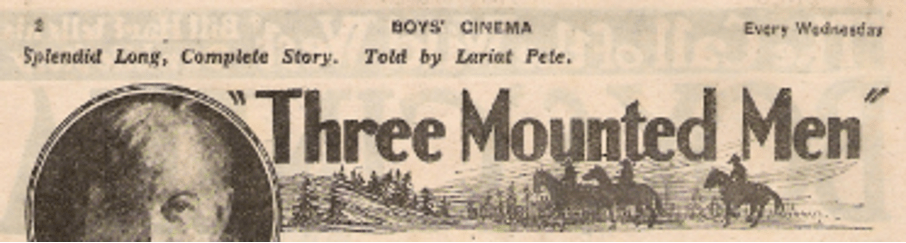



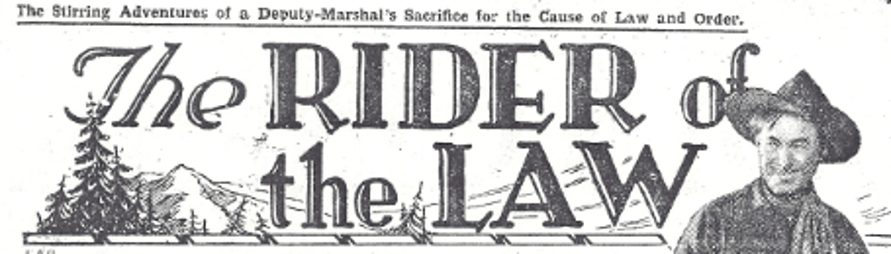


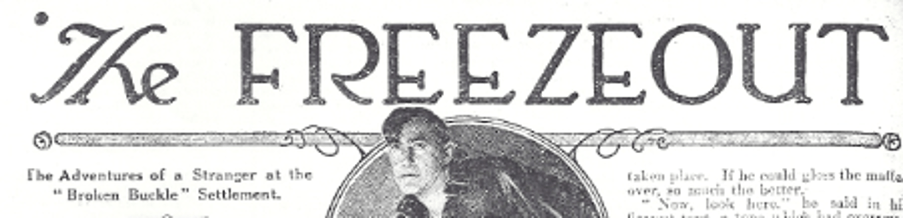

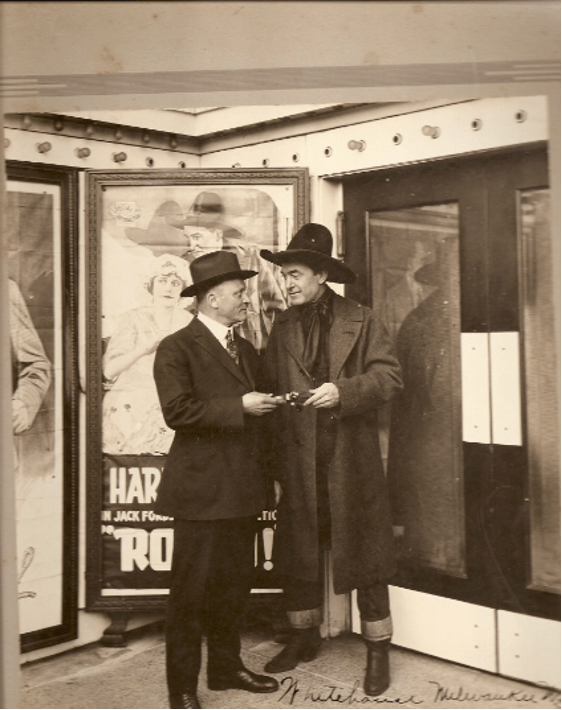

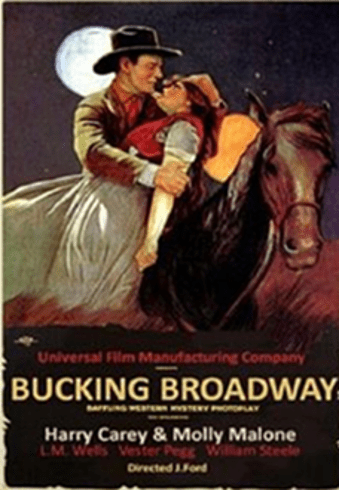
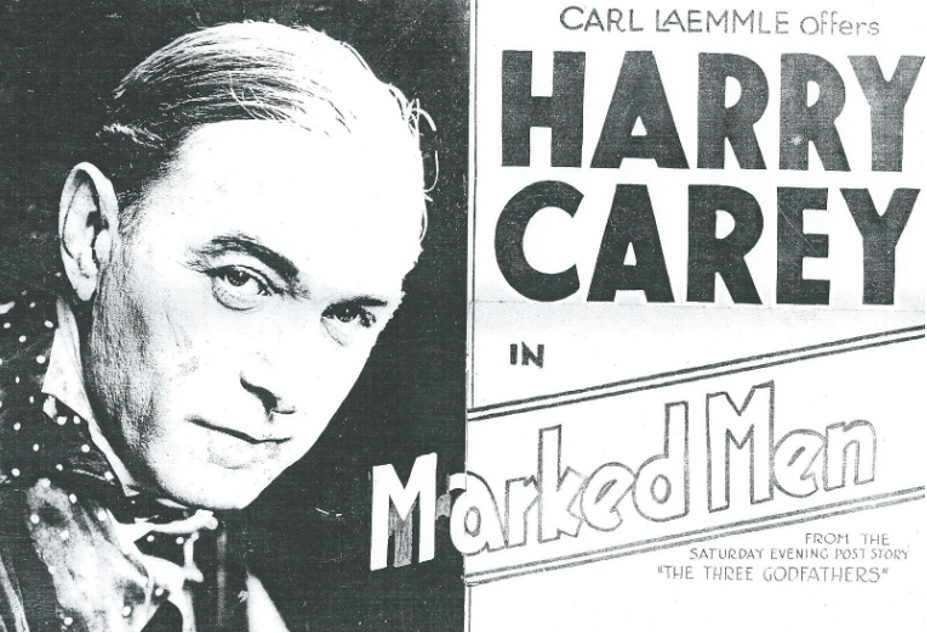
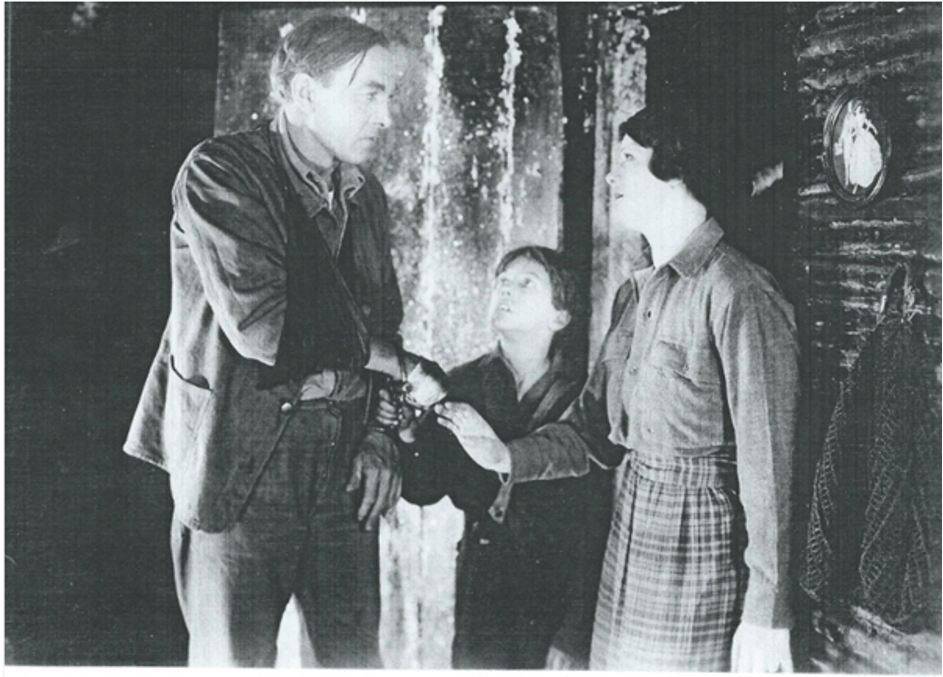


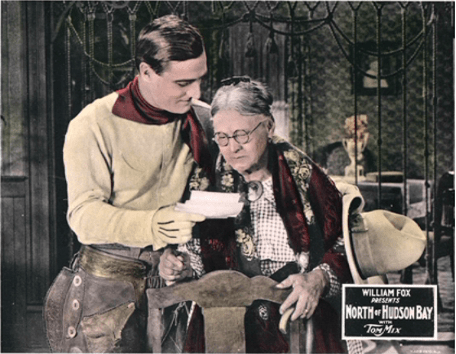
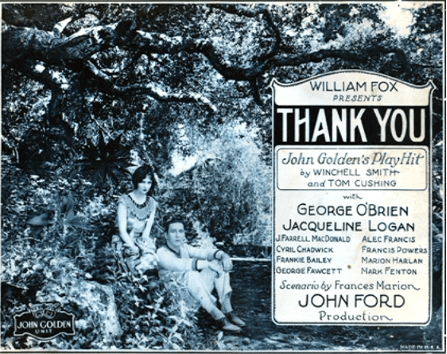
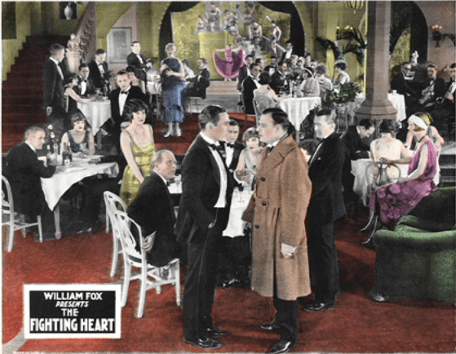
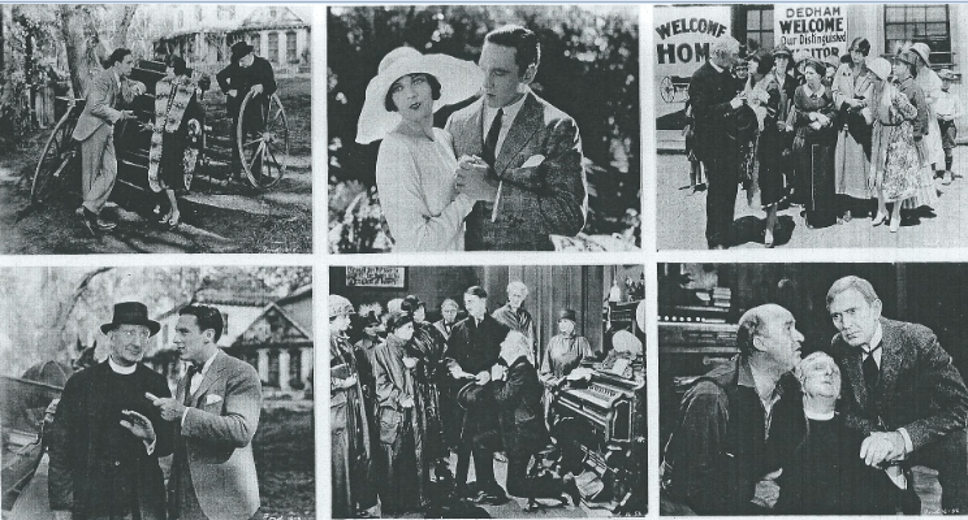
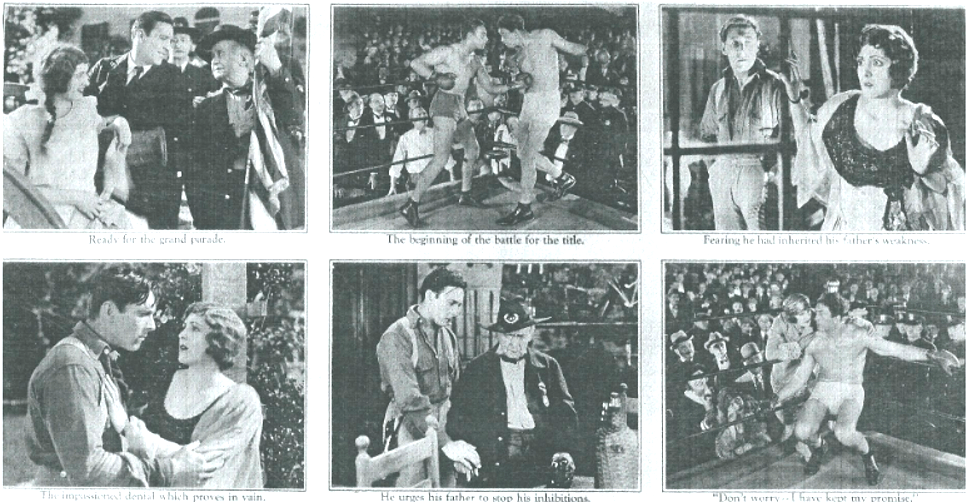
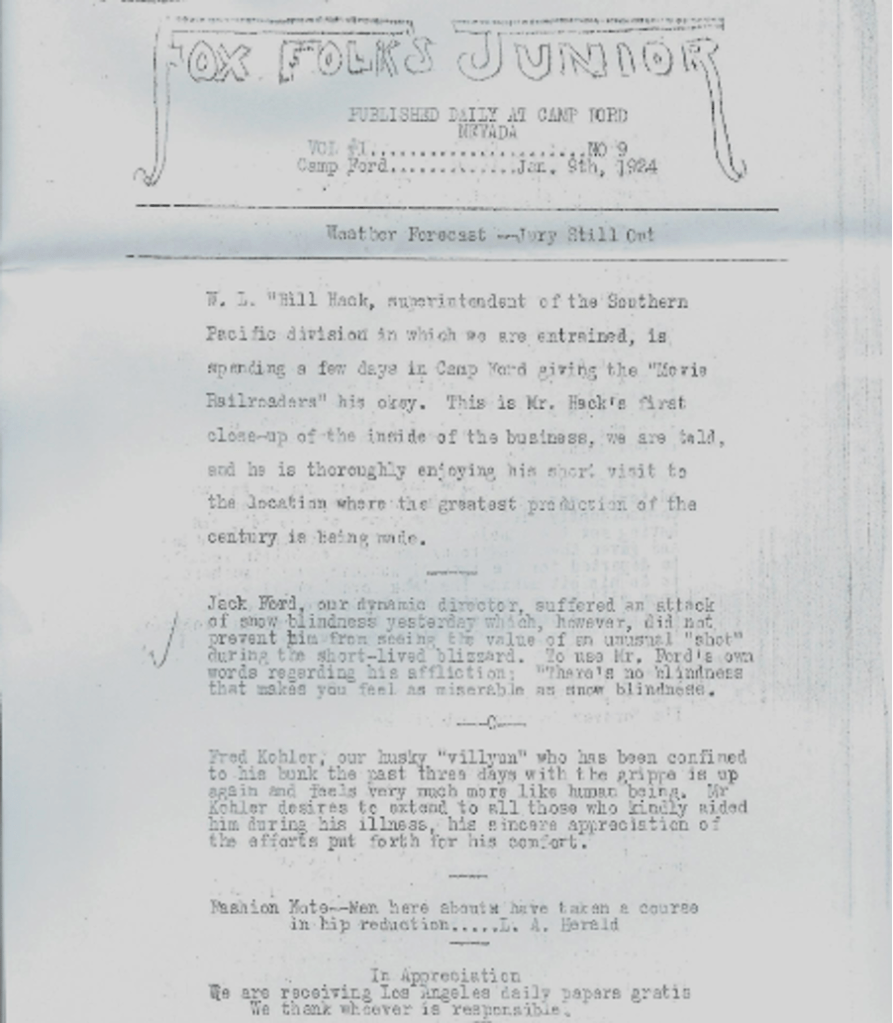
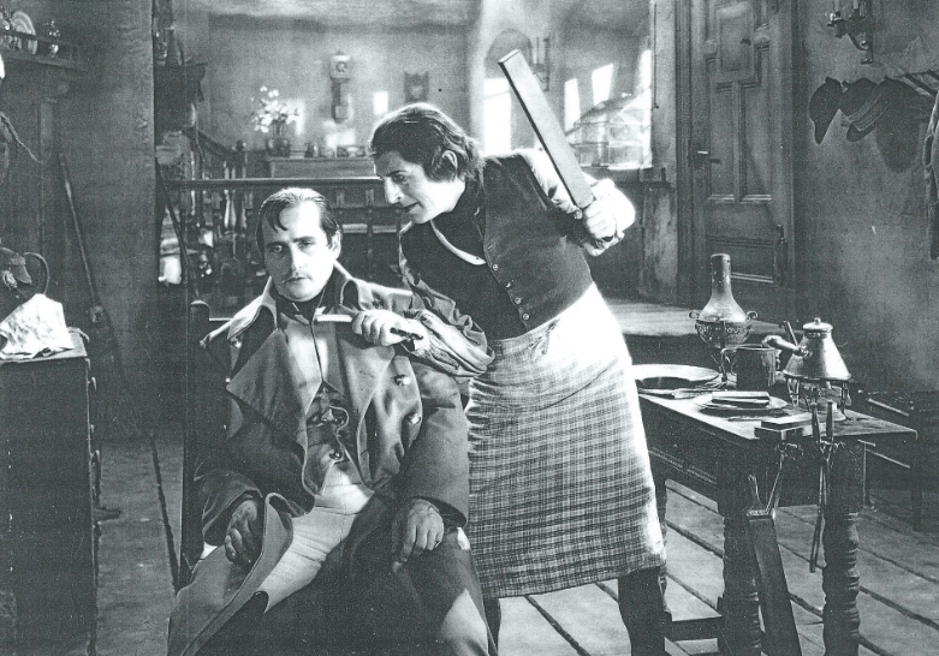

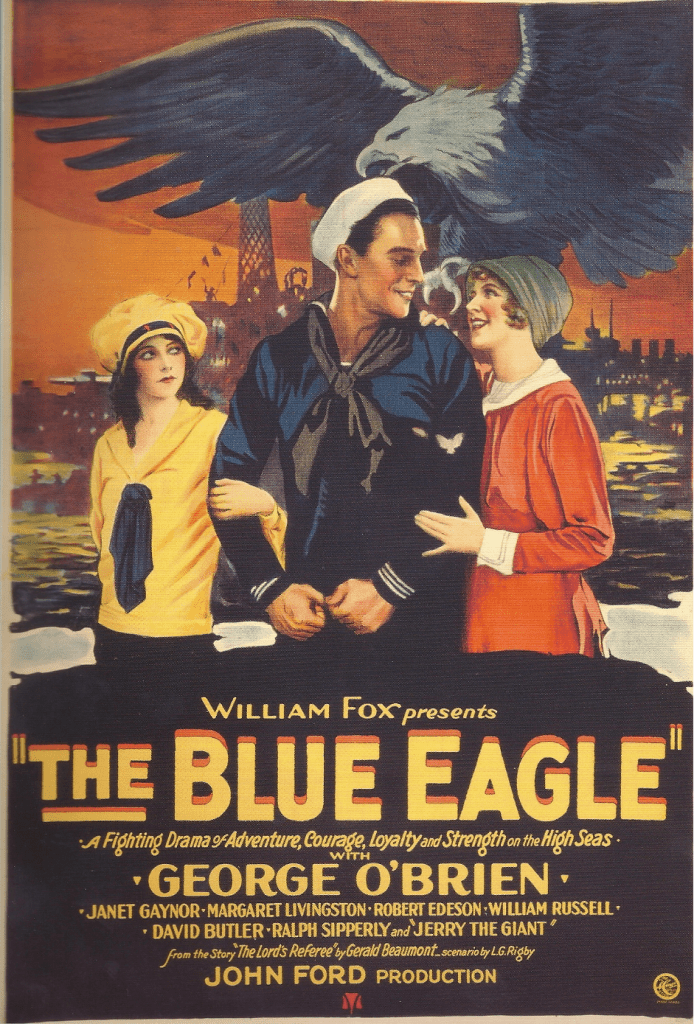
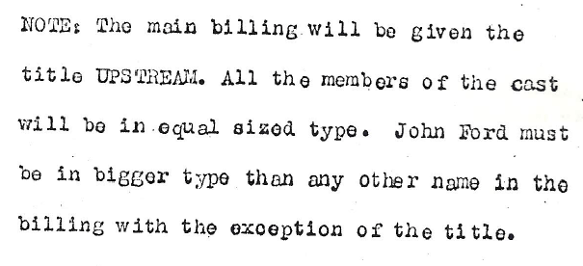

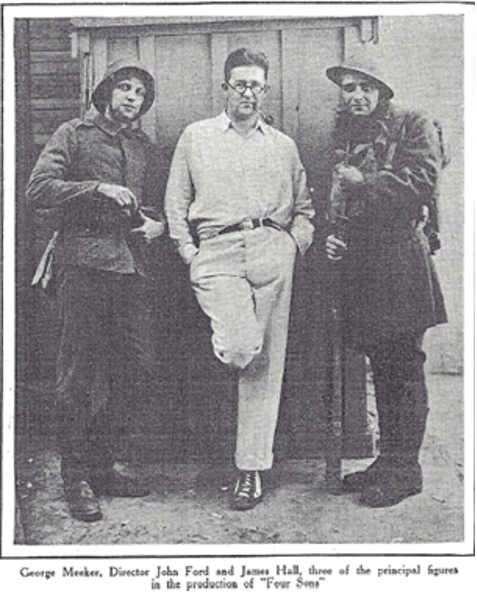

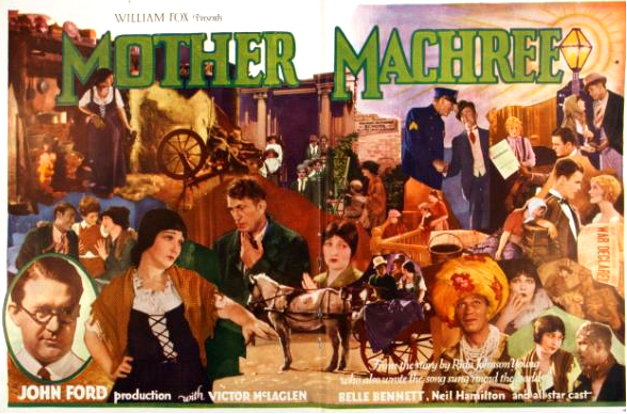
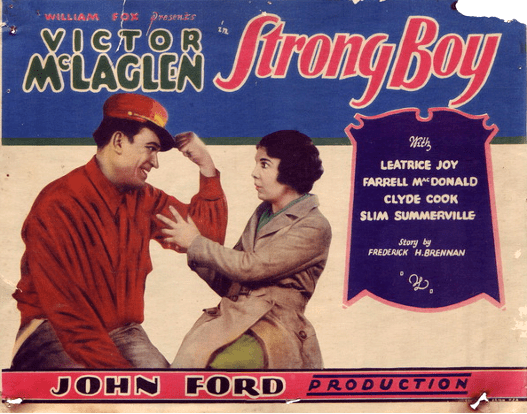

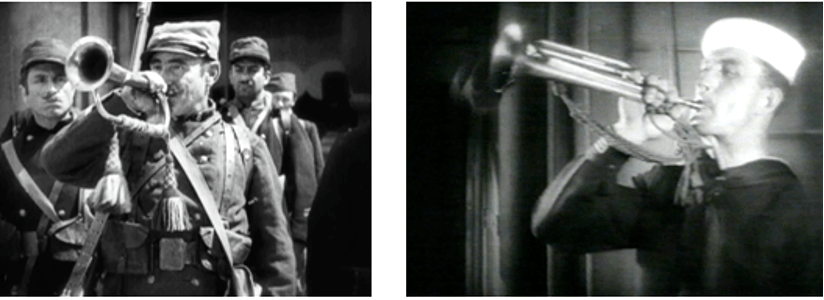
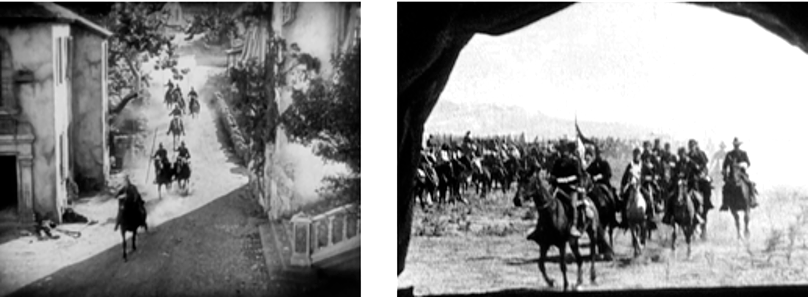

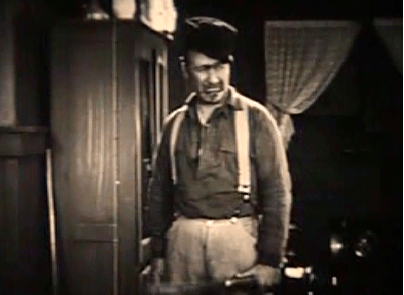
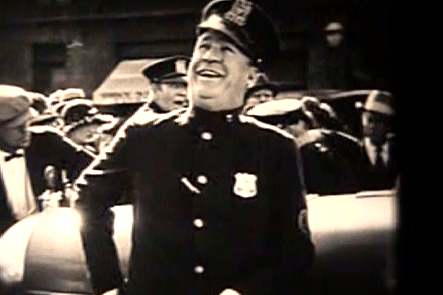


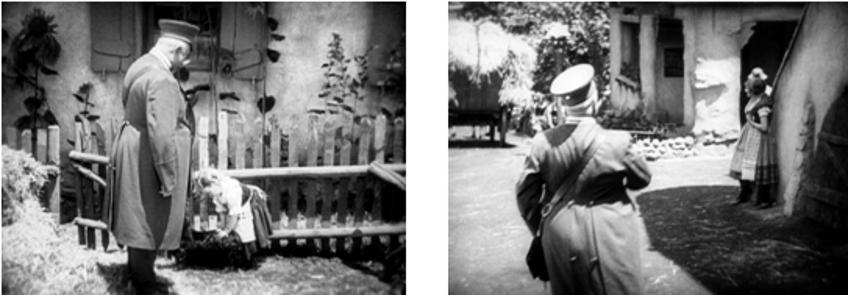

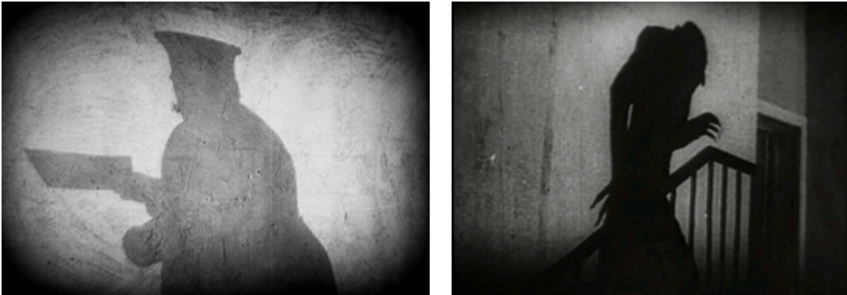
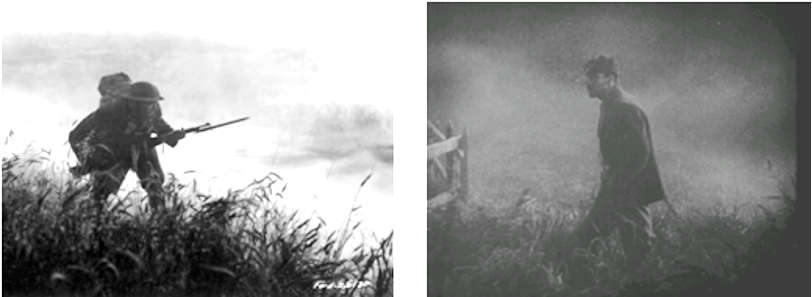
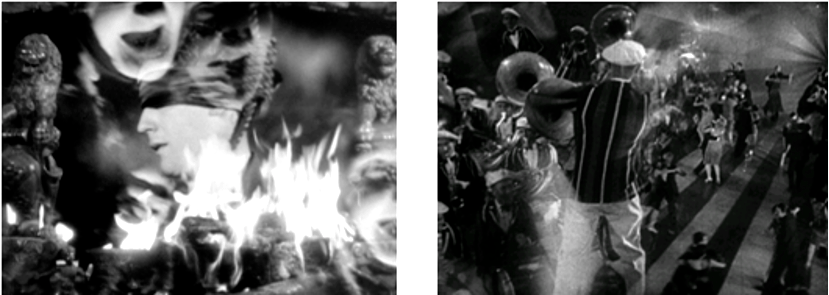

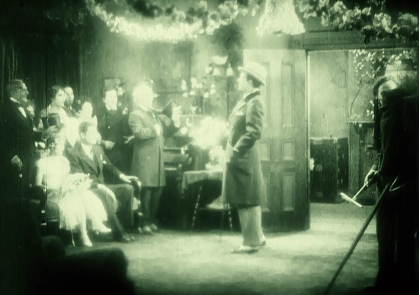


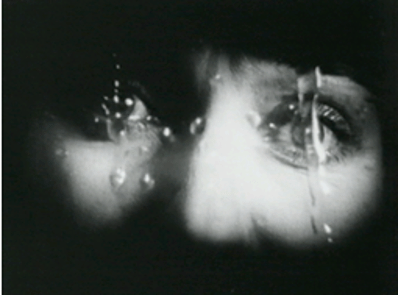
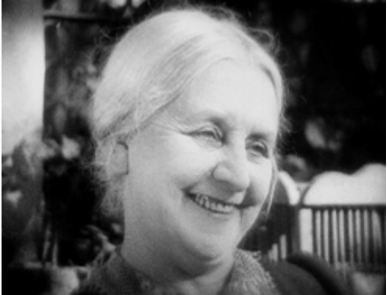
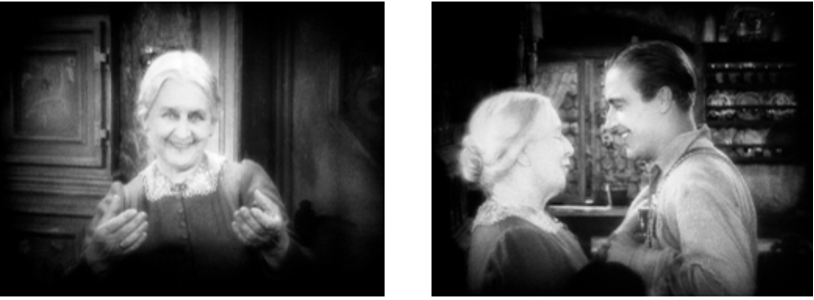
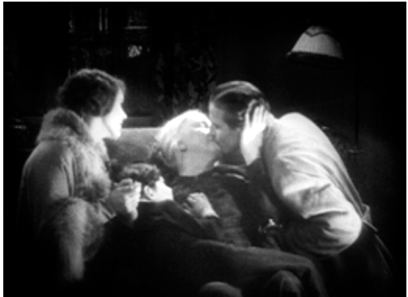

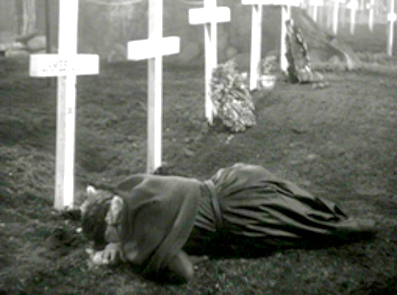
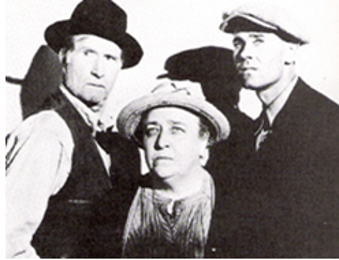
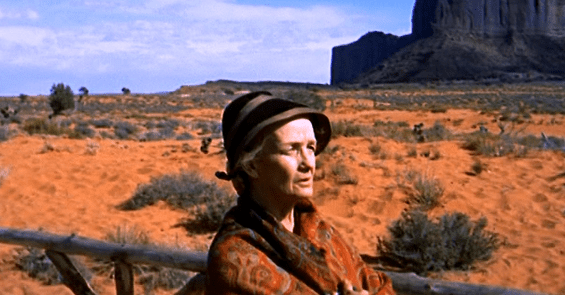
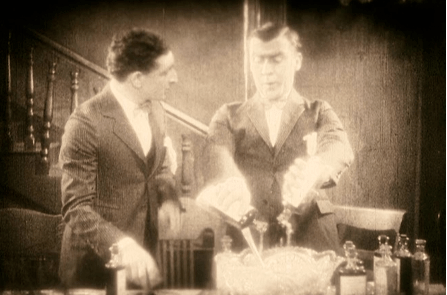
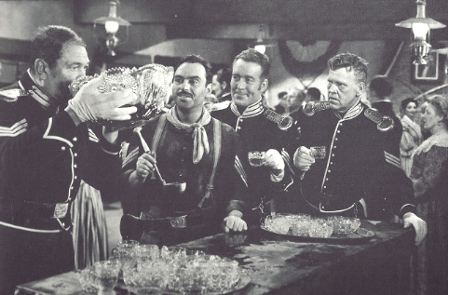


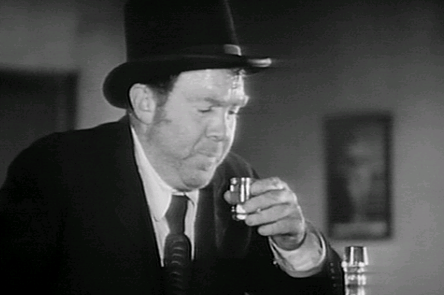


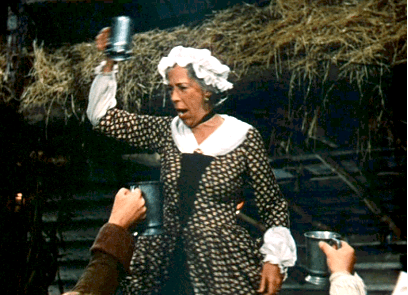
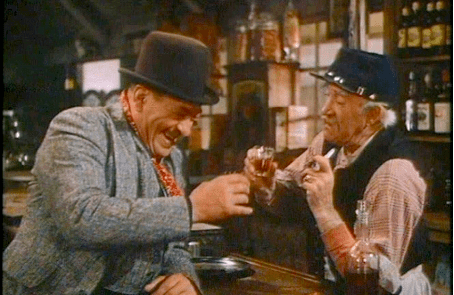

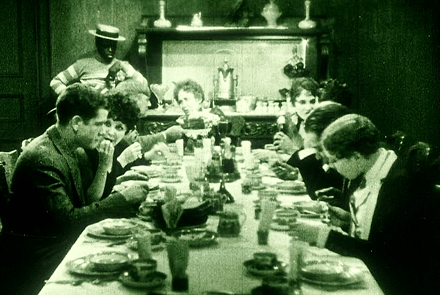
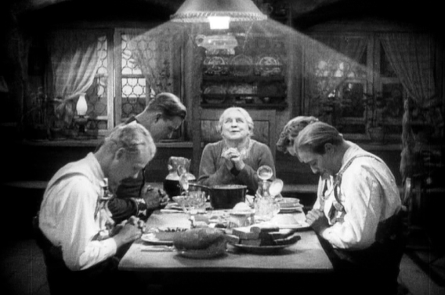

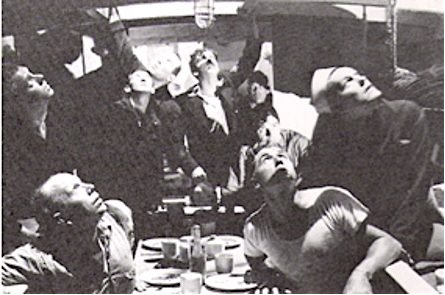
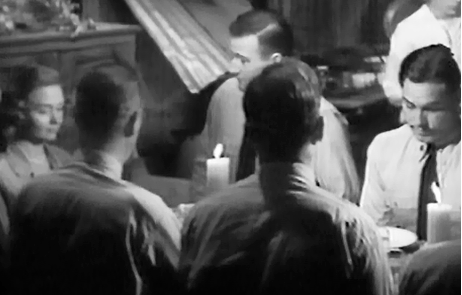

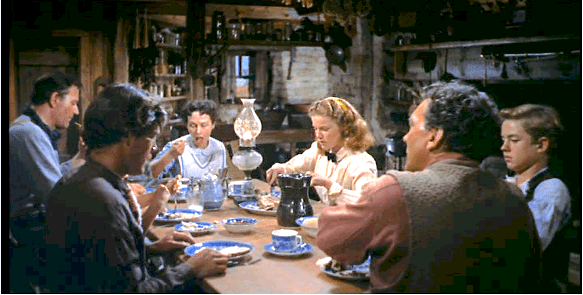

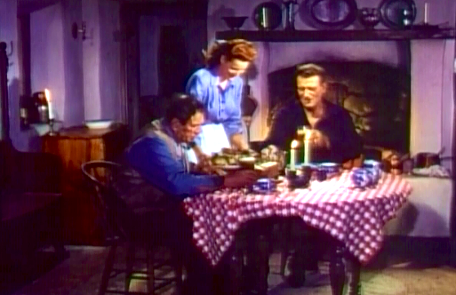


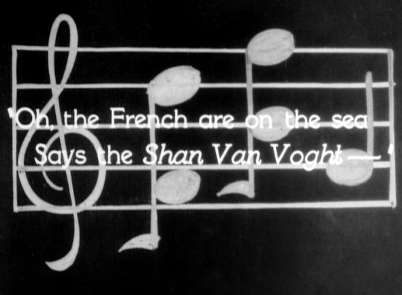
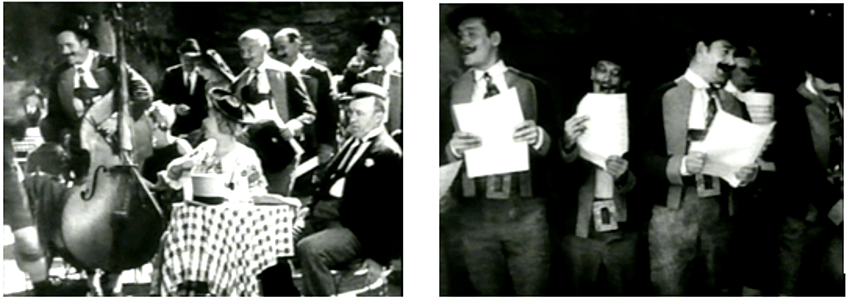


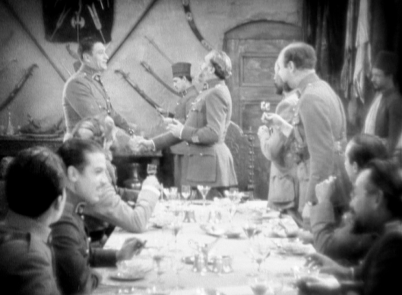
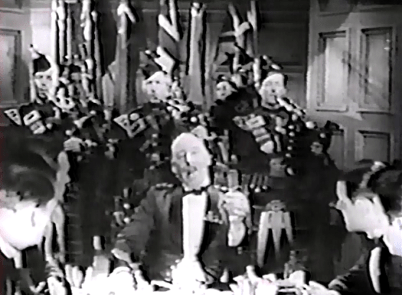


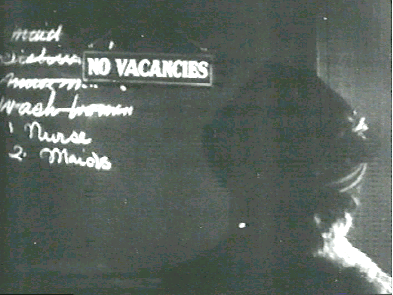
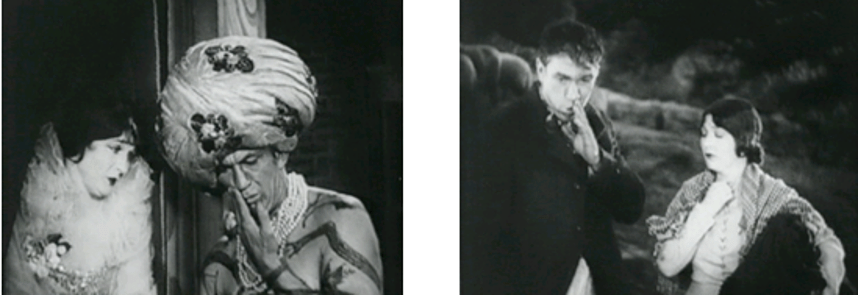


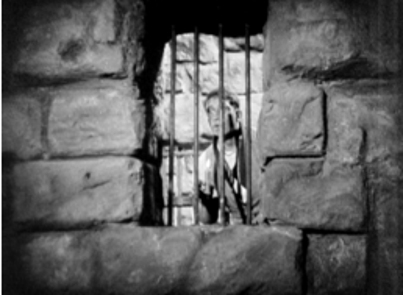
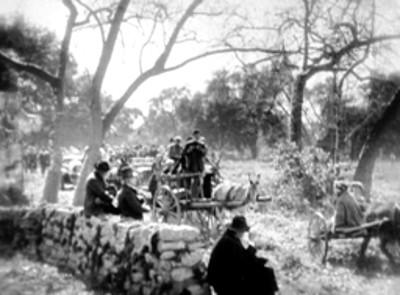


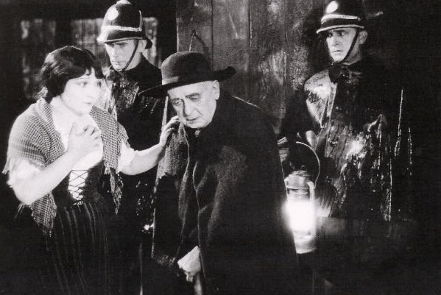


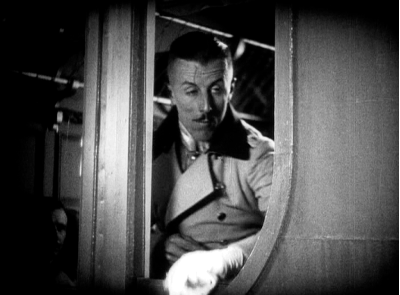
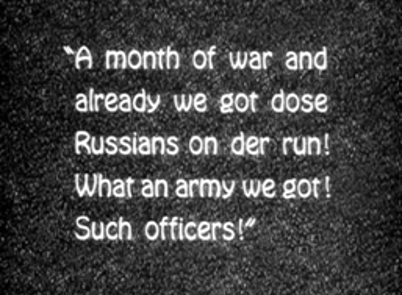
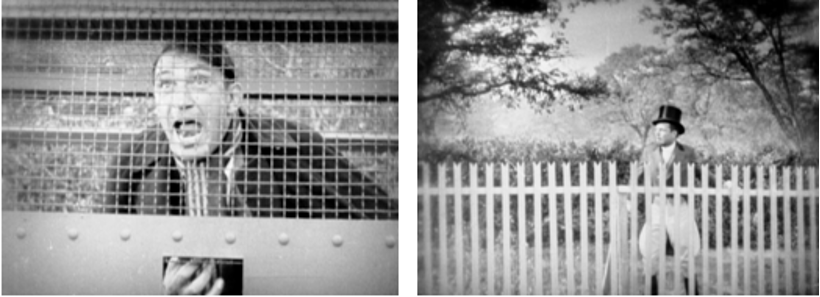


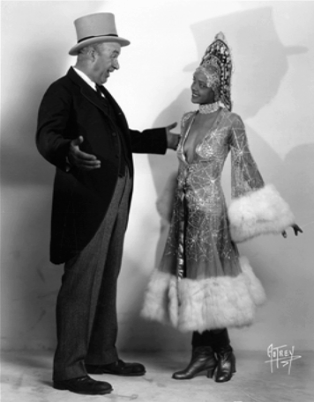
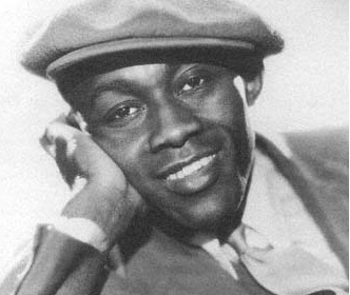

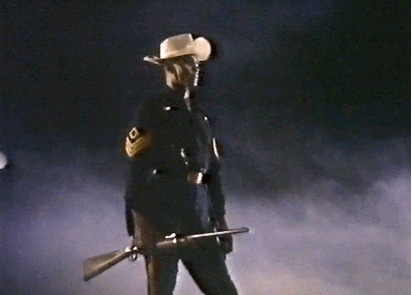
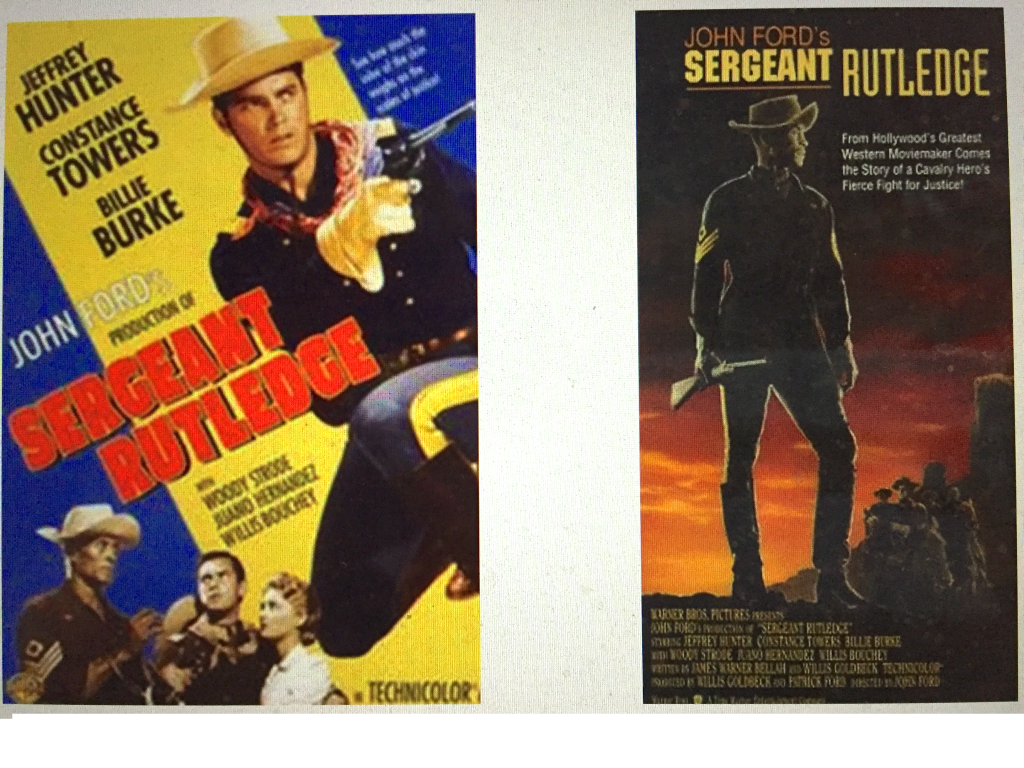




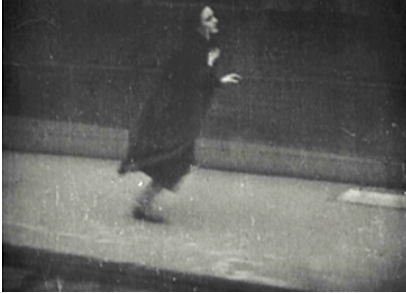
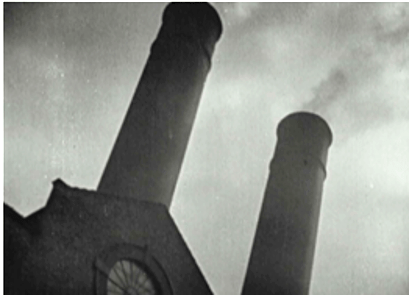
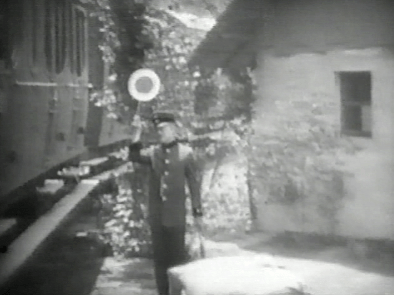
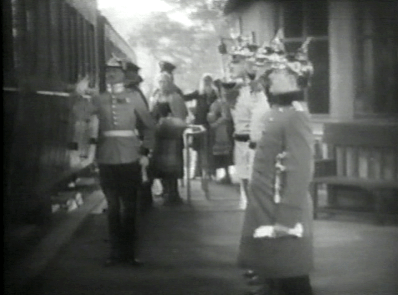
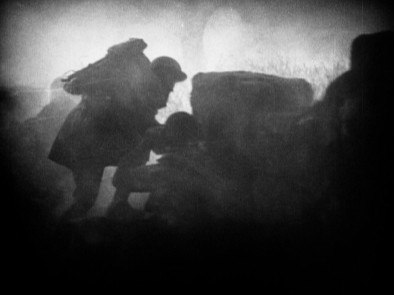

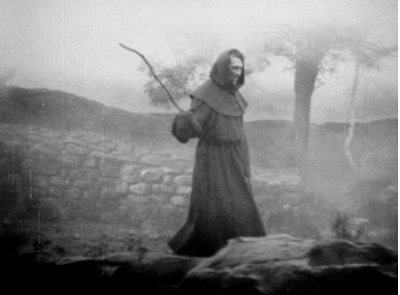

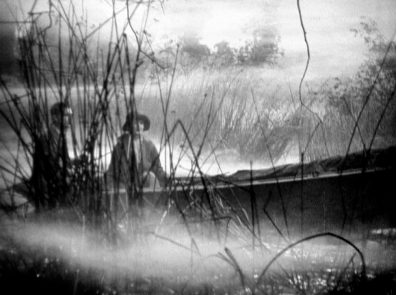
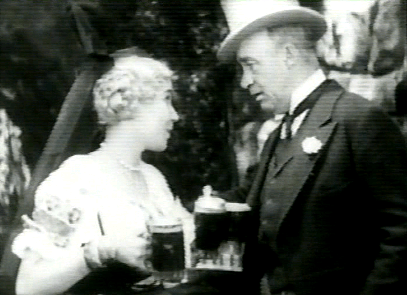

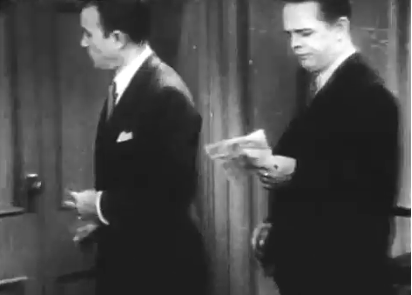
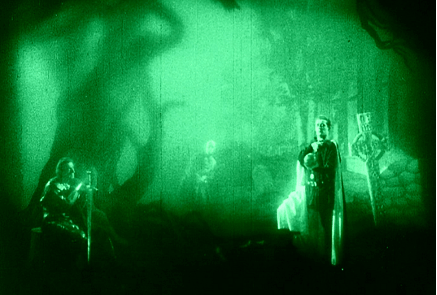
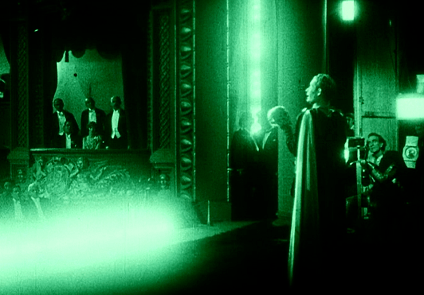

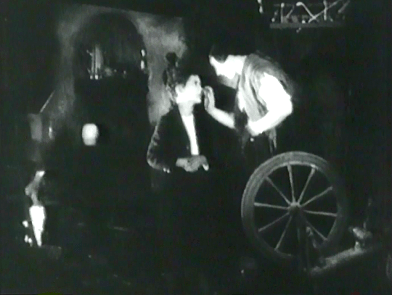
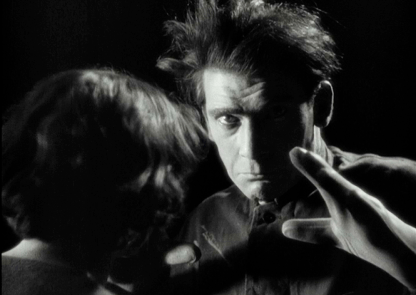


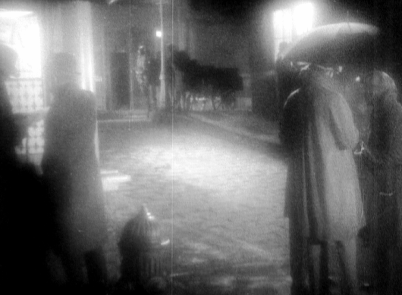


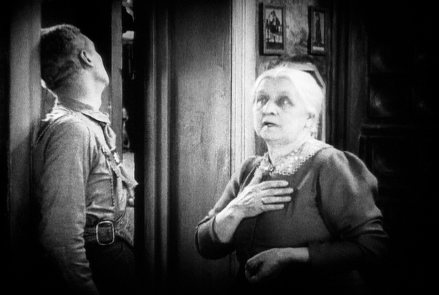
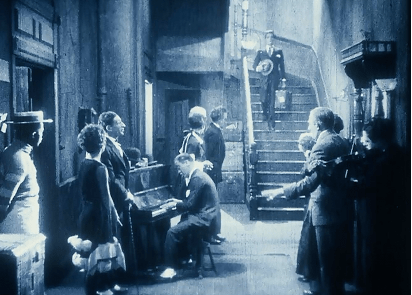


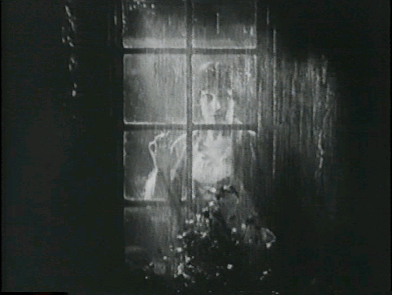
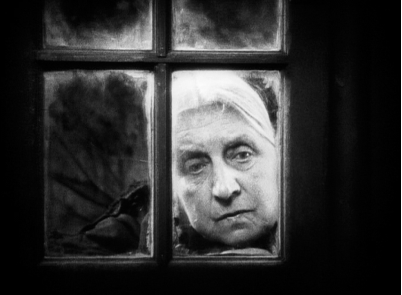
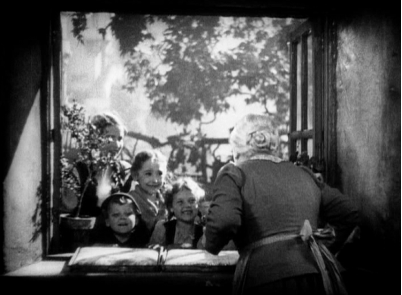
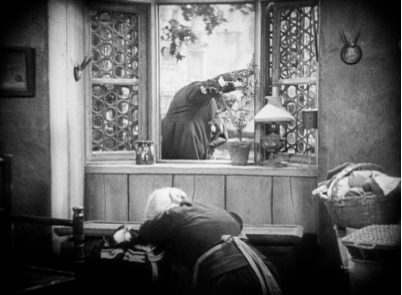
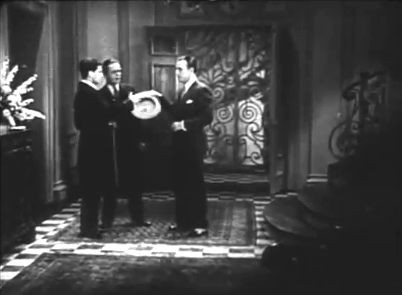
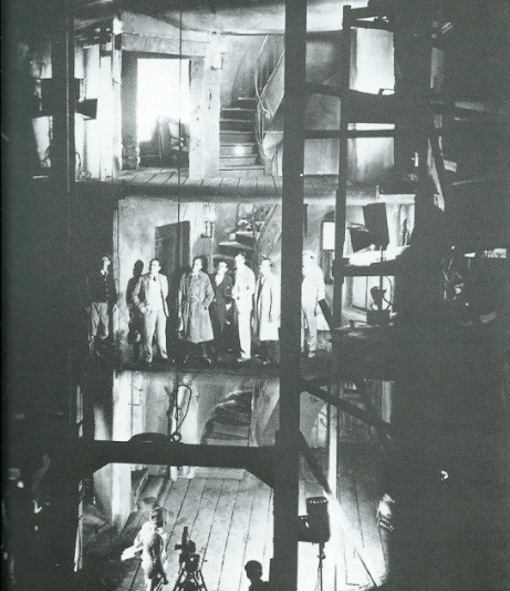



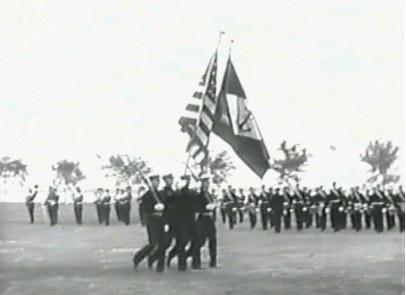
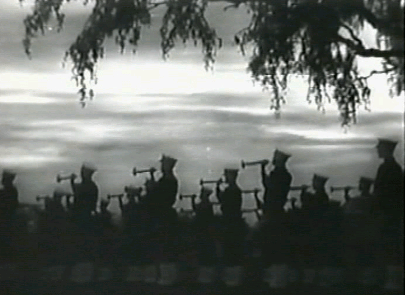
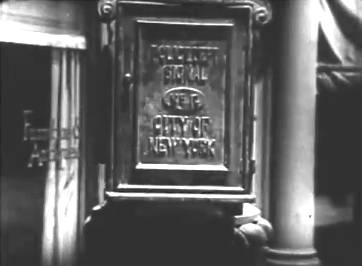
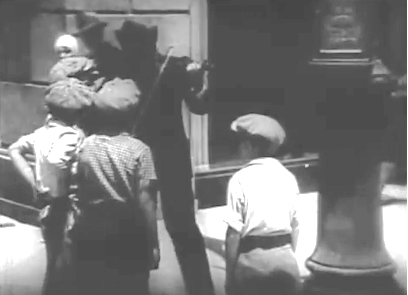
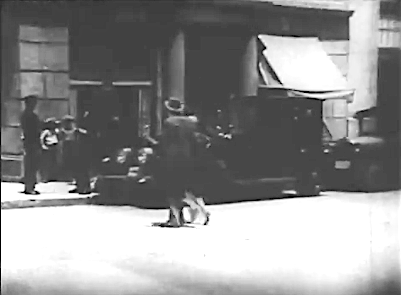
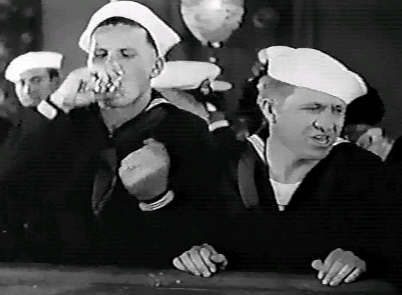

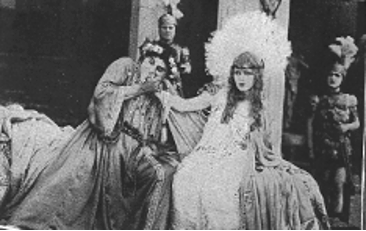
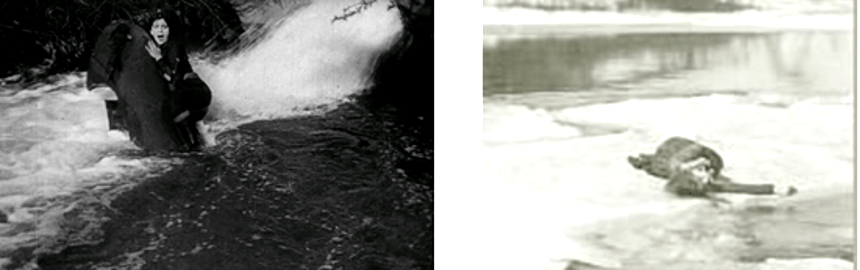
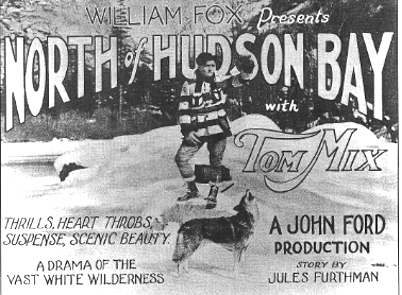
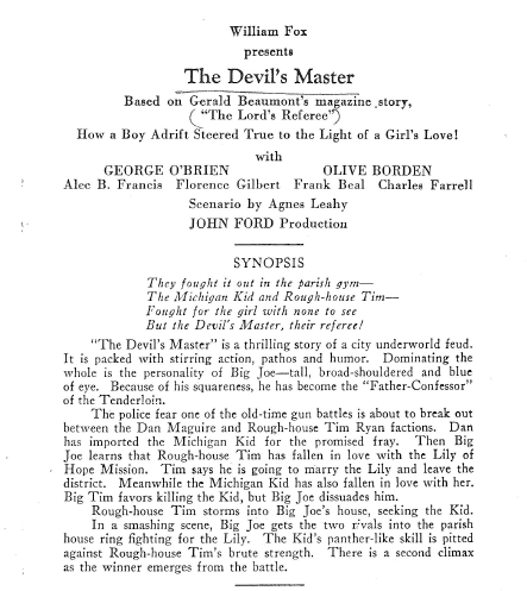
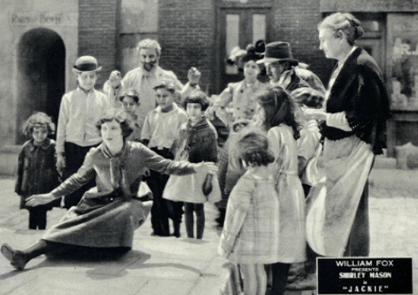

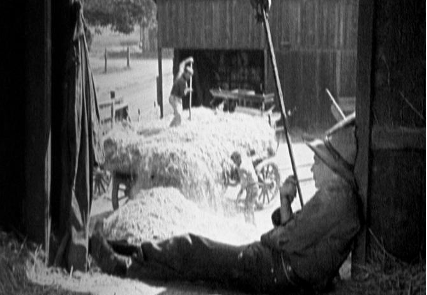

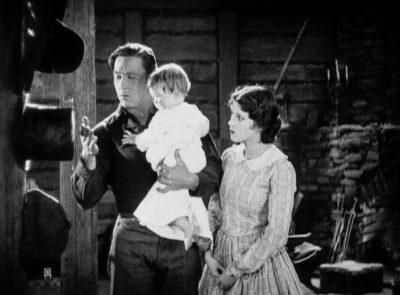
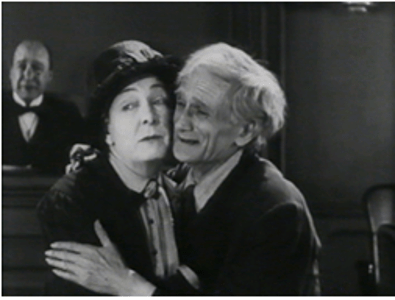


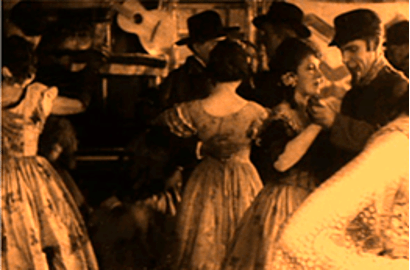

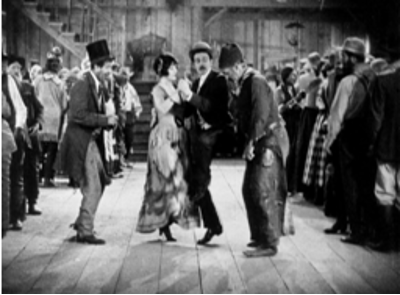


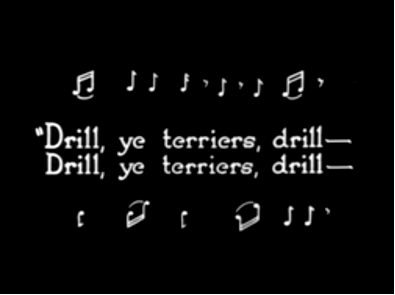


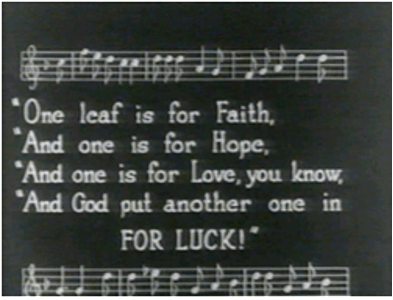
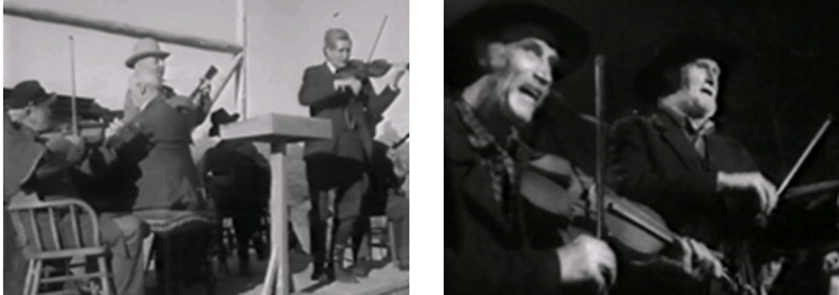


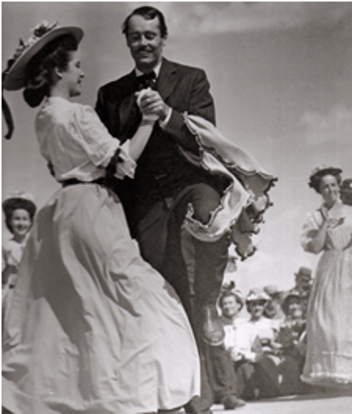
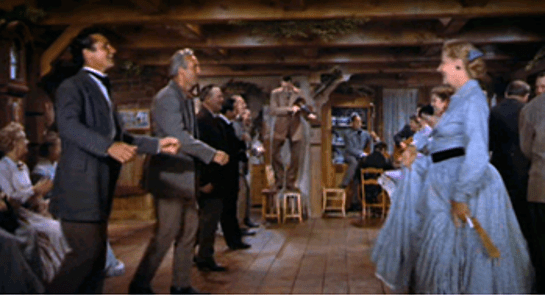

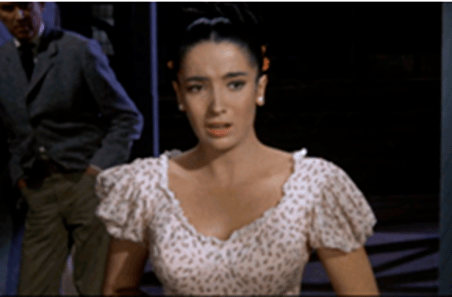


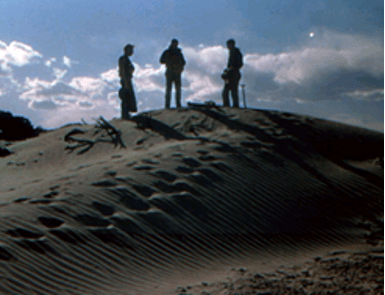
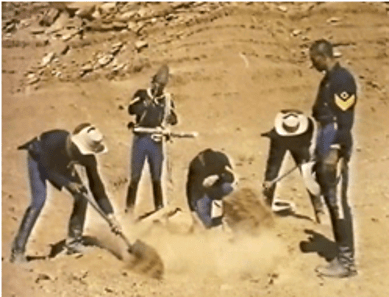
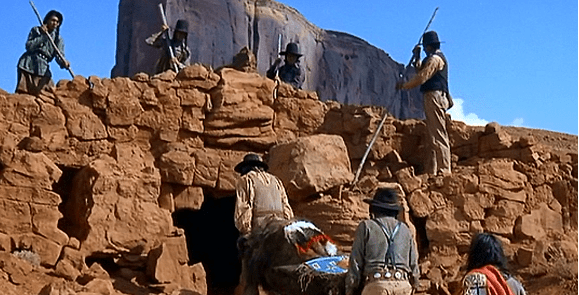

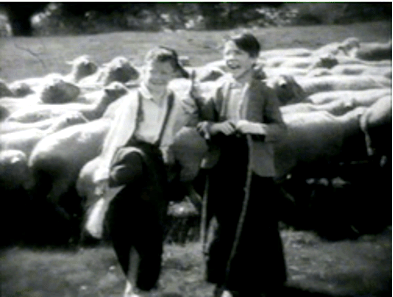

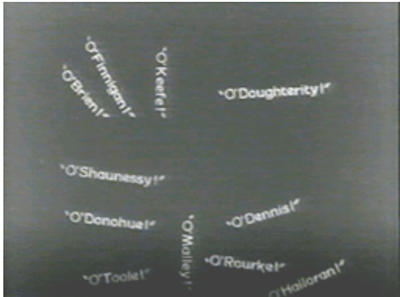
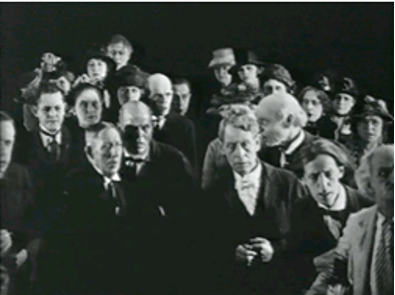


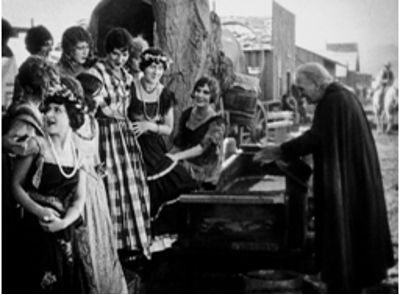
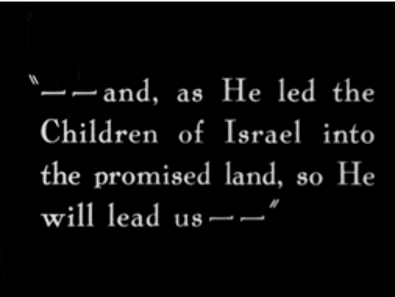

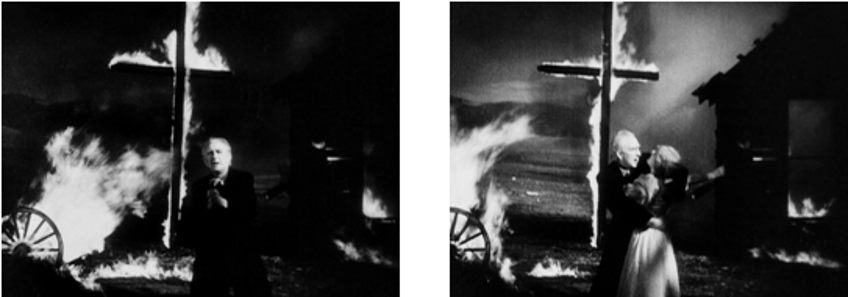


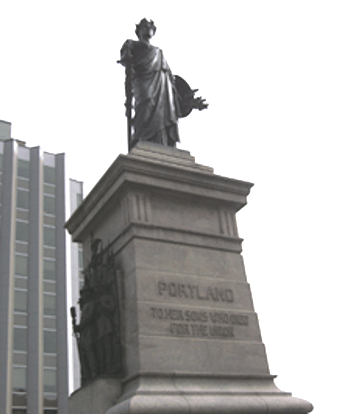

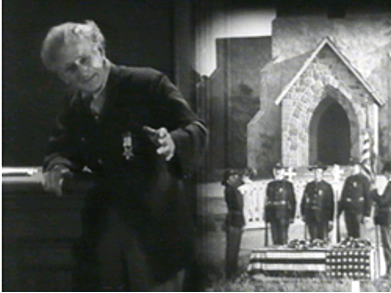


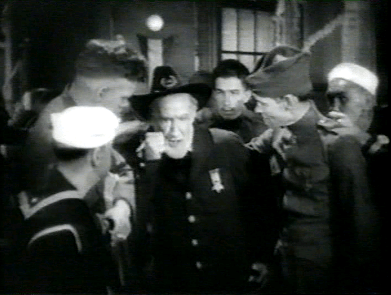
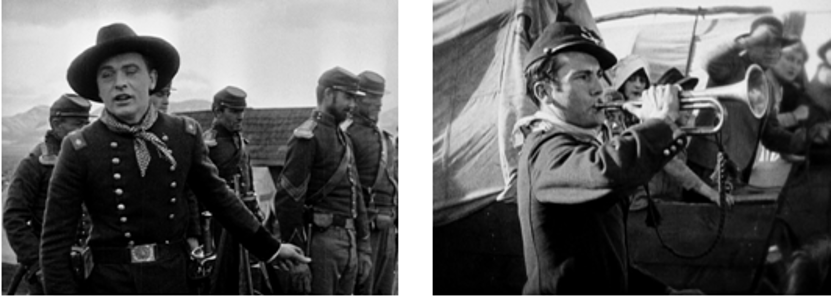


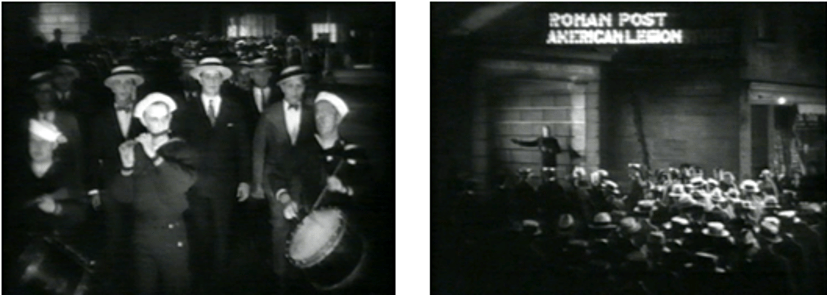
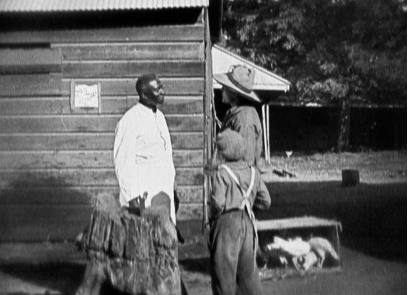
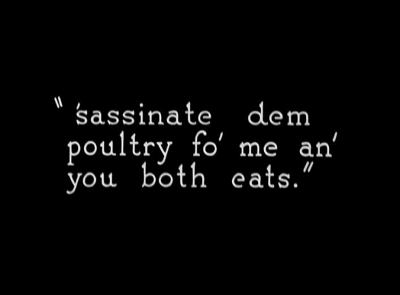

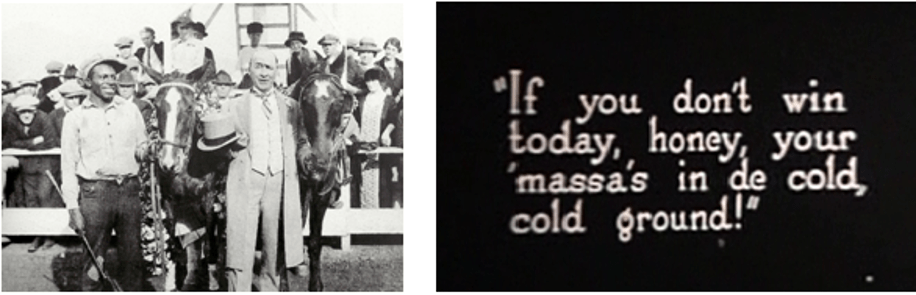


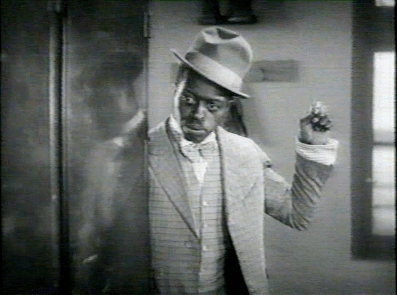
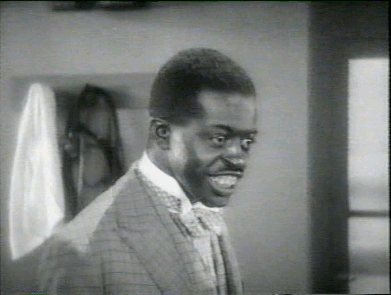

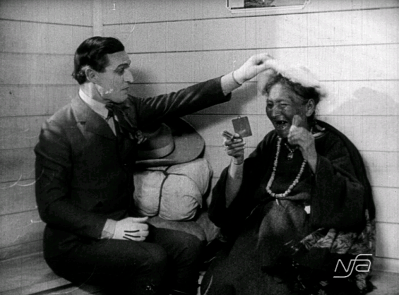


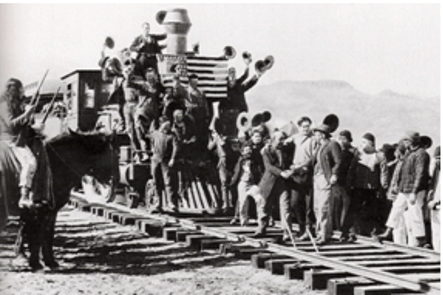
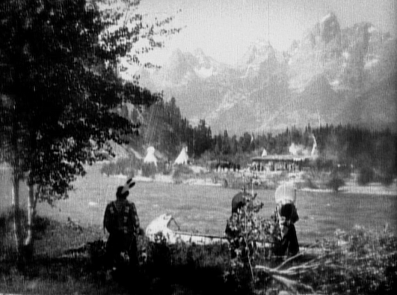
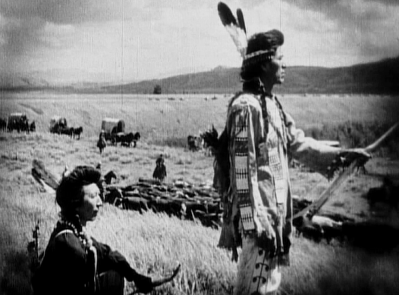


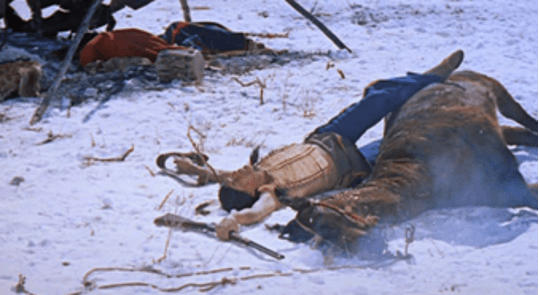


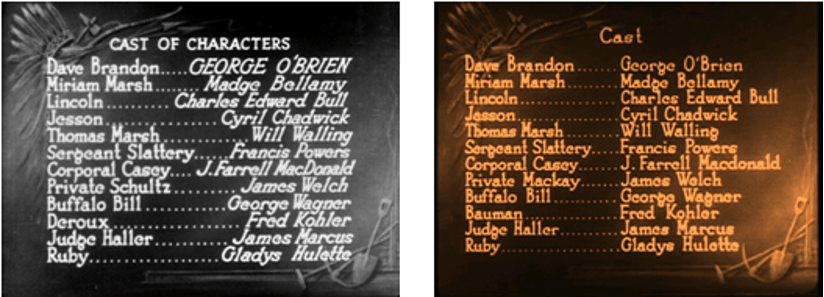




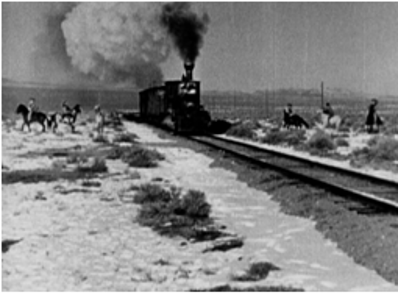


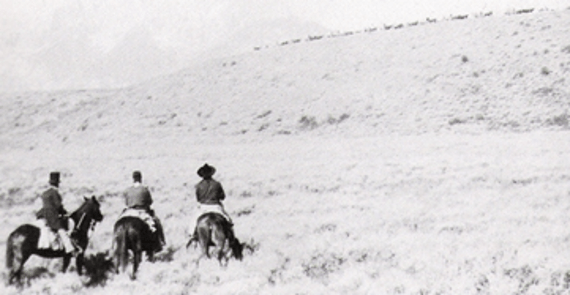
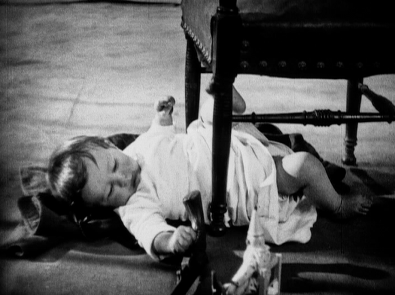

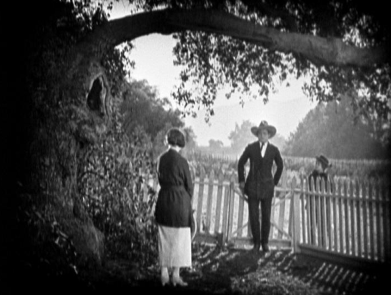
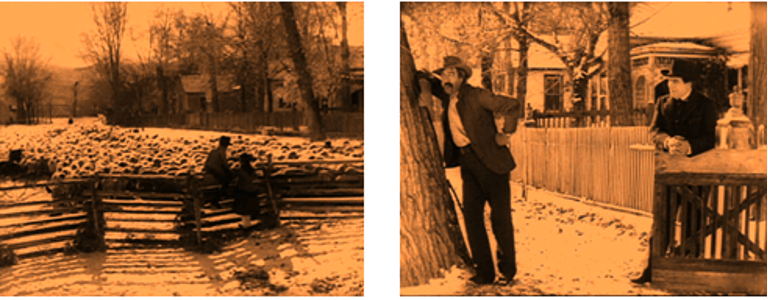
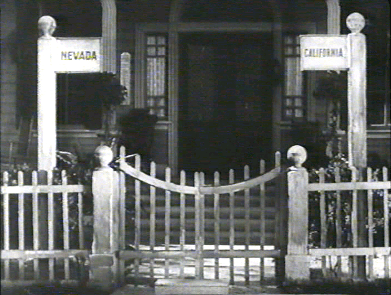
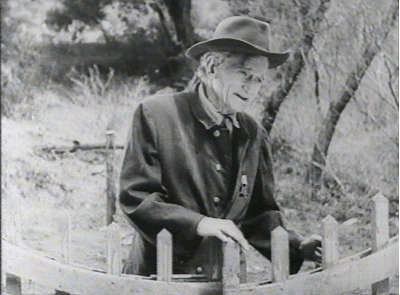


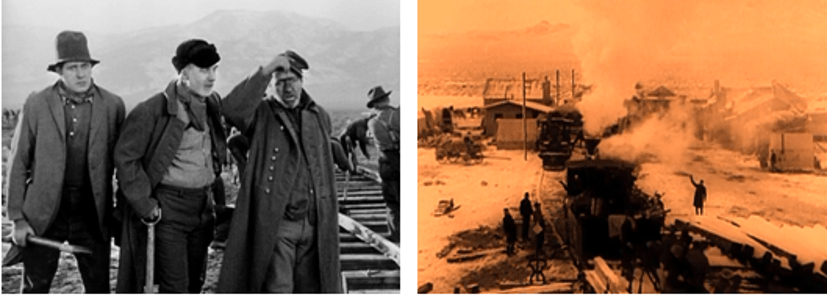


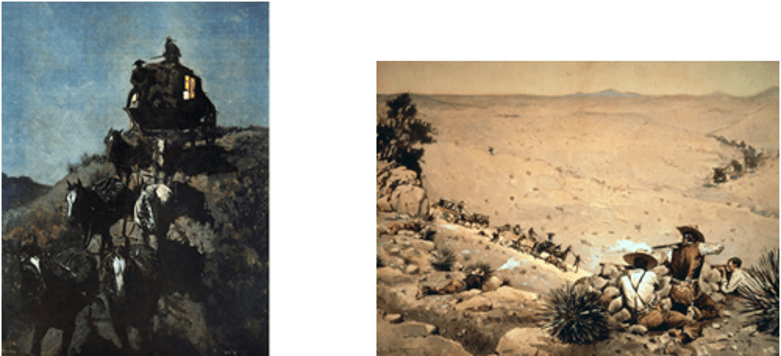
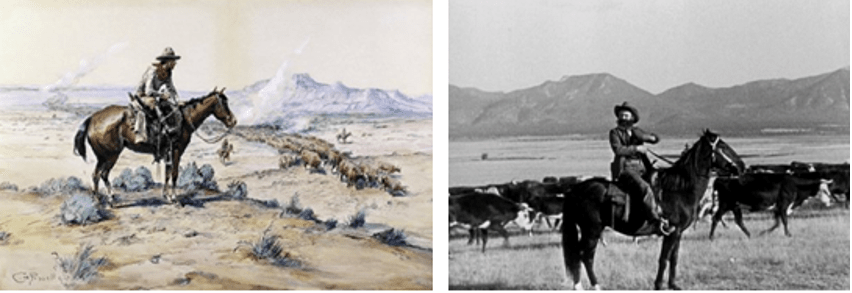


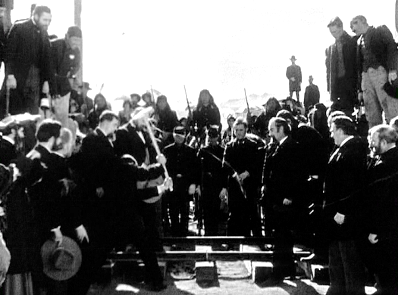


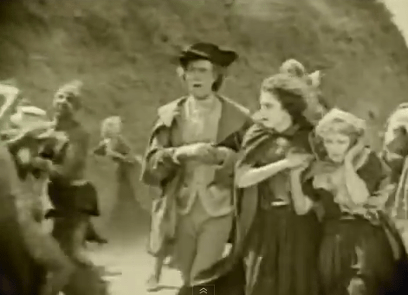

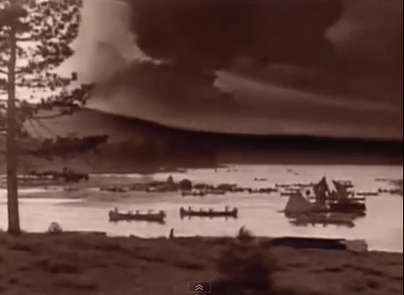
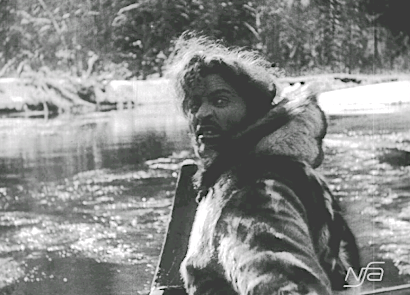


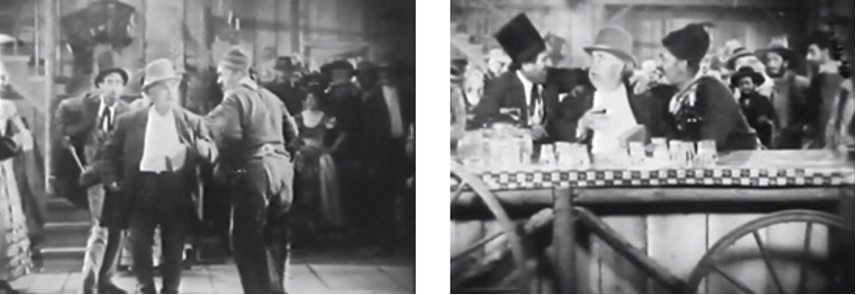

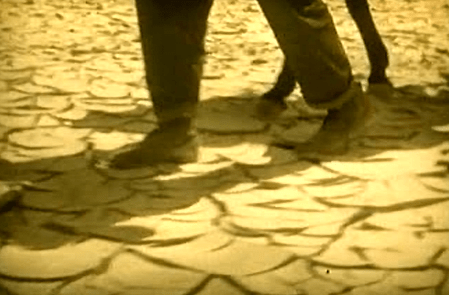
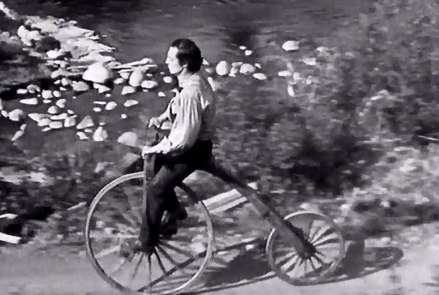

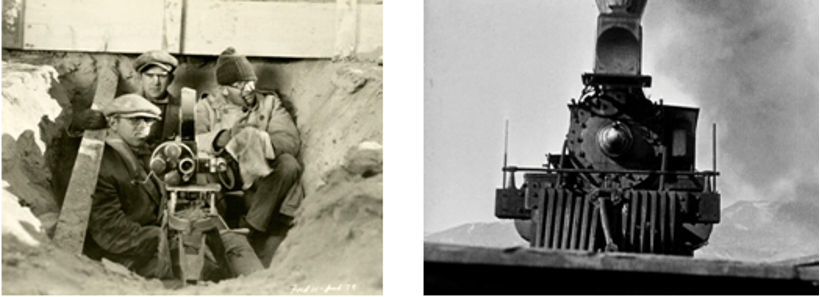

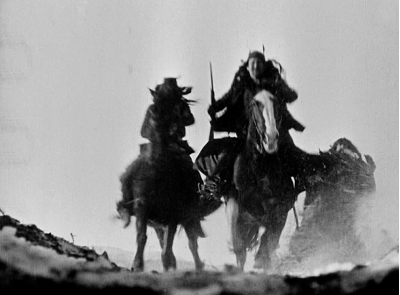




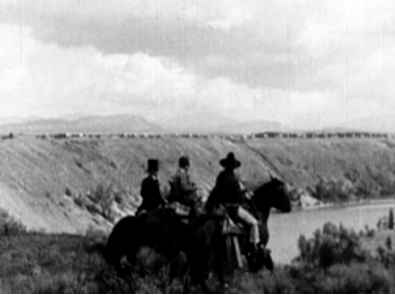


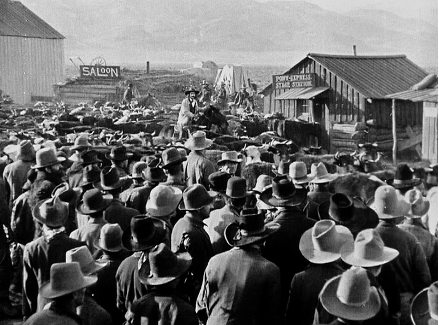
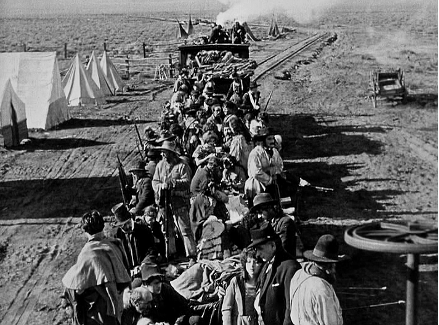


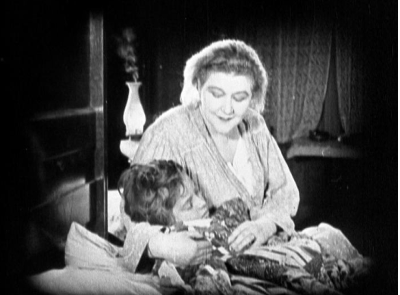


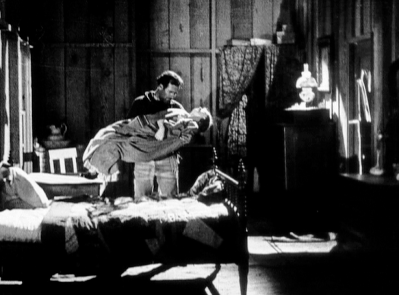

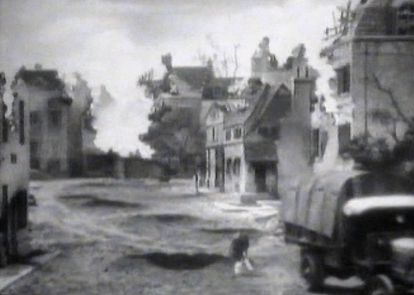
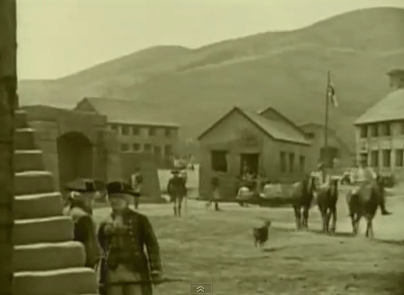

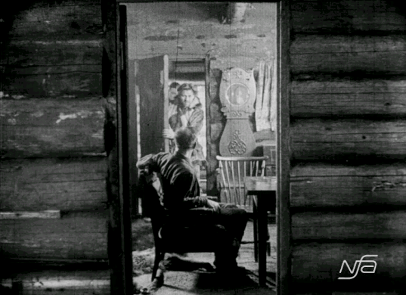


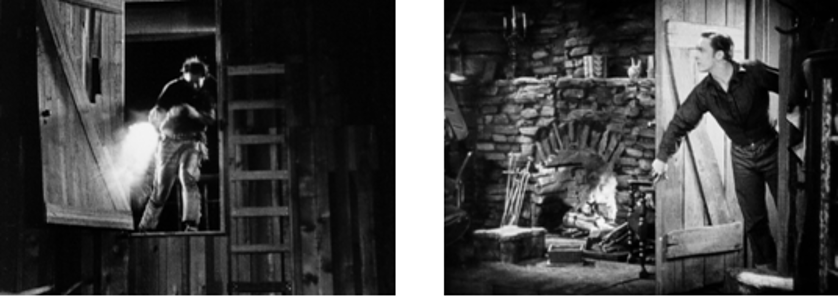
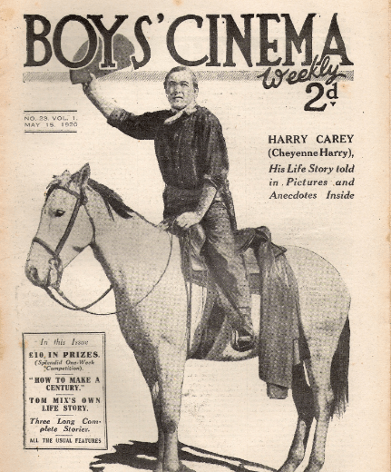
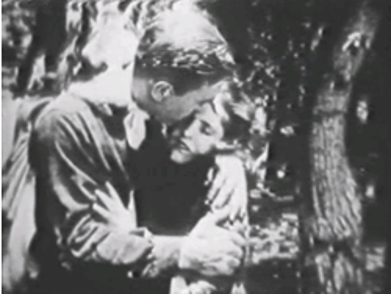


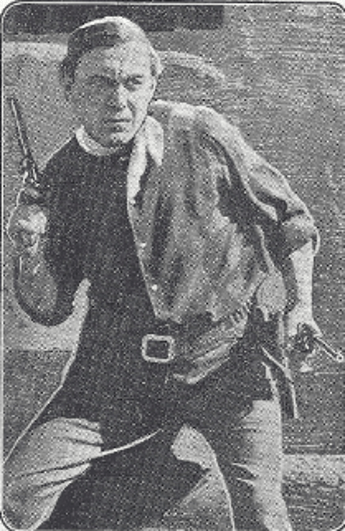


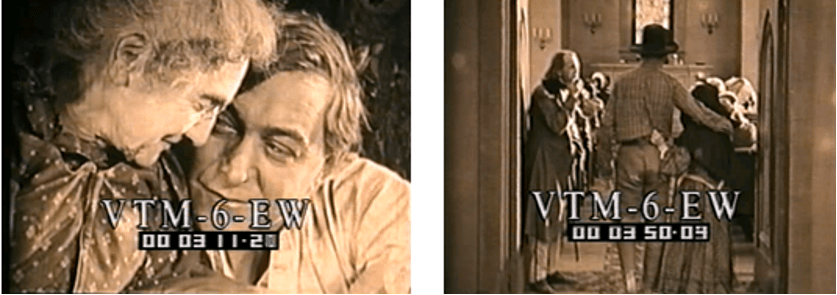


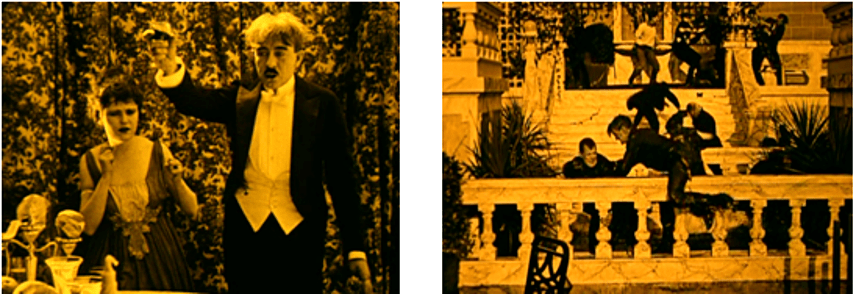
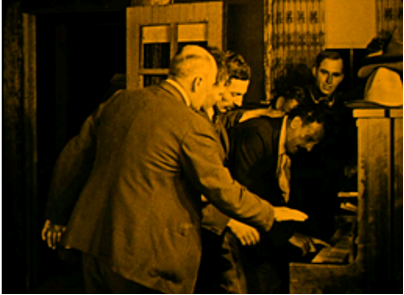
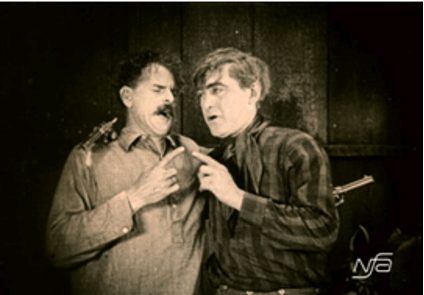

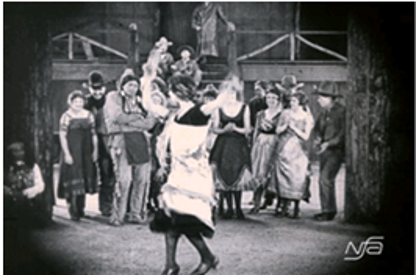

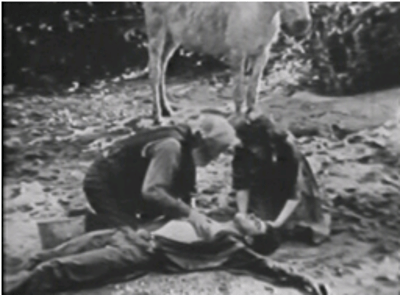
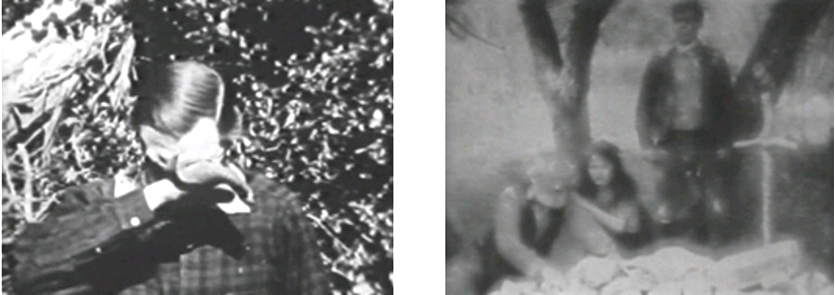
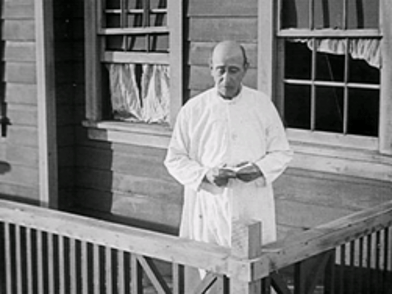
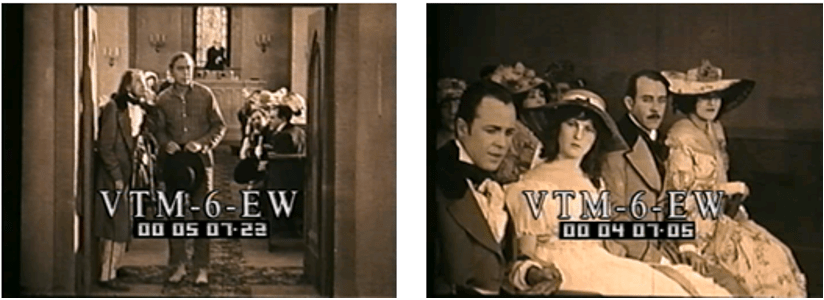
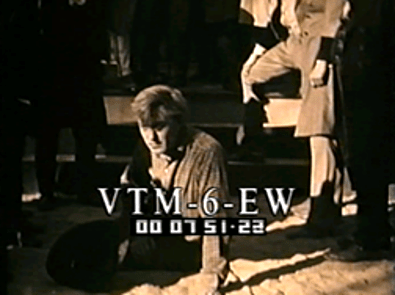
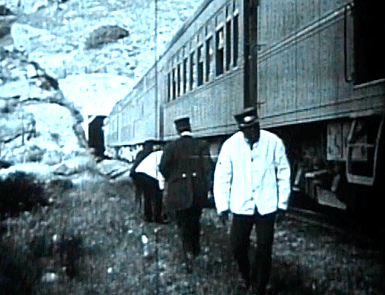

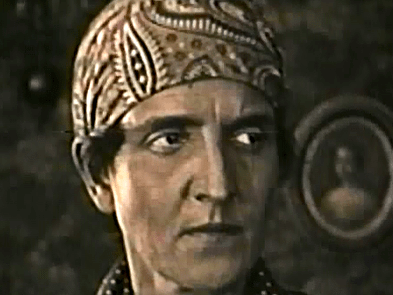
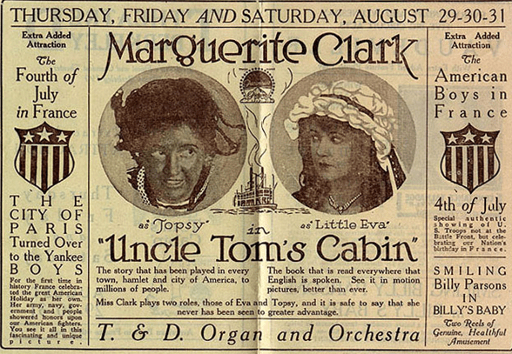


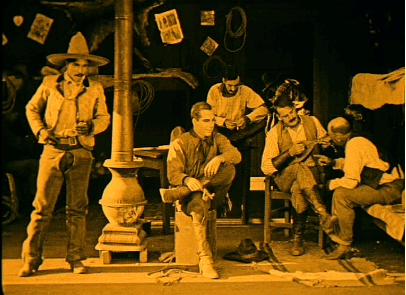

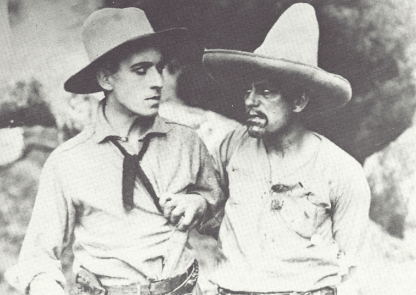


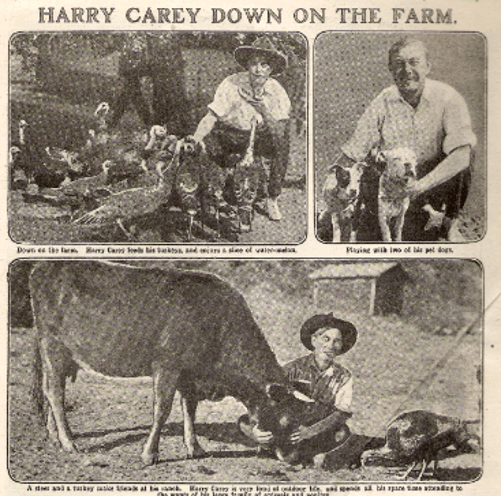
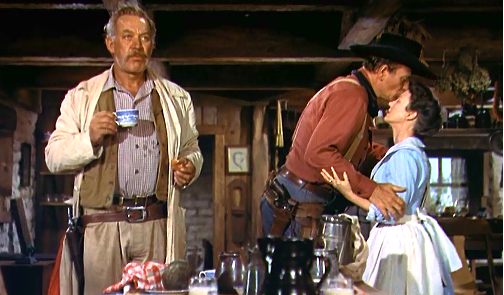
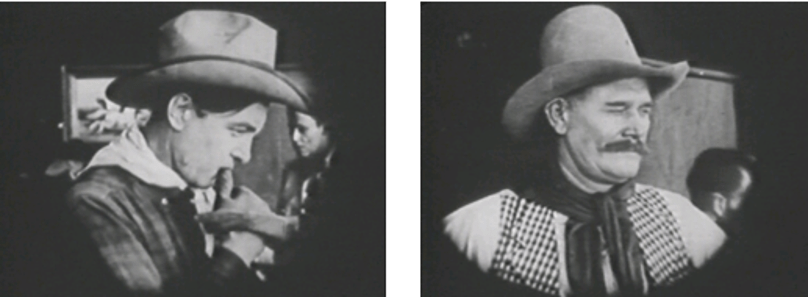
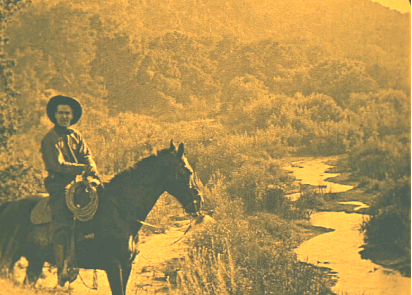
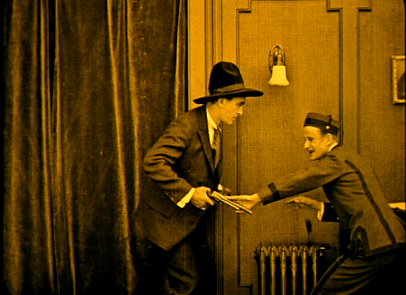
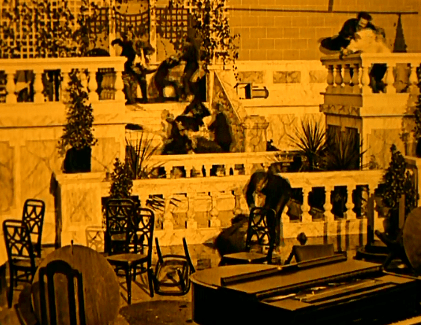
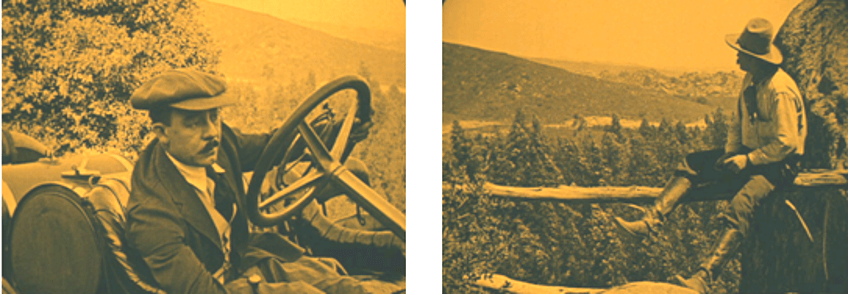
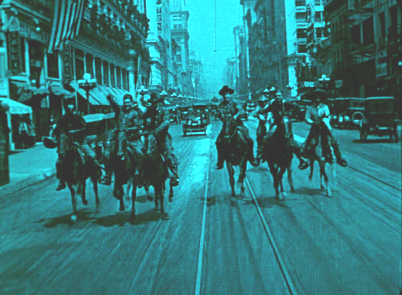

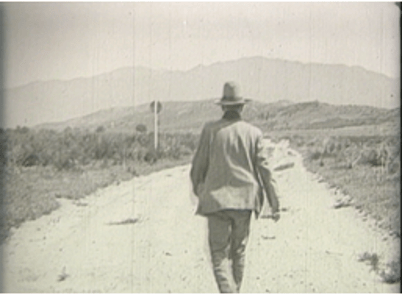


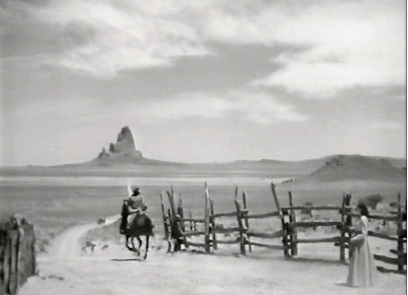
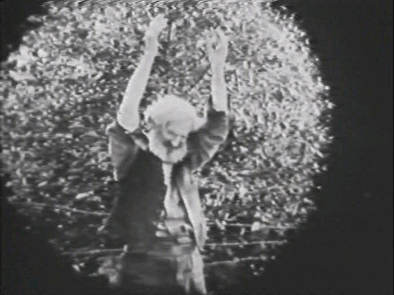

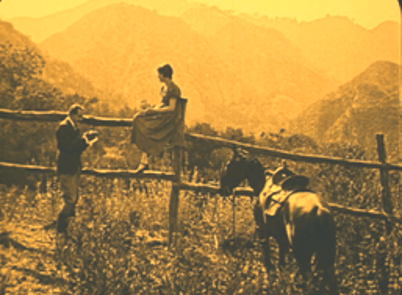

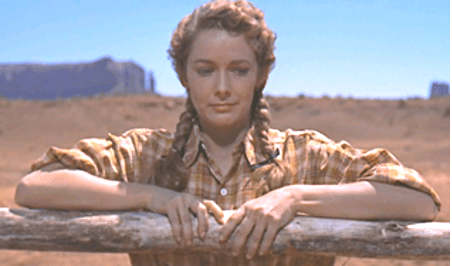
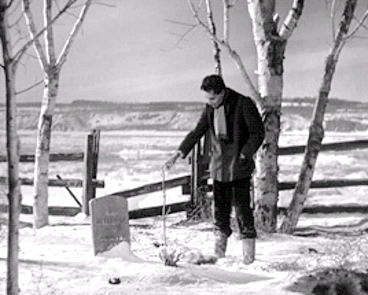
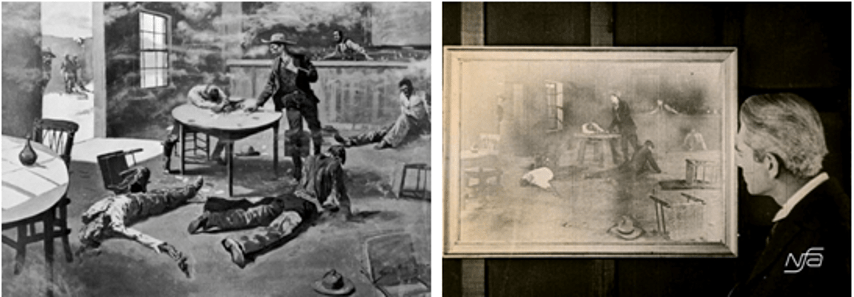
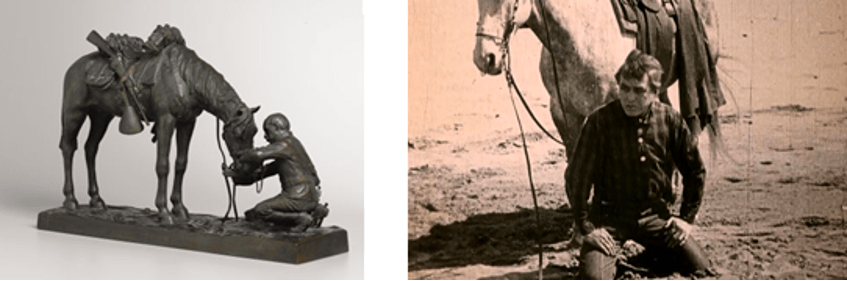
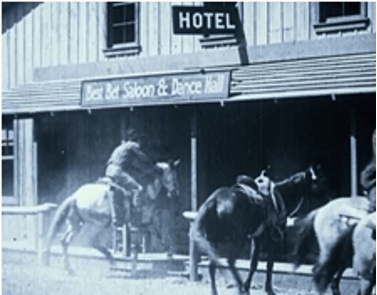
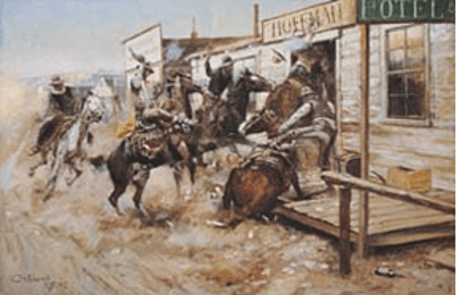

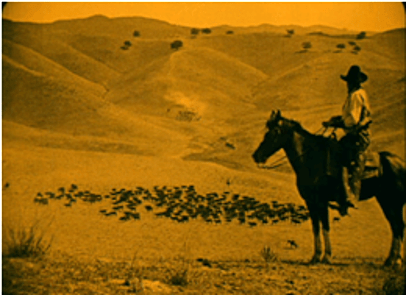
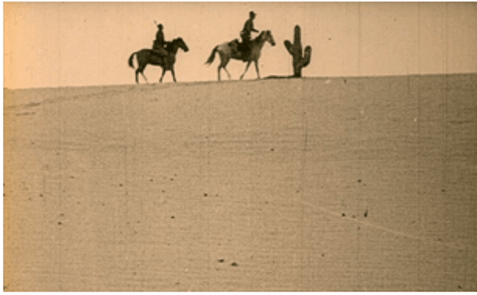
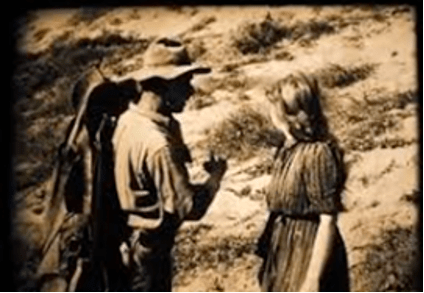


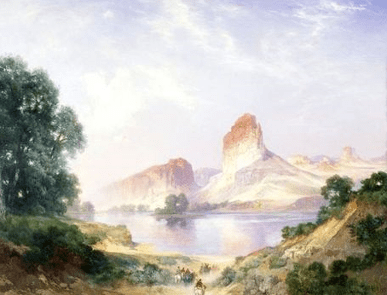


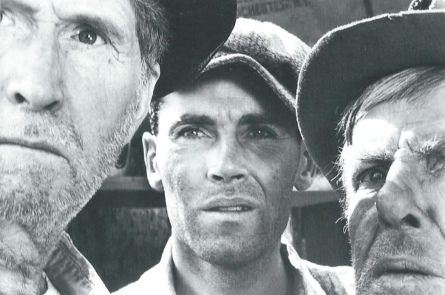


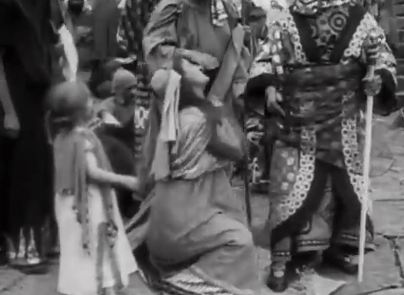


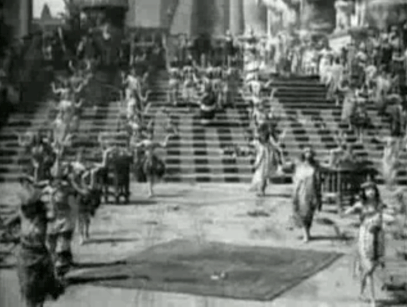
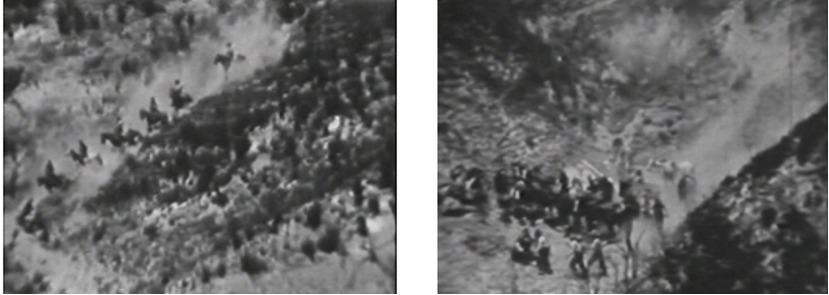

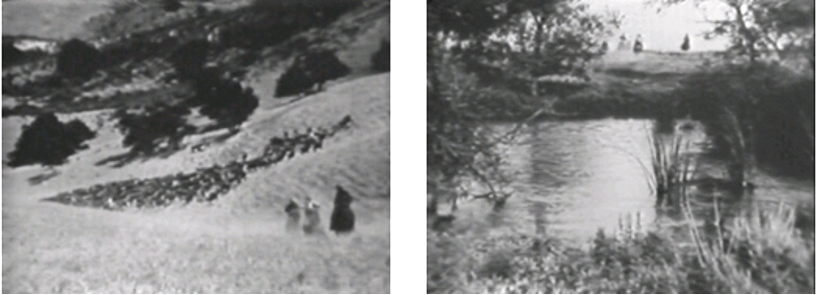
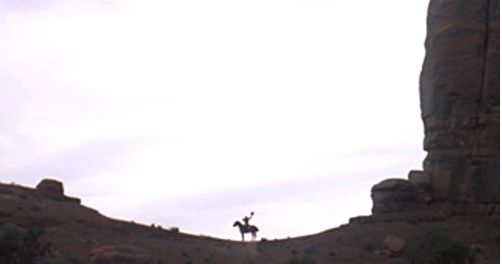


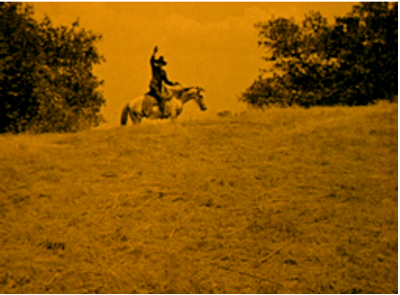

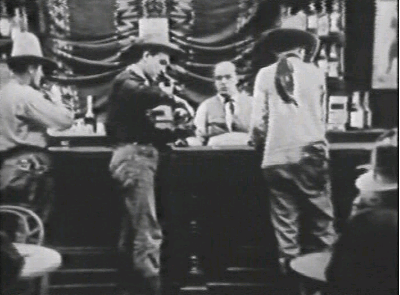
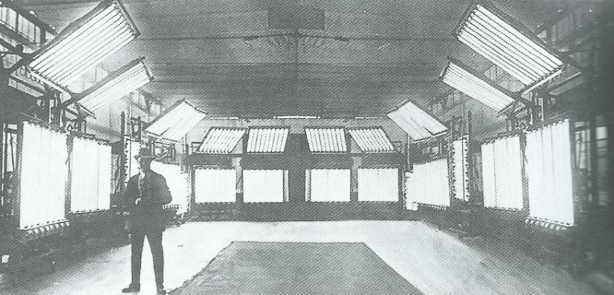


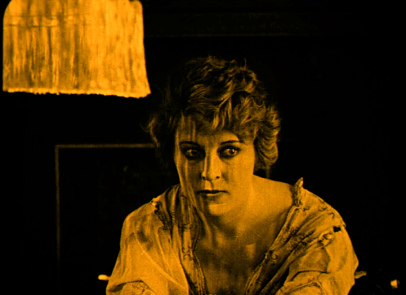
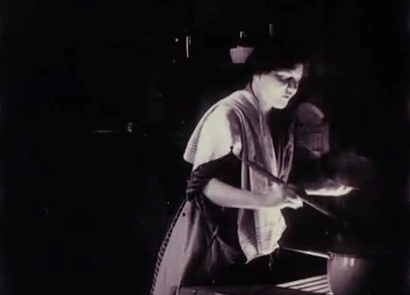
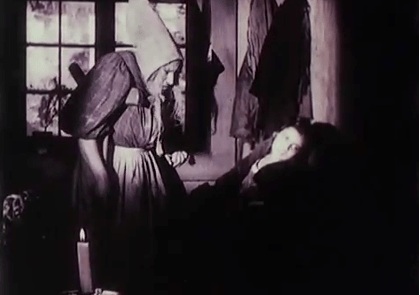
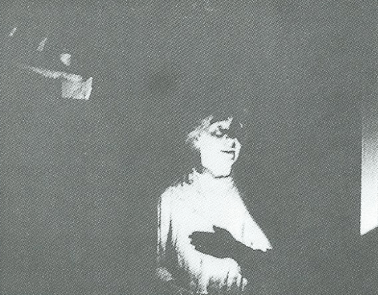
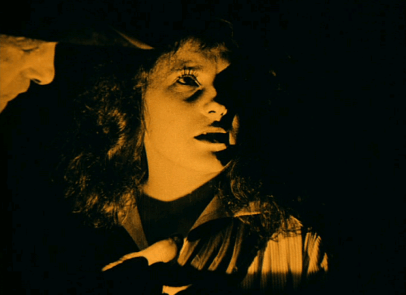


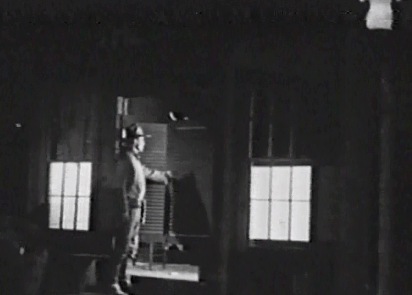
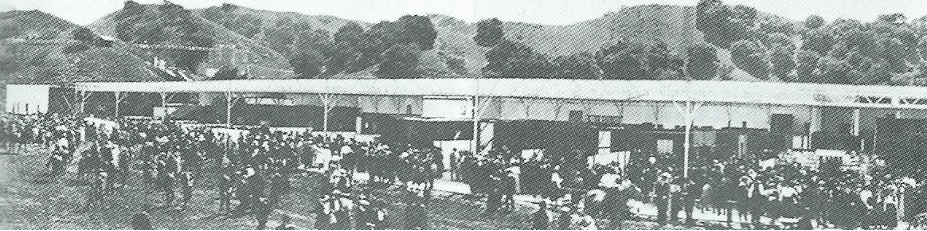
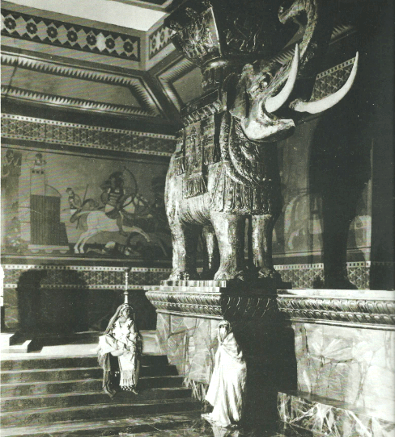


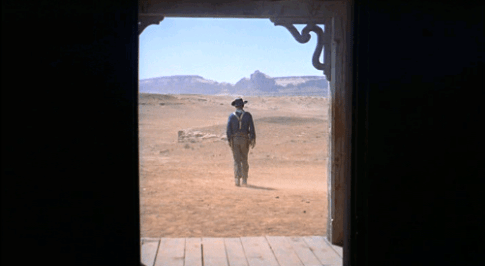
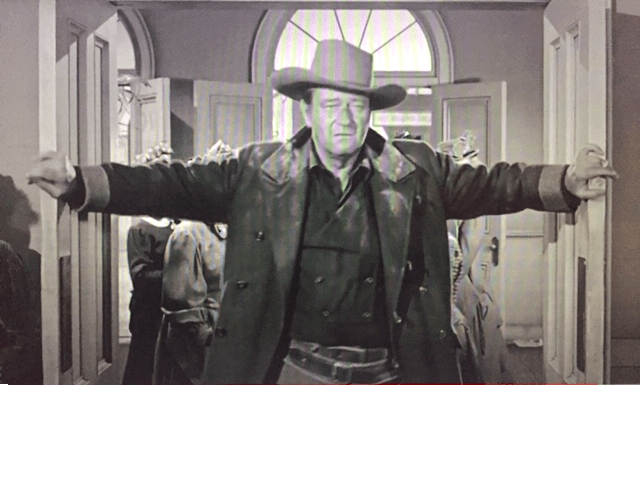
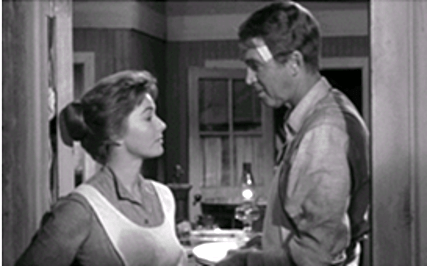

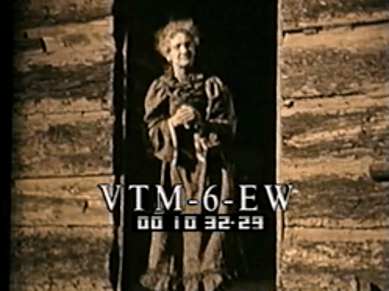


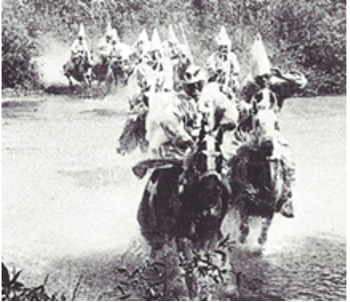


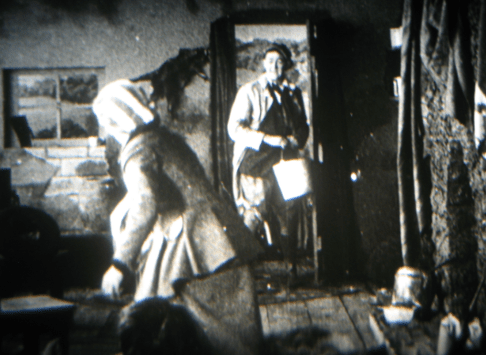

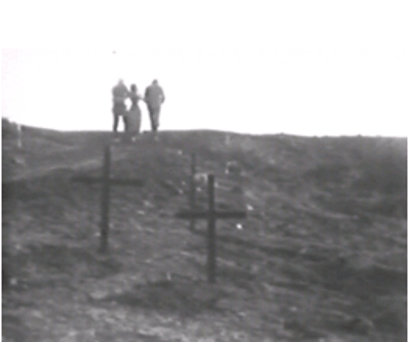
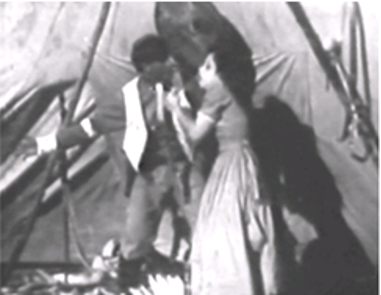


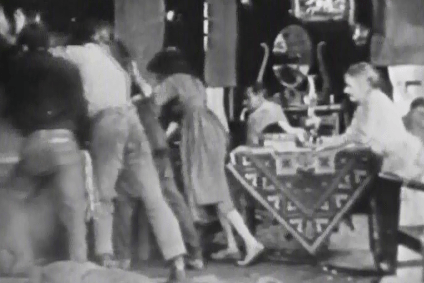
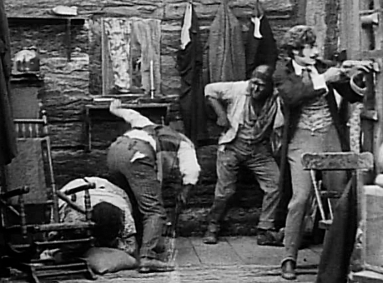

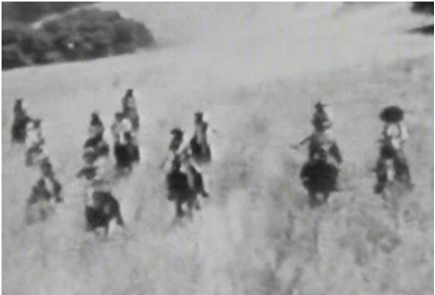
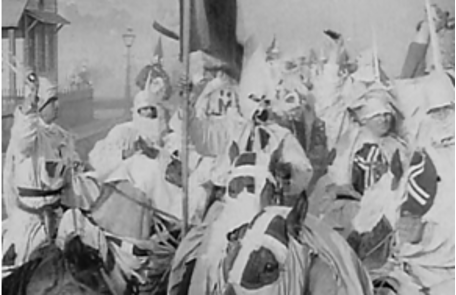


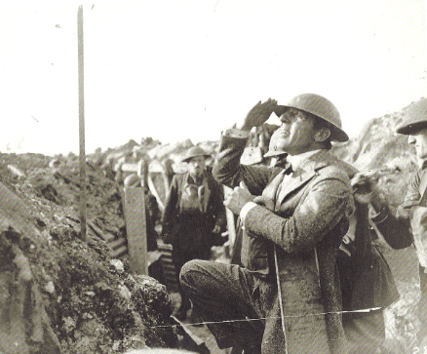



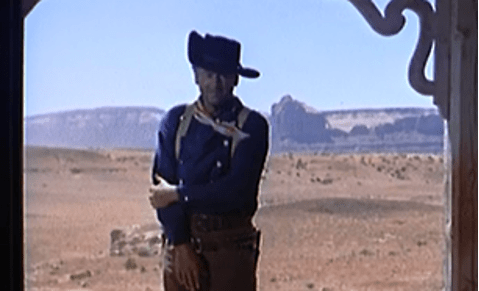

 Steve Mayhew